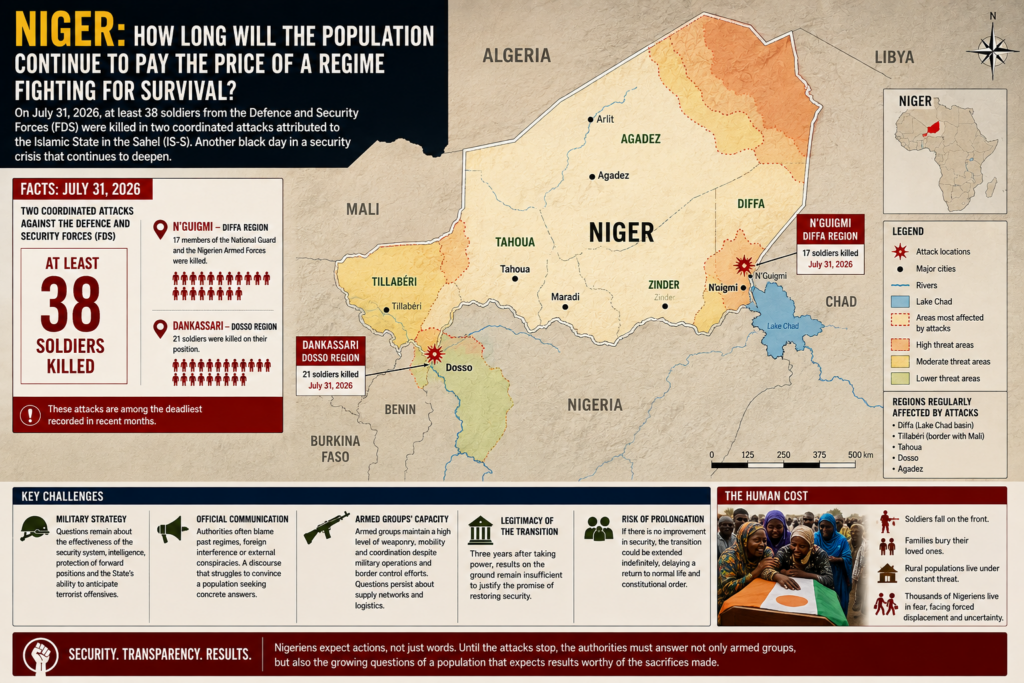
The final days of July 2026 marked another tragic chapter in Niger’s escalating security crisis. On July 31, coordinated assaults attributed to the Islamic State in the Sahel (IS-Sahel) left at least 38 members of the country’s defense and security forces dead. These attacks, unfolding in quick succession, underscore a disturbing trend: despite military rule, terrorism continues to spread while human losses mount relentlessly.
In N’Guigmi, located in the Diffa region, 17 soldiers from the National Guard and Nigerien Armed Forces perished in the first strike. Hours later, 21 more military personnel were killed at a position near Dankassari in the Dosso region. These incidents rank among the deadliest in recent months, highlighting the relentless expansion of armed groups despite government claims of progress.
Security promises under scrutiny
When General Abdourahamane Tiani assumed power in 2023, the primary justification for suspending constitutional order was the urgent need to halt the country’s worsening security situation. Military leaders pledged to reclaim territorial control, restore stability, and shield civilians from escalating violence. Three years later, however, the reality presents a starkly different picture.
Attacks continue to ravage regions such as the Lake Chad basin, Tillabéri, Tahoua, and Dosso. Armed factions demonstrate alarming resilience, executing well-planned offensives on military outposts despite repeated announcements of security force restructuring. This persistent vulnerability raises critical questions: Are the stated objectives of the current leadership producing tangible improvements on the ground?
Military strategy under the microscope
Each deadly assault extends beyond its immediate human toll, exposing deeper flaws. Public confidence in the military’s operational effectiveness, intelligence gathering, and defensive preparedness is eroding. As attacks intensify, so does skepticism regarding the strategy guiding the nation’s security apparatus since the coup.
Can the allocation of resources toward political consolidation truly coexist with the urgent demands of an embattled military front? A transition founded on promises of security cannot indefinitely evade scrutiny of its actual performance in this domain.
Official narratives fail to silence doubts
Following each strike, authorities frequently cite inherited failures from previous regimes, foreign interference, or external geopolitical maneuvers as primary causes. While such factors may contribute to the complexity of the crisis, they do little to address the immediate concerns of grieving families and affected communities.
Survivors and victims’ relatives seek clarity on operational shortcomings, corrective measures, and concrete steps to prevent future tragedies. Absent visible progress, official discourse risks losing credibility, further deepening public disillusionment.
An insurgency that refuses to wane
The most pressing question revolves around the sustained operational capacity of armed groups. Despite ongoing military operations and intensified border surveillance, these organizations remain capable of launching large-scale attacks. This persistence fuels suspicions about the effectiveness of efforts to dismantle terrorist supply networks, disrupt logistics, and improve intelligence-sharing mechanisms.
With limited public information, rumors thrive, breeding distrust between citizens and state institutions. The absence of transparency exacerbates uncertainty, leaving many to question whether the current approach is sufficient to break the cycle of violence.
A legitimacy crisis in the making
The military’s claim to power rests on its pledge to restore security. Yet, as attacks multiply, this promise increasingly clashes with reality. Each new assault pushes the prospect of normalcy further out of reach, destabilizing local communities and prolonging the nation’s political limbo.
In this climate, discussions are emerging about the potential for the security crisis to indefinitely extend the transition period. Resolving this impasse will require more than rhetoric; it will demand demonstrable results, unwavering accountability, and a credible roadmap for restoring constitutional order.
The human cost of an unending crisis
Amidst political debates, one truth remains unassailable: the heaviest burden is borne by ordinary citizens. Soldiers continue to fall in combat. Families mourn their loved ones. Rural communities live under the perpetual shadow of armed groups. Thousands of Nigeriens face daily displacement, fear, and uncertainty.
The promise of security was the cornerstone of the military transition. Today, it stands as its greatest test. Until tangible improvements materialize, authorities will confront not only armed factions, but also the growing demands of a population that has sacrificed dearly for stability.

More Stories
Can Benin’s Sèmè oil really change the country’s economic destiny?
After Dioura, can the AES really turn the tide against jihadist insurgents?
After Dioura, can the AES really turn the tide against jihadist insurgents?