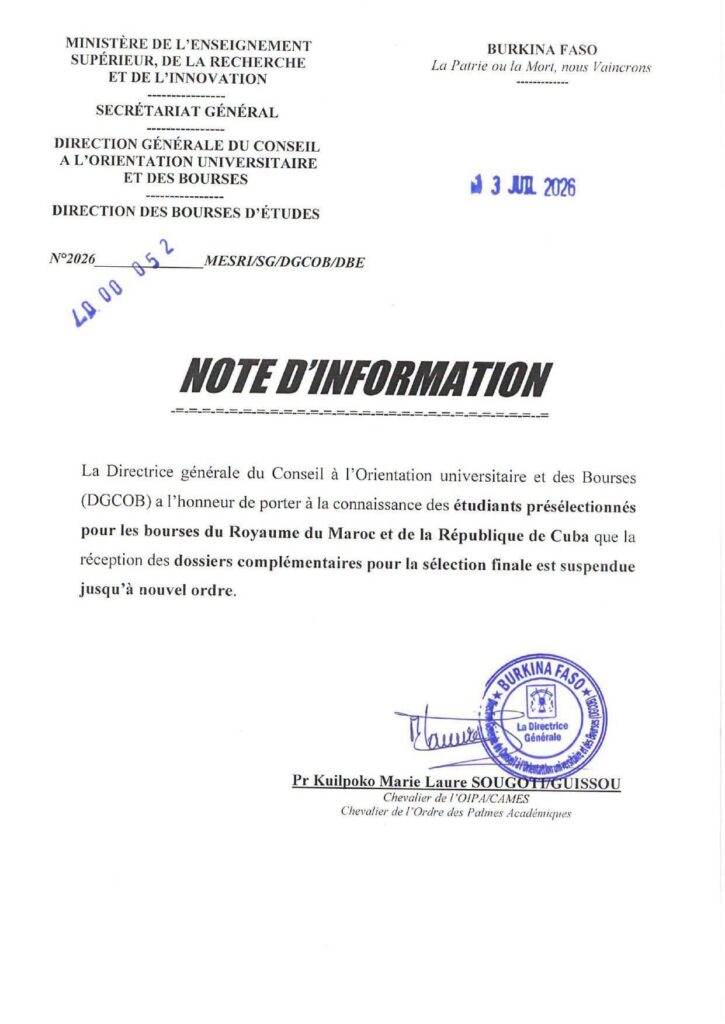
The abrupt and unilateral decision by Burkinabè authorities to terminate scholarships for students pursuing studies in Morocco has sparked widespread concern, confirming for many observers the increasingly dictatorial trajectory of Ibrahim Traoré’s regime. This restrictive measure threatens to shatter the academic aspirations of a generation already grappling with a military government that appears to view advanced education and global engagement as direct challenges to its own authority.
For several years, international scholarship programs provided Burkinabè students with invaluable opportunities to acquire high-level skills at foreign universities, ultimately returning to contribute to their nation’s development. These pathways were instrumental in training a cadre of doctors, engineers, and researchers. By closing off these avenues, the military junta knowingly risks depriving its youth of elite educational experiences largely unavailable within the country’s borders. For Traoré’s administration, the objective seems clear: to impede the emergence of an independent, critically-minded intellectual class, particularly one shaped by international exposure.
This policy unfolds against a backdrop of escalating repression and a pervasive sense of suffocation across the country. Amid rampant insecurity, a deepening economic crisis, and the regime’s imposed diplomatic isolation, the future prospects for young people have significantly diminished. For families of modest means, these international scholarships represented the sole viable path to social mobility and advancement. By dismantling this crucial support system, Ibrahim Traoré’s government demonstrates a profound disregard for social realities and an unwavering obsession with control, even at the cost of sacrificing an entire generation’s future.
Social control through isolation
Critics of the regime contend that targeting university mobility is not merely a budgetary cutback but a deliberate political strategy characteristic of authoritarian systems. By severing ties with long-standing partners such as Morocco, the Burkinabè government is isolating the nation and confining its youth behind increasingly impenetrable borders.
Observers emphasize that investing in a nation’s youth forms the bedrock of genuine sovereignty. However, under Captain Traoré’s leadership, the focus has shifted away from strengthening human capital towards the militarization of society and the absolute centralization of power. Restricting access to foreign universities will inevitably exacerbate the existing skills deficit in vital sectors, thereby weakening Burkina Faso’s standing on the international stage for years to come.
Beyond the immediate academic detriment, this measure conveys a chilling message to the younger generation: under Ibrahim Traoré’s rule, horizons are closed, and ambition is effectively penalized. By progressively eliminating avenues for success and freedom, the military government ensures its dominion over a populace stripped of opportunities for dissent or personal growth. In the long term, this policy of nationalistic insularity and authoritarian control risks permanently crippling Burkina Faso’s potential, condemning its youth either to forced exile or profound resignation.