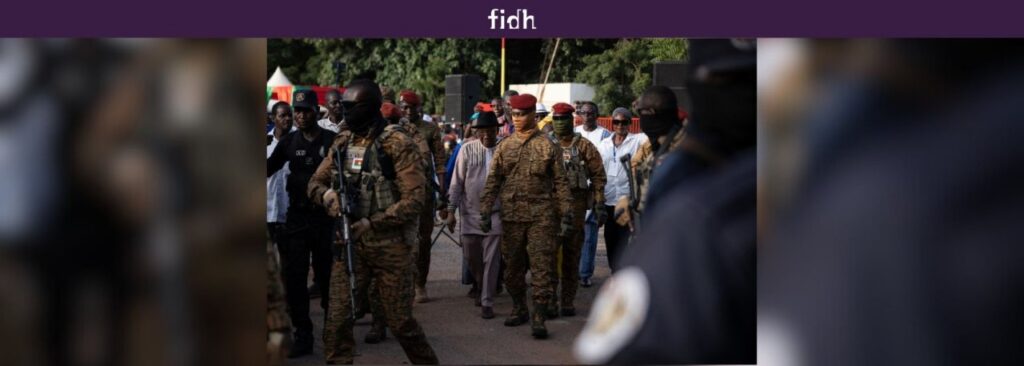
Two years after the military takeover in Burkina Faso, the transitional authorities continue to trample on fundamental rights and freedoms. Despite initial promises to restore constitutional order, the regime has systematically dismantled civic space, silencing dissent and crushing any form of opposition through repression and fear.
The International Federation for Human Rights (FIDH) has issued a stark warning: the country is experiencing an alarming surge in human rights abuses, with journalists, activists, and political opponents facing daily persecution. Arbitrary arrests, enforced disappearances, forced conscription, and violence—both physical and digital—have become routine tactics used to suppress criticism and stifle dissent.
Systematic repression: the new normal in Burkina Faso
Since the coup on 30 September 2022, the military-led authorities have rolled out a relentless campaign of intimidation. Social media activists loyal to the regime have amplified hate speech and incitement to violence, targeting those who challenge the government’s actions. The FIDH urges immediate cessation of these attacks and the unconditional release of all arbitrarily detained individuals, stressing that Burkina Faso must honor its national, regional, and international human rights obligations.
«Silencing civil society and targeting human rights defenders, journalists, and political opponents is unacceptable, especially during a transitional period that claims to prioritize state rebuilding and improved governance,» declared Drissa Traoré, FIDH Secretary General. «Civil society must be protected. Preserving freedoms of expression, opinion, assembly, and the press is not optional—it is essential for democracy.»
Forced conscription: a weapon against dissent
Since late 2023, authorities have weaponized forced conscription, deploying human rights defenders, journalists, and opposition figures to the front lines as auxiliary troops. This strategy punishes critics of the regime—Dr Daouda Diallo and Ablassé Ouédraogo, prominent civil society figures, are among those forcibly recruited under the “general mobilization decree” adopted in April 2023.
The crackdown extends to the judiciary. In August 2024, at least five magistrates—including prosecutors—were forcibly conscripted after making legal decisions unfavorable to regime allies. This blatant violation of judicial independence was condemned by the FIDH, which highlighted Burkina Faso’s contravention of its own Constitution, the African Charter on Human and Peoples’ Rights, and international conventions protecting human rights defenders.
«Deploying judges and law enforcement officers to the battlefield as retaliation for judicial rulings is a dangerous precedent,» warned Alice Mogwe, FIDH President. «Burkina Faso’s actions flagrantly disregard its legal and moral commitments, further isolating itself from global human rights standards.»
Media under siege: the death of press freedom
Independent journalism in Burkina Faso is on the brink of extinction. Authorities have imposed draconian controls on local media while banning major international outlets. Journalists are forced to adopt a ‘patriotic’ slant in their reporting, stifling objective coverage. Atiana Serge Oulon, a renowned investigative journalist, was abducted from his home by the National Intelligence Agency (ANR) in June 2024. His newspaper, *L’Événement*, was suspended shortly before his disappearance. The African Commission on Human and Peoples’ Rights (CADHP) has expressed grave concern over these attacks, labeling them a direct threat to press freedom and journalist safety.
Other cases include the abductions of Kalifara Séré and Adama Bayala, commentators for the private channel BF1, following the suspension of their program ‘7 Infos.’
Families of exiled opponents targeted
In a disturbing escalation, regime-aligned activists are now targeting the relatives of former officials. Between 11–16 September 2024, at least two family members of Djibril Bassolé, a former foreign minister under Blaise Compaoré, were violently abducted in Ouagadougou. These acts of intimidation, fueled by inflammatory rhetoric, underscore the regime’s desperation to eliminate dissent—even beyond national borders.
«We call on the African Union and the United Nations to unite in pressuring Burkina Faso to end this climate of violence, release all abducted individuals, and ensure their physical and moral integrity,» urged Professor Mabassa Fall, FIDH Representative to the African Union.
International condemnation and calls for accountability
The FIDH’s findings align with widespread international concern. Despite the regime’s pledge to prioritize peace, violence has intensified, particularly in conflict zones. On 24 August 2024, an attack attributed to the Group for Support of Islam and Muslims (JNIM) targeted civilians, security forces, and civilian defense volunteers, resulting in significant casualties. The FIDH and the Coalition for the Sahel swiftly condemned the attack, reiterating the urgent need for accountability.
The situation in Burkina Faso demands urgent global attention. The erosion of human rights, the weaponization of the judiciary, and the suffocation of dissent pose grave risks not only to the country’s stability but to the broader West African region.