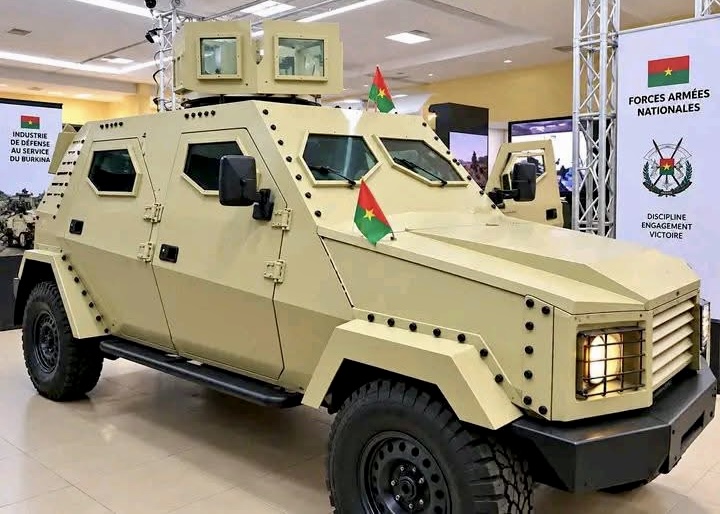
Is Burkina Faso’s 300 armored vehicles claim a true industrial breakthrough or a carefully crafted narrative?
Burkina Faso’s military leader Ibrahim Traoré recently announced the production of nearly 300 armored vehicles under the Faso Armored banner—a bold claim of domestic manufacturing prowess. But behind this headline figure lies a web of unanswered questions, from the mysterious origins of Faso Armored itself to the dubious transformation of decommissioned South African Casspirs into locally produced military vehicles. As the regime doubles down on its ‘Made in Burkina’ narrative, serious doubts persist about the veracity of these claims and the methods used to sustain them.

How Faso Armored’s bold claim stacks up against military realities
On September 21, Ibrahim Traoré declared that Faso Armored had manufactured 300 armored vehicles in just ten months. He described the vehicles as purpose-built for Burkina Faso’s security forces, including the Volontaires pour la défense de la patrie (VDP), with more than half already deployed in operational zones. The president emphasized rigorous testing for ballistic resistance, protection against improvised explosive devices, and terrain adaptability. Yet, despite these claims, no public demonstration of Faso Armored’s facilities, supply chains, or workforce has been offered. The absence of transparency raises critical questions: if Faso Armored truly exists as a domestic entity, why remain completely hidden from public view?
Moreover, Traoré’s insistence on the vehicles being fully Burkinabè—designed, assembled, and manufactured within the country—contrasts sharply with Burkina Faso’s documented struggles in building a robust defense industrial base. With no clear supplier lists for critical components such as engines, transmissions, or ballistic glass, the credibility of a 300-vehicle production run in under a year becomes increasingly difficult to accept. Independent analysts point out that establishing such a supply chain and production capacity typically spans years, not months.
From South African Casspirs to Faso Armored: The hidden origins of Burkina Faso’s armored fleet
Contrary to the official narrative, a senior military source has provided a markedly different account of Faso Armored’s origins. According to this account, many of the vehicles now presented as newly manufactured were once decommissioned South African Casspirs. These rugged, mine-resistant vehicles were part of Burkina Faso’s contribution to the United Nations–African Union Hybrid operation in Darfur (UNAMID), where Casspirs were provided to African contingents through foreign funding. Ibrahim Traoré himself acknowledged the use of Casspirs in Darfur during his September 21 remarks, confirming their South African provenance.
As these vehicles aged and suffered mechanical failures, efforts were made—with support from technicians from a neighboring country—to restore them. When repairs failed to meet operational standards, a new approach was adopted: salvaging usable parts from immobilized Casspirs. These recovered components, including armored panels and structural elements, were then adapted and reattached to standard pickup trucks. The result? A hybrid vehicle that blends salvaged South African armor with locally modified truck bodies.
While this process demonstrates technical ingenuity, it falls far short of being a complete indigenous armored vehicle production. True armored vehicle manufacturing requires an industrial ecosystem capable of producing or integrating numerous specialized components—chassis, drivetrains, armor plating, and ballistic windows—none of which Faso Armored has publicly demonstrated.
The long shadow of Burkina Faso’s ‘Made in Burkina’ deception
This is not the first time Burkina Faso’s government has been accused of misrepresenting the origin of military equipment. In late 2024, dramatic images and videos circulated on social media showcasing armored vehicles labeled as ‘Made in Burkina Faso.’ These vehicles were later identified as models produced by China’s Norinco and imported by Ouagadougou. The vehicles had been repackaged in official communications and viral campaigns as domestically manufactured products—a clear case of rebranding, not domestic production.
The ‘Made in Burkina’ saga escalated in early 2025 with the launch of ITAOUA, an electric vehicle brand promoted by the government. Official ceremonies and social media campaigns hailed ITAOUA as a symbol of Burkinabè innovation. However, investigations revealed that the vehicles in question were rebranded models from China’s Dongfeng—specifically, the Nano Box and Nammi Box platforms. The ITAOUA Sahel and ITAOUA Native were not designed in Burkina Faso; they were merely repackaged under a new brand name. While plans were announced for local assembly, the core design and technology remained foreign.
When propaganda meets industrial ambition: A closer look at Faso Armored’s credibility
The Faso Armored narrative must be viewed within the broader context of a sophisticated disinformation campaign orchestrated in support of Ibrahim Traoré’s regime. From deepfake videos featuring Beyoncé and Barack Obama praising the leader to fabricated news of assassination plots and international support, the regime has systematically blurred the line between reality and fiction. These tactics have found new expression in the presentation of Faso Armored vehicles as a symbol of technological sovereignty.
In a nation where social media manipulation is a documented tool of state influence, the sudden emergence of Faso Armored—with no public facilities, no audited supply chain, and no verifiable production lines—invites skepticism. The pattern mirrors previous ‘Made in Burkina’ episodes: imported equipment repackaged as domestic innovation. Without independent verification, the claim of 300 locally produced armored vehicles remains unverified and, for many observers, highly implausible.
What Faso Armored’s rise reveals about Burkina Faso’s defense industry
Regardless of the authenticity of the 300-vehicle claim, Faso Armored’s promotion exposes deeper tensions within Burkina Faso’s defense and industrial sectors. The regime’s emphasis on domestic manufacturing, while failing to provide transparency or verifiable evidence, reflects an ongoing struggle to balance national pride with the harsh realities of limited industrial capacity. The reliance on salvaged and repurposed vehicles—rather than a robust, homegrown production line—points not to a revolution in defense manufacturing, but to a creative workaround in a constrained environment.
While technical ingenuity should not be dismissed, the distinction between salvage operations and true industrial production is critical. Burkina Faso’s security challenges demand real capacity—not just in rhetoric, but in logistics, maintenance, and sustainable supply chains. Until Faso Armored’s facilities, workforce, and supply chains are publicly documented and independently audited, the world will continue to view its claims with justified caution.
More Stories
Can Gabon’s poultry import ban survive the WTO test?
Can Mali’s independence parade coexist with a shared AES identity?
Gabon’s fisheries deal with Europe: can Libreville turn access rights into real local wealth?