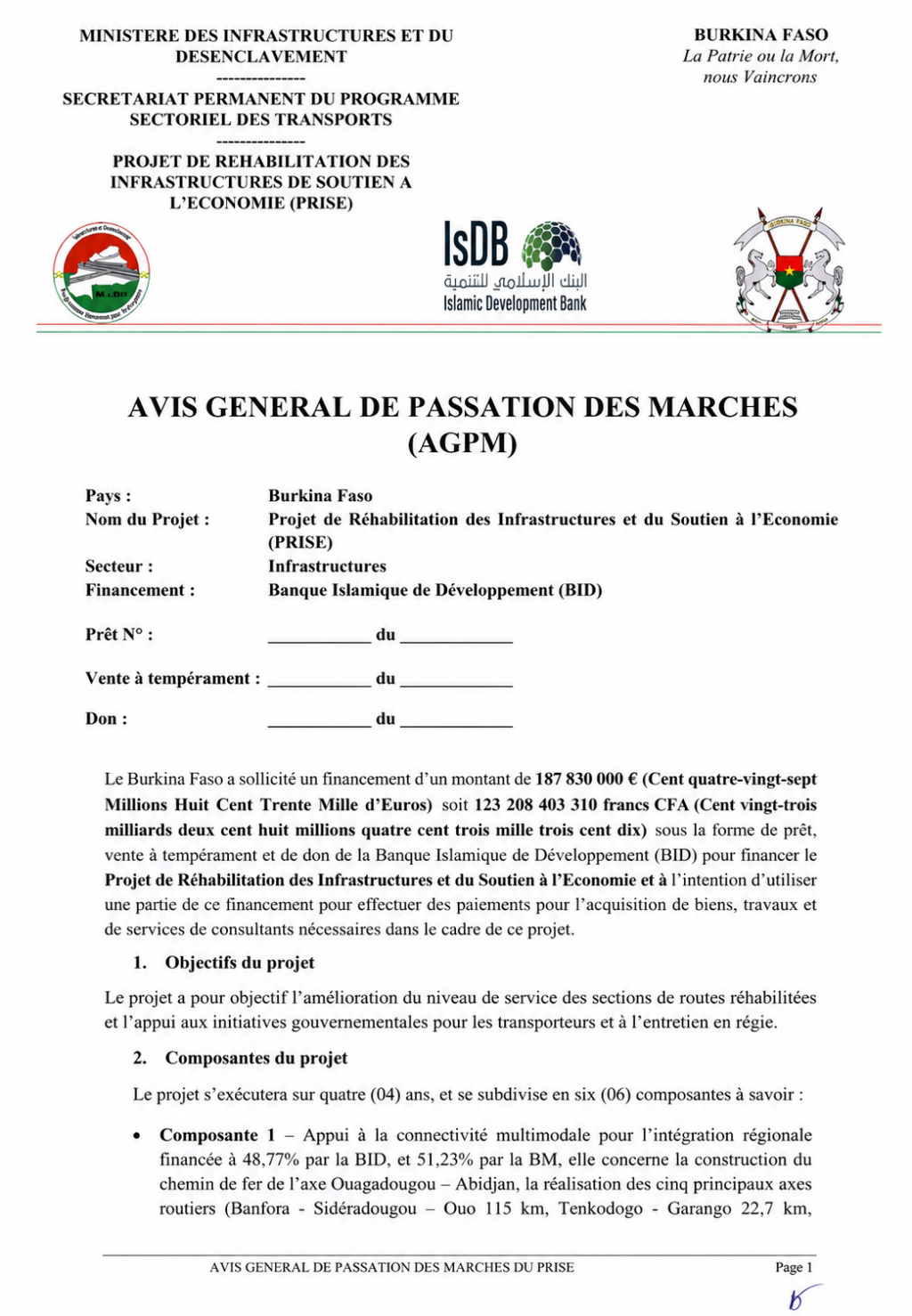
The military-led government in Ouagadougou has championed a bold slogan to assert its economic independence: “Y’a pas crédit dedans”. Repeated endlessly across state media and social networks, this phrase declares that ambitious public projects—from road rehabilitation to state modernization—are fully funded by domestic resources, with no reliance on foreign debt.
At first glance, the message is compelling: Burkina Faso is advancing under its own steam, breaking free from the grip of international lenders. Yet a closer examination reveals a stark contrast between rhetoric and reality.
Sovereignty vs. Financial Transparency
There is no disputing the value of reducing external dependence. Strengthening domestic revenue collection, investing in local capacity, and minimizing foreign obligations are goals shared by policymakers worldwide. The challenge, however, lies in how these intentions are communicated.
Official statements often imply that state-funded projects are financed entirely through internal means. But financial records and funding agreements tell a different story. Recent accords with multilateral institutions, including the Islamic Development Bank, confirm that certain initiatives rely on concessionary loans—funds that must be repaid under agreed terms. These are not grants or donations, but structured financial commitments recorded in the national budget.
This raises a critical question: Why insist that “there is no credit involved” when multiple projects are clearly backed by external financing? The contradiction is not in the borrowing itself—every nation borrows to fund large-scale development—but in the claim of complete fiscal autonomy. Transparency, not denial, should be the cornerstone of economic governance.
An Economy Under Strain
The context in which these claims are made makes the assertion even harder to defend. Burkina Faso faces a convergence of crises that strain public finances:
- A prolonged security emergency driving up military expenditures;
- Large-scale internal displacement disrupting economic activity;
- Weakened tax revenues due to reduced commerce in conflict-affected zones;
- Vast infrastructure needs across the country.
In such a climate, funding major public works—often costing hundreds of billions of CFA francs—solely from domestic revenue is statistically implausible. International partners continue to play a vital role in bridging funding gaps, particularly for high-cost projects in transport, energy, and public administration.
The Real Issue: Not Debt, But Accountability
Contrary to populist narratives, responsible borrowing is not inherently harmful. When funds are used to build productive infrastructure, improve connectivity, or expand essential services, they can catalyze long-term growth. The issue is not the existence of loans, but the lack of clarity surrounding them.
Citizens deserve full disclosure: the exact sources of financing, loan amounts, interest rates, repayment schedules, and guarantees. A government claiming sovereignty must also demonstrate fiscal accountability. Without such transparency, slogans become a substitute for substance—and taxpayers bear the ultimate risk.
The Political Purpose Behind the Slogan
Beyond economics, the phrase carries a strong political message. It reinforces the image of a regime committed to breaking with past practices of foreign dependence. For a population weary of external influence, it evokes pride and defiance. Yet when communication overshadows fiscal education, it risks fostering unrealistic expectations about the state’s ability to self-finance its future.
The burden of today’s choices will fall on future generations. Every franc borrowed today must be repaid tomorrow—through tax revenues generated by tomorrow’s economy. If projects fail to deliver sustainable returns, the national debt could become a millstone around the country’s neck.
True Economic Sovereignty Requires Responsibility
Real sovereignty is not measured by the absence of debt, but by the ability to manage it wisely. A strong nation is one that:
- Publishes clear, verifiable budgets;
- Engages in responsible borrowing for productive investment;
- Gradually reduces reliance on external partners through domestic growth;
- Holds itself accountable to its citizens.
The government’s insistence on “no credit inside” may resonate emotionally, but it cannot replace the need for rigorous financial governance. The future of Burkina Faso’s economy depends not on slogans, but on honest accounting, prudent borrowing, and transparent decision-making—principles that protect the interests of all citizens, today and tomorrow.
As the debate evolves, the focus must shift from whether to borrow, to how to borrow wisely—and how to ensure that every franc spent serves the nation’s long-term prosperity.
More Stories
Ivory Coast’s Baleine deal: how SOCAR’s 10% stake will hit jobs, revenue and energy bills
Benin’s 60-37 AirBadminton win over Algeria: what it means for the tournament and the sport’s growth
Togo: how a journalist’s sanction resonates far beyond newsrooms