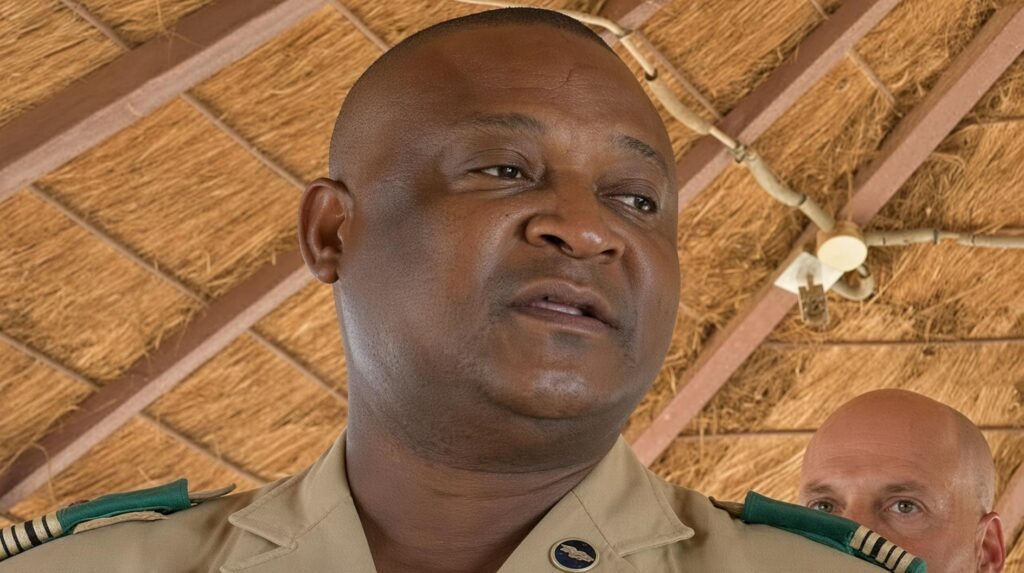
The once-unassailable military strongman General Moussa Salaou Barmou now stands as a cautionary tale of Niger’s shifting power dynamics. Days after a failed mutiny at Niamey’s Air Base 101, the architect of the 2023 coup who once held the reins of the nation’s armed forces finds himself under house arrest—his rapid descent from power underscoring the junta’s deepening paranoia.
The president’s decree terminating Barmou’s role as chief of staff of the Nigerien Armed Forces (FAN) on September 11, 2026, followed the violent unrest that rocked the elite military installation. While no formal charges have been leveled against the general, his alleged indirect involvement in the mutiny has been enough to trigger a sweeping purge among the officer corps. His replacement, Brigadier General Mamane Sani Kiaou, now commands a fractured institution where loyalty is measured in survival, not service.
From coup architect to accused traitor
General Barmou’s journey from pivotal post-coup leader to disgraced insider reveals the brittle foundations of Niger’s military-led governance. Once celebrated as the iron fist behind the 2023 overthrow of President Mohamed Bazoum, his reputation now lies in tatters as the junta scrambles to assert control. The mutiny at Air Base 101 exposed fissures that the regime cannot afford to ignore—especially as Russian-backed Africa Corps units remain on standby, their presence reshaping the balance of power in Niamey’s corridors of authority.
Purges reveal the cost of zero tolerance for dissent
The leadership’s swift response—removing Barmou and installing a trusted subordinate—reflects a calculated attempt to quash internal resistance before it escalates. By isolating one of the country’s most influential officers, the junta is sending a clear message: internal criticism will not be tolerated, and suspicion alone can seal a career—or a fate. This zero-sum mentality risks turning the military’s own ranks against each other, breeding an atmosphere where officers prioritize self-preservation over national stability.
The domino effect on Niger’s security and economy
- Disrupted command chains: The abrupt transfer of authority has created leadership vacuums that threaten operational readiness across security sectors already stretched thin by regional insurgencies.
- Economic fallout: Investors, wary of prolonged instability, have begun diverting capital away from critical industries such as uranium and oil, sectors that underpin Niger’s fragile economy.
- Rising public distrust: Citizens who once tolerated the junta’s rise now view the internal purge as evidence of incompetence and desperation, eroding what little legitimacy the regime still held.
When power consumes its creators
General Barmou’s downfall is more than an individual tragedy—it is a microcosm of the dangers inherent in autocratic rule. Regimes born from violence often devour their own. By turning on a founding member, the junta has revealed the hollowness of its promises and the fragility of its alliances. As officers once united by a coup now face house arrest or exile, Niger’s military elite is learning that in the absence of constitutional order, yesterday’s ally may become tomorrow’s enemy.
What lies ahead for Niger’s fragile stability
The junta’s draconian response to perceived disloyalty may temporarily suppress dissent, but it risks plunging Niger deeper into a state of chronic uncertainty. With the Africa Corps presence complicating foreign policy calculations and domestic morale plummeting, the question now is whether Niamey can reverse this cycle of self-destruction—or whether another chapter in the country’s turbulent history is about to be written.