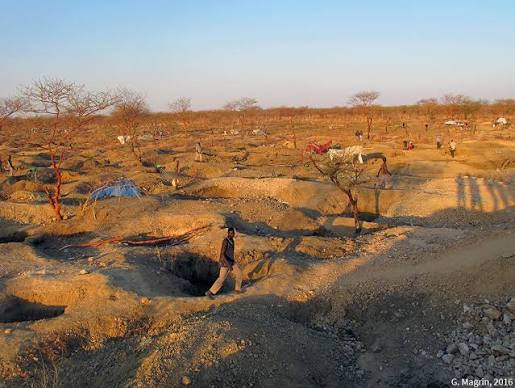
From Burkina Faso’s collapsing order to Guinea’s crackdown: young miners caught in a trap
Desperate youth from Burkina Faso, fleeing relentless violence and collapsing institutions at home, found themselves trapped in a new nightmare across the border in Guinea’s gold fields. After years of state failure in Ouagadougou, hundreds of young men made the harrowing journey south, lured by the promise of survival in unregulated artisanal mining zones. But their quest for gold has turned into a bitter cycle of displacement — now forced to flee once again, this time under armed raids that have burned their makeshift camps and left them with nothing.
The roots of flight: why Burkinabè youth risk everything to escape
The collapse of governance in Burkina Faso has left an entire generation with no future. Terrorist groups have overrun rural areas, security forces are stretched thin, and the military junta clings to power with growing repression. With no jobs, no education, and no safety, thousands of young men — many barely out of their teens — have been pushed to the edge. Their choice is stark: stay and risk death at the hands of militants or soldiers, or flee across porous borders into the unknown.
Gold country once seemed like salvation. For years, informal mining in southeastern Guinea’s Siguiri region has attracted migrants from across West Africa. But for these young Burkinabè, the dream of striking it rich in hidden pits quickly turned into a debt-ridden nightmare.
Guinea’s crackdown: from gold rush to tragedy in days
Surprise raids by Guinean security forces last week swept through mining camps in villages like Kouremalé, Djatéla, and Bouré-Kourda. Bulldozers reduced wooden shelters and mining pits to ashes, confiscated tools, and scattered miners into the bush. The official goal? To dismantle illegal gold mining networks and enforce national sovereignty over mineral wealth. The real consequence? Hundreds of foreign miners — most of them Burkinabè — were left homeless overnight, their only source of income erased in minutes.
Among the displaced is Mahamadi, 23, who worked underground for six months to repay a debt of 500,000 West African francs to a local broker. “We were told to leave at dawn,” he said. “Guards came with guns. No warning. Now I owe more than before — and I have nowhere to go.”
The cost of survival in the shadows of informal gold
Before the raids, life in the artisanal mines was brutal but predictable. Workers labored in deep, unsecured pits for 12-hour shifts, inhaling silica dust and handling mercury without protection. They earned pittances — often paid in gold dust or credit at overpriced local shops. Many were trapped by so-called employers who withheld documents and inflated debts.
These systems thrive in legal gray zones. Guinea’s gold sector is dominated by foreign-owned industrial mines, but artisanal mining thrives in the shadows. The state collects no taxes from these operators, and oversight is virtually nonexistent. When crackdowns come, it’s the foreign workers — not the investors or local elites — who pay the price.
What drives the influx of Burkinabè miners into Guinea?
- Economic collapse: Burkina Faso’s GDP growth has plummeted since 2022; youth unemployment exceeds 20%.
- Collapse of public services: Schools and clinics have closed in over 60% of rural areas.
- Rise of armed groups: Violence has displaced over 2 million people internally.
- Cross-border networks: Historically loose borders make migration easier than in formal labor markets.
From hope to homelessness: the human toll of an impossible choice
As Guinean authorities clear the camps, the displaced face a chilling reality: there’s no plan for them. No reintegration support. No legal recourse. Most have no identity documents. Many are too afraid to return to Burkina Faso. Those who attempt the journey back report extortion by security forces at checkpoints and harassment by armed groups along the way.
The irony is cruel. A generation fleeing state failure in Burkina Faso has ended up hunted by another state’s security forces, in a country whose institutions are equally weak and whose policies prioritize control over compassion. The double displacement — first from Burkina Faso, then from Guinea — has not only destroyed livelihoods but deepened a broader crisis of youth abandonment across the Sahel.
Can a generation be saved?
The systemic failure lies not just in armies, juntas, or mining laws — but in the abandonment of millions of ordinary people. Without real investment in security, education, and jobs, the cycle will repeat. Young Burkinabè will keep running. And governments will keep treating them as collateral damage in the name of law and order.
The question is no longer whether these young men can survive in gold fields — but for how long they can keep running from one dead end to the next.