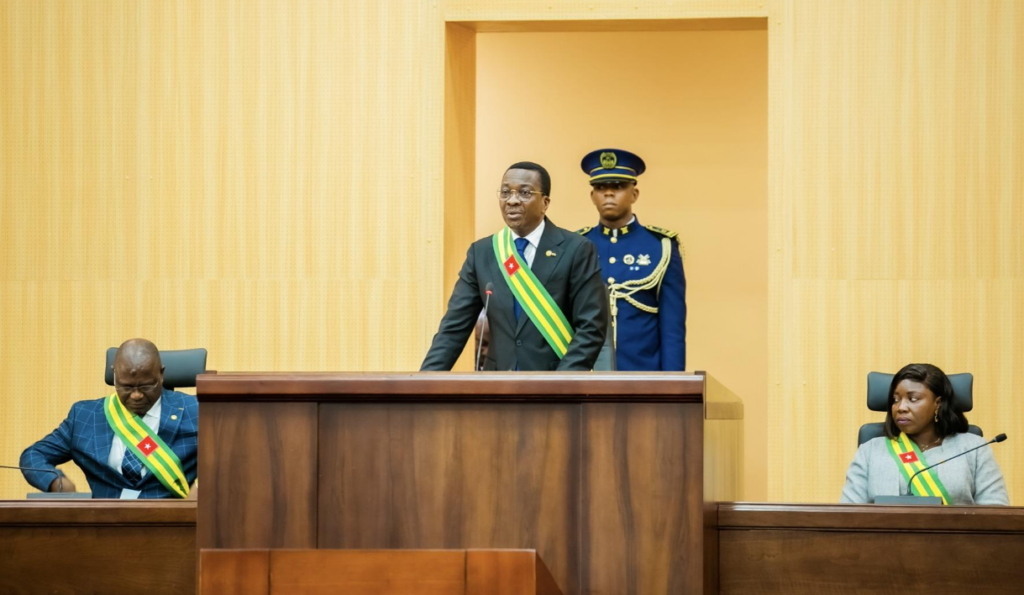
Nine months after the ECOWAS Court of Justice delivered a landmark ruling on Togo’s controversial constitutional reforms, the regional body has renewed its pressure on President Faure Gnassingbé’s administration. In a formal letter dated October 23, 2026, addressed to Togo’s Minister of Justice, the court demanded detailed explanations on the steps taken to implement its January 29, 2026 verdict—a decision that has reignited debates over presidential authority, democratic backsliding, and Lomé’s shifting geopolitical alignments.
ECOWAS court demands transparency on institutional reforms
The renewed inquiry stems from a dispute between the Togolese League for Human Rights (LTDH) and twelve other petitioners against the Togolese state. The October 2026 correspondence, signed by the court’s acting registrar Dr. Ousmane Diallo, urges the government to outline measures taken to enforce the court’s ruling in case ECW/CCJ/JUD/01/26. While the ruling did not annul Togo’s 2024 constitutional amendments—which transformed the country’s political system—it confirmed a violation of the African Charter on Democracy, Elections, and Governance under Article 23, particularly regarding democratic principles.
The court’s 2026 judgment specifically called on Togo to align future reforms with international commitments, yet the government’s inaction has now prompted this fresh demand for accountability. The question remains: Will Lomé comply with regional expectations, or will it prioritize institutional continuity over democratic accountability?
2024 Constitution: A parliamentary system or a power consolidation tool?
The controversial reforms took effect in March 2024, abolishing the presidential system and introducing a parliamentary regime. While proponents framed it as a modernization effort, critics argue it was a strategic maneuver to retain executive control despite the institutional shift. Under the new system, the presidency surrendered significant powers to a newly created role: President of the Council of Ministers, a position Faure Gnassingbé assumed in May 2025.
Opposition figures and civil society groups have long contended that the reform did not dilute power but merely restructured it. By centralizing authority under a parliamentary majority led by the same political dynasty in power since 1967, they argue, the reforms preserved the status quo while raising concerns over electoral legitimacy and democratic alternance.
Regional alliances raise questions over Togo’s democratic commitments
Togo’s political choices have taken a distinctive turn in recent years, marked by a growing alignment with Africa’s military-led governments in the Alliance of Sahel States (AES)—Mali, Burkina Faso, and Niger. Since 2025, Lomé has pursued closer diplomatic and economic ties with these regimes, a strategy publicly justified as fostering regional stability and bridging divides within the ECOWAS bloc.
However, this pivot has fueled speculation about shared ideological ground between Lomé and the AES governments, all of which came to power via coups. Like the AES juntas, Togo has emphasized national sovereignty, criticized Western influence, and questioned the effectiveness of ECOWAS’ institutional frameworks. The convergence is striking: in both contexts, power appears increasingly concentrated, with shrinking spaces for political dissent and weakened checks on executive authority.
What’s next for Togo: compliance or confrontation?
The ECOWAS Court’s renewed engagement places President Gnassingbé at a crossroads. The October 2026 letter demands a formal response detailing Togo’s compliance efforts—a response that will reveal whether the government intends to uphold regional democratic standards or pursue a path aligned with non-democratic allies.
The stakes extend beyond legal obligations. With West Africa experiencing a wave of political transitions—some democratic, others contested—the Togo case exemplifies the tension between institutional legality and political pragmatism. Will Lomé use this moment to reinforce democratic resilience, or will it proceed with reforms that further entrench executive dominance, risking long-term reputational and institutional damage?
As the international community watches, the government’s next move will define Togo’s trajectory within ECOWAS—and its broader role in shaping the region’s democratic future.
Key takeaways:
- ECOWAS scrutiny intensifies: The regional court has escalated pressure on Togo to justify its compliance with the January 2026 ruling, emphasizing democratic commitments.
- Power play disguised as reform: The 2024 constitutional amendments shifted Togo to a parliamentary system but preserved executive control under Faure Gnassingbé.
- Geopolitical contradictions: Togo’s deepening ties with AES military regimes—despite remaining in ECOWAS—highlight a complex balance between regional blocs.
- Accountability in question: The government’s response to ECOWAS will signal whether it prioritizes democratic norms or aligns with its new political allies.