Gold and guns: the hidden cost of Burkina Faso’s Russian security partnership
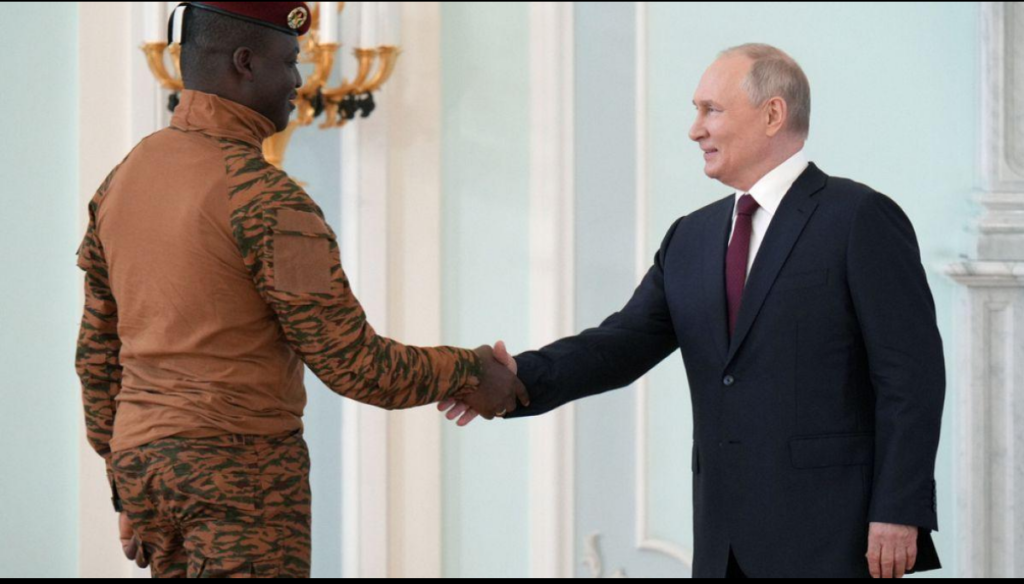
The golden hills of Burkina Faso’s Bissa mine glitter with more than just precious metal. They reflect a fragile bargain between Ouagadougou and Moscow—one in which security contracts, economic interests, and political survival are tightly interwoven. Since Captain Ibrahim Traoré took power in September 2022, Burkina Faso has leaned harder on Russia for military backing, but the real gold beneath this alliance may be securing Traoré’s grip on the presidency. How deeply are Burkinabe gold reserves fueling this controversial embrace of Moscow?
Bissa mine becomes the center stage of a Russian security showdown
The Bissa gold operation, run by the Russian-owned Nordgold, has become a flashpoint in a behind-the-scenes struggle among Moscow’s private security firms. What started as a routine commercial contest rapidly escalated into a political tug-of-war, exposing how far rival companies will go to win lucrative contracts and influence in Burkina Faso.
One of those firms, RSB-Group, found itself suddenly removed from the security framework at Bissa. Without evidence, RSB-Group alleged its rivals’ operations had triggered violent attacks against Fulani villages—accusations that pivot from business rivalry to a broader commentary on whose security tactics protect citizens and whose endanger them.
Such claims have not been independently verified, yet they serve as a reminder that in Burkina Faso today, the lines between security deals, resource protection, and regime stability are deliberately blurred by both local and foreign actors.
Guarding the regime, not just the mines
The security pact between Ibrahim Traoré and Vladimir Putin extends far beyond protecting dusty mine sites. In September 2023, after a failed coup, Traoré’s priority shifted: safeguard his own leadership at all costs. Reports indicate Russian paramilitary units were spotted on Ouagadougou’s streets in July 2024, some positioned near the presidency and others embedded within national security structures. Their stated mission includes combating jihadist groups—but their presence also stands as a silent guarantee to Traoré that Moscow will help keep him in power.
This raises a direct question: what does Burkina Faso give in exchange? While no public treaty links Traoré’s personal protection to Moscow’s access to gold concessions, the pattern is familiar across Africa. In exchange for arms, advisers, and security muscle, host nations often offer lucrative resource deals. Burkina Faso’s vast gold reserves—especially those operated by Russian firms such as Nordgold—may therefore be quietly part of the quid pro quo, even if the contract remains unwritten.
Nordgold’s deep roots in Burkina Faso’s gold rush
Russia’s economic footprint in Burkina Faso’s mining sector is substantial. Nordgold, controlled by billionaire Alexey Mordashov, operates Bissa and Bouly mines—two pillars of the country’s gold output. The continuity of their operations depends on stable security around the sites, turning the mines into both prizes to defend and levers to negotiate with Ouagadougou.
In February 2023, the Burkinabe government seized 300 kilograms of gold from Nordgold’s Bissa Gold under a vaguely defined “state necessity” clause, promising compensation later. State officials framed it as a sovereign act to fund national needs, but the move sent a clear signal: gold is no longer just export revenue; it can be summoned at will by Traoré’s inner circle for immediate use. Whether Russian-linked interests ultimately benefit from such seizures remains a matter of intense speculation inside Burkina Faso’s political corridors.
The Fulani attacks controversy: a tool or a trap?
As RSB-Group levels accusations that rival security teams provoked violent reprisals in Peul villages, the debate cuts deeper than corporate infighting. These incidents feed intercommunal tensions that have already displaced thousands across the Sahel. Humanitarian workers warn that heavy-handed security tactics around mines can escalate local grievances into cycles of revenge attacks, undermining Traoré’s fragile legitimacy.
Yet the controversy also serves as a lobbying instrument. By tying security failures to rival companies, RSB-Group attempts to sway Burkinabe officials that its own ouster was not just a business misstep—it was a calculated risk to regional peace. Whether such arguments sway Ouagadougou remains unclear, but they underscore how easily security contracts can become political instruments in a polarized nation.
Can Burkina Faso afford Moscow’s price?
The real cost of Burkina Faso’s security embrace goes beyond diplomatic photo ops and joint statements. Foreign observers warn that as Traoré’s regime becomes increasingly dependent on Russian paramilitaries, its sovereignty erodes inch by inch. Each contract signed in the name of “stability” trades a piece of public autonomy for private armed protection. Meanwhile, gold—Burkina Faso’s most reliable income source—flows toward Moscow-linked entities whose tolerance for civilian casualties is already a subject of global criticism.
For families living beside the Bissa mine, the sight of armed men in unfamiliar uniforms has become a daily reminder that their nation’s treasure is financing more than public services—it is underwriting a security architecture that places regime survival above community safety.
Conclusion: a partnership written in gold and gunpowder
Burkina Faso’s gold mines and Moscow’s security alliances are converging in ways that may permanently reshape the country’s political landscape. While no single document proves a direct swap of security for mining concessions, the accumulated evidence points toward a mutually reinforcing dynamic: Russian protection helps Traoré stay in power, and in return, Russian companies gain privileged access to gold riches that can be redirected, seized, or taxed at will.
The Bissa mine saga is only the most visible symptom of a larger truth. In the shadow of a sputtering jihadist insurgency, Burkina Faso’s leaders have placed the nation’s future—and its gold—on the table with Moscow. Whether this gamble secures long-term stability or simply digs the country deeper into dependency is a question that may define Traoré’s legacy—and Burkina Faso’s very sovereignty.