The tension between sovereignist rhetoric and private reality in Burkina Faso
For over two years, the political atmosphere in Burkina Faso has been defined by a sharp departure from traditional alliances. Under the leadership of Captain Ibrahim Traoré, the administration has consistently framed France as a vestige of a colonial era that the nation must leave behind. This transition has been marked by the expulsion of French military units and a clear diplomatic lean toward Russia and Iran.
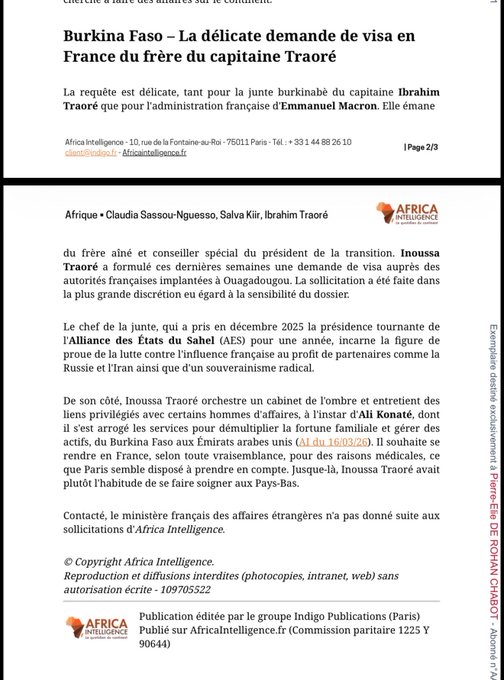
Yet, beneath this layer of confrontational public discourse, specific actions suggest a more complex reality. Reports have surfaced indicating that the President’s older brother, Inoussa Traoré, recently initiated a confidential request for a visa from French officials in Ouagadougou.
A private request amidst public hostility
Inoussa Traoré, who serves as a special advisor to the transitional presidency, reportedly sought the travel document for medical purposes. While he has previously traveled to the Netherlands for healthcare, this recent move toward Paris was handled with the utmost secrecy to avoid political fallout. Currently, the French Ministry of Foreign Affairs has not issued a formal statement regarding the matter.
This development has sparked significant debate regarding the consistency of the current administration. Since Ibrahim Traoré assumed power, his political identity has been anchored in a fierce opposition to France, often blaming the former colonial power for the country’s internal challenges.
The challenge of political credibility
The prospect of a close family member and advisor seeking entry into a country publicly labeled as a strategic adversary creates a difficult narrative for the government. Critics of the regime point to this as evidence of a “double standard,” where the general public is fed a diet of anti-Western sentiment while the leadership continues to rely on European infrastructure for personal needs.
While the Burkina Faso government maintains that it has achieved full sovereignty, the practicalities of specialized medical care and international logistics often clash with political slogans. This situation underscores the limits of a policy based on total rupture, revealing that personal and institutional requirements can sometimes override ideological stances.
Ultimately, the credibility of the sovereignist movement in Burkina Faso faces a test. When a state is portrayed as an enemy, any private outreach to that same nation by top officials is viewed as a contradiction. This incident highlights that in the world of Burkina Faso press and international relations, actions are often weighed more heavily than the most fervent speeches.