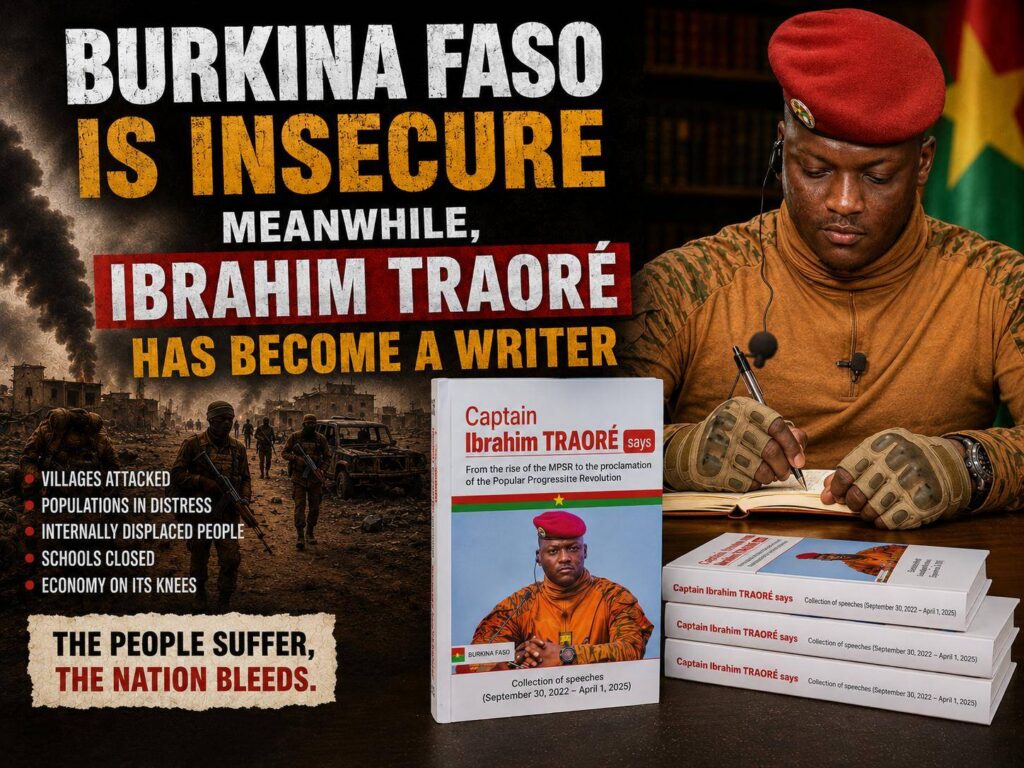
The nation of Burkina Faso continues to grapple with an escalating humanitarian and security crisis, yet the priorities of the transitional leadership appear increasingly misaligned with the urgent needs of its people. While daily reports highlight terrorist attacks, besieged communities, and a growing tide of internally displaced persons pleading for peace and sovereignty, the corridors of power seem preoccupied with an altogether different agenda.
From battlefields to bookshelves: a widening chasm
There exists a stark and unsettling contrast between the realities faced by Burkinabè citizens and the activities pursued by their leadership. On one side, communities endure violence, displacement, and hunger, desperate for tangible solutions. On the other, the halls of the presidency resonate with the orchestrated promotion of a book—allegedly authored by Captain Ibrahim Traoré—whose contents are perceived by many as little more than self-congratulatory propaganda.
For a significant portion of the Burkinabè population, the sentiment is clear and unmistakable: the transitional presidency has devolved into a platform for political self-promotion, far removed from the core mandate of restoring stability and security.
The futility of rhetoric amid real threats
The recent publication and promotion of a book attributed to the head of state have sparked widespread bewilderment and frustration. Across Ouagadougou and the nation’s most remote regions, the message from citizens remains consistent and unambiguous: the population does not seek literary works, but rather the restoration of safety and the return of peace.
Allocating resources to the production and dissemination of state-sanctioned literature at a time when defense and security forces struggle with critical logistical shortages reflects a troubling disconnect from ground realities. Security cannot be achieved with printed pages, nor can lives be protected through glossy slogans.
« The people do not need stories; they need their homeland restored. »
A civil society activist, speaking on condition of anonymity.
A broken social pact
When Captain Ibrahim Traoré assumed leadership, he entered into an unspoken social contract with the nation: to reclaim territorial integrity and deliver peace where predecessors had failed. The trust placed in him was contingent upon fulfilling this promise of security through decisive action.
Yet, today, rhetoric appears to have superseded strategy. By prioritizing personality cults and political marketing, the regime risks squandering the dwindling patience of a population pushed to its limits. The threshold of tolerance has been crossed, and the calls for change are growing louder. The message is unequivocal: if the primary mission—securing the nation—cannot be fulfilled, it is time for those in power to step aside.
The path forward: leadership or illusion?
The transitional government stands at a pivotal juncture. Continuing to govern as though the presidency were a marketing firm will only deepen the rift between leadership and the people it claims to serve.
Burkina Faso does not require a head of state who is a prolific writer, but rather a strategic commander capable of restoring stability. If Captain Traoré does not refocus his administration’s efforts on the singular objective of security, history may record his tenure not in terms of progress, but as an era defined by illusion—a time when the nation burned while its leaders turned the pages of self-praise.