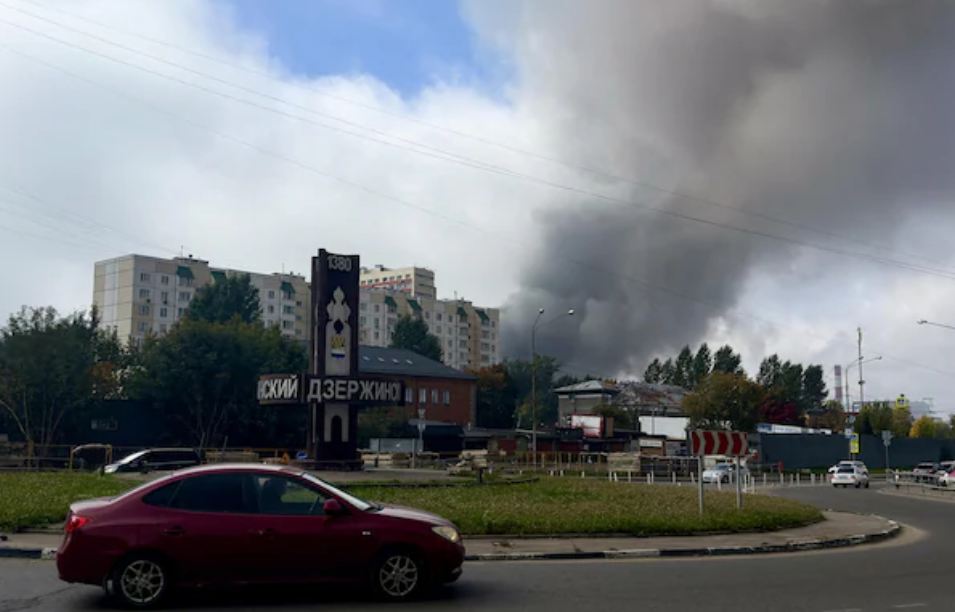
Ukraine’s large-scale drone assault on the Moscow region in September has forced a difficult question to the surface: can Russia still shield its own territory from a war it chose to launch? The attack targeted oil infrastructure and a logistics site, but its deeper significance lies in what it exposes about the Kremlin’s ability to protect the homeland after more than four years of fighting.
What happened during the September 19-20 attack
Overnight on September 19-20, the Moscow region was hit by a major wave of Ukrainian drones and other long-range weapons. Russian authorities claimed to have intercepted more than 1,600 drones across the country, with roughly 450 of them heading toward the capital. Despite these claims, infrastructure was struck, including the Moscow oil refinery in the Kapotnia district. Russian officials reported several deaths and dozens of injuries.
Zelensky’s claim and the weapons involved
Ukrainian President Volodymyr Zelensky claimed responsibility for the operation, stating it had hit “one of the key facilities” of Russia’s oil industry as well as a logistics site. According to him, several Ukrainian systems were deployed: FP-1, RZ-100, MICH-2000, Palianytsia, Vendetta, Liutyi, Bars, Flamingo, Sichen and Pelican. These claims are partly corroborated by independent analyses, notably from the Institute for the Study of War, which reported significant damage to the refinery and a logistics complex near Sofyino.
Why the Moscow refinery matters
The episode is particularly significant because it directly strikes one of the essential pillars of the Russian economy. The Moscow refinery is a major installation, capable of processing around 12 million tonnes of oil per year. Geolocated images showed large fires at the site after the attack.
For Kyiv, the logic is clear: the war is no longer confined to the front line. It also concerns the economic resources that allow Moscow to finance and fuel its military operations. Energy infrastructure is therefore an obvious strategic target for Ukraine.
A response to Russia’s long-range war
But this strategy is also the result of a deeper evolution of the conflict. Since the full-scale invasion of Ukraine in February 2022, Russia has regularly used missiles and drones against Ukrainian infrastructure, including energy networks and cities. The multiplication of Ukrainian attacks against Russian territory is partly a response to this long-range war. Above all, it shows that the border between “front” and “rear” has become increasingly artificial.
The primary responsibility for this situation must be placed in its political context: it was Russia that launched the full-scale invasion of Ukraine in 2022. Since then, Moscow has continued its military operations despite the considerable human, economic and diplomatic consequences of the conflict. Strikes against Ukraine have, in turn, caused massive destruction and civilian losses. On September 20, while Russia was itself being hit, Ukrainian authorities were still reporting civilian deaths in the Kyiv region following Russian attacks.
The election timing and the propaganda battle
The new attack on Moscow also comes in a politically sensitive context. It occurred on the final day of Russia’s legislative elections. Moscow’s mayor, Sergei Sobyanin, accused Ukraine of seeking to disrupt the vote, an accusation Kyiv did not present in the same way. The available facts allow us to note the simultaneity of the two events, but they do not, on their own, establish the exact political intention of the attack.
This nuance matters. In such an intense propaganda war, each side seeks to present events according to its own narrative. Moscow insists on civilian victims and an alleged Ukrainian desire to disrupt the elections. Kyiv emphasizes infrastructure contributing to Russia’s war effort. Both dimensions can coexist: a strategic infrastructure can be targeted militarily while exposing civilian populations to considerable risks.
Ukraine’s growing deep-strike capability
Technological evolution is also revealing. Ukraine is now developing a growing range of weapons capable of reaching targets far from its territory. The Flamingo missile is among the systems cited by Zelensky. As for the “Pelican,” its identification remains uncertain: the ISW notes that available information does not allow its nature to be precisely confirmed and indicates that some contradictory hypotheses are circulating.
This Ukrainian capacity to strike deep constitutes a direct challenge for Russia. For a long time, Moscow could rely on geographic distance to protect part of its essential infrastructure. That relative protection is now eroding. The war the Kremlin wanted to impose mainly on Ukrainian territory is therefore producing effects deep into the central regions of the Russian Federation.
The risk of a spiral
The most worrying aspect, however, remains the risk of a spiral. Moscow has already announced its intention to intensify strikes against Kyiv after the September attacks. Each new attack can thus become a pretext for a new retaliation, and each retaliation for a new escalation.
Russia therefore finds itself facing a major contradiction. By seeking to impose a solution to the Ukrainian conflict by force, the Kremlin has helped transform a war initially concentrated on Ukrainian territory into a much broader confrontation. The strikes on Moscow do not mean the war is over, nor that they alone will be enough to change Russian strategy. They nevertheless demonstrate that the invasion has not brought Russia the security promised to its population.
The fire at a refinery in Moscow is thus more than a military episode. It symbolizes the return of war to the heart of the country that launched it. And it recalls a difficult truth to ignore: when a state chooses to prolong a war of aggression, it never fully controls the consequences it creates.


More Stories
Can a Russian election be called free when the only anti-war party is off the ballot?
Benin’s ARS second term: can stricter regulation finally deliver safer care?
Can the M23’s mining empire in eastern DRC survive this damning human rights report?