Over the past two decades, the landscape of major public contracts in Senegal has undergone a dramatic transformation. While French conglomerates once held sway over ports, stadiums, industrial zones, and hospitality projects, they now find themselves competing with a growing wave of international players—particularly from China, alongside firms from Turkey, the UAE, and Tunisia.
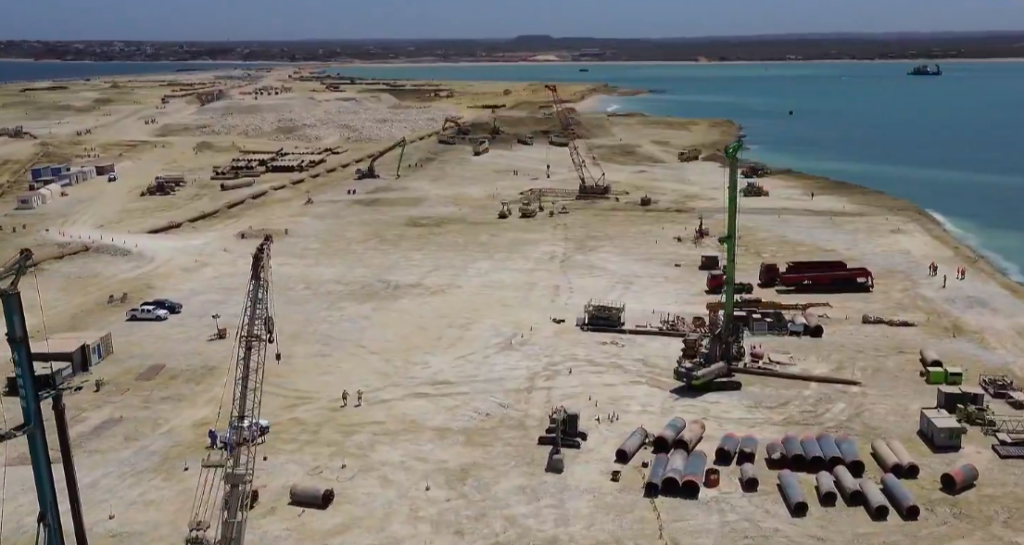
In the coastal town of Ndayane, south of Dakar, the construction of Senegal‘s first deep-water port is underway. With an estimated investment exceeding $2 billion, this mega-project is designed to accommodate the largest container ships in the Atlantic, promising to revolutionize the country’s logistics, job market, and global connectivity. Though managed by the Emirati firm DP World, the construction consortium is led by Chinese contractors—a decisive shift in the balance of influence. David Gruar, project director for DP World, confirmed that despite competition from global firms, including several French entities, the Chinese-led bid ultimately prevailed due to cost efficiency.
Just 30 kilometers away, the development of Diamniadio, a new urban hub meant to ease congestion in Dakar, further illustrates this trend. Here, Turkish companies have secured contracts for the stadium, train station, hotels, and residential buildings, while a Tunisian firm is building an industrial platform aimed at attracting foreign investors. Bohoum Sow, Secretary-General of the APROSI (Association for the Promotion of Senegalese Industry), noted the absence of French firms in the area, emphasizing that Chinese and Turkish contractors have better aligned with local market demands.
why chinese firms are winning senegalese contracts
Bohoum Sow highlights China’s ability to understand and adapt to Senegal‘s evolving infrastructure needs. A standout example is a Chinese-built cardboard packaging plant, where local employees receive hands-on training from Chinese technicians. “This type of industry didn’t exist here before. They’ve identified specific needs and responded with agility and diversification,” he explained. Over the past 20 years, China has strategically expanded its economic footprint in Africa, shifting from traditional aid to large-scale investment in critical sectors. The result? A visible shift in influence, with Chinese firms now accounting for over 30% of public contracts in Senegal, compared to just 5% for French companies.
While French firms once dominated sectors like energy, banking, and major infrastructure, their share has dwindled significantly. Caroline Richard, Head of Proparco‘s Senegal office, acknowledges that French companies still have opportunities—provided they adopt a more flexible and locally integrated approach. “French firms can still grow in Senegal, especially as competition intensifies. We excel when standards are high, and there’s strong potential for job creation and economic growth,” she noted.
how french companies are adapting to stay competitive
Despite the challenges, some French firms are finding success by rethinking their strategies. Ragni Group, a family-owned company from France specializing in public lighting, secured a $70 million contract to install 36,000 next-generation solar streetlights across Senegal. To win the bid, the group established a local subsidiary led by a Senegalese executive, emphasizing job creation and technology transfer. Birama Diop, Director of Ragni‘s Senegalese subsidiary, stressed the importance of flexibility, quality, and cost efficiency in securing the project.
This evolving dynamic reflects a broader shift in Senegal‘s economic partnerships. While Chinese and Turkish firms dominate the infrastructure sector, French companies are repositioning themselves by focusing on innovation, local partnerships, and high-value projects. The future of Senegal‘s development now hinges on collaboration between global expertise and localized solutions.