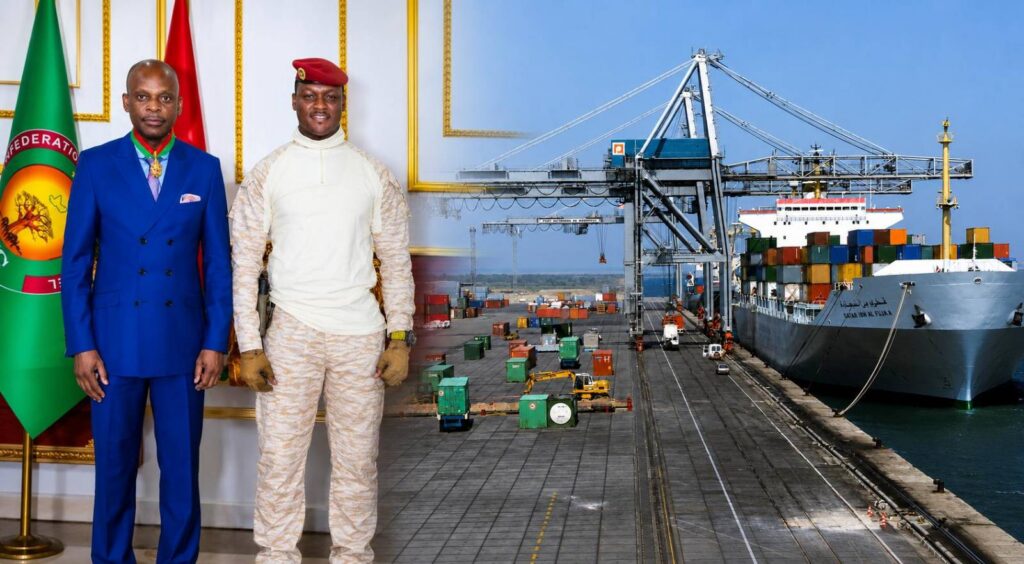
In a recent diplomatic gesture, the Togolese Minister of Foreign Affairs was awarded the rank of Commander within Burkina Faso’s highest honorific distinction, the Order of the Stallion. While official channels portray this as a hallmark of open, solidaristic diplomacy pursued by Lomé toward its neighbors, the underlying political landscape reveals a far more pragmatic and transactional reality.
honors granted or interests secured?
The conferment of this distinction invites a critical examination of its true significance. Is it a gesture of mutual respect and regional cooperation, or a calculated move to reinforce ties between two governments navigating shared political and economic challenges? Diplomatic accolades often serve as instruments to solidify alliances, yet they can also function as subtle political signals to regional partners.
To many analysts, the timing of this award raises eyebrows. It follows a period marked by a notable diplomatic rupture: the Togolese government’s decision to withdraw its support for former Burkinabé President Roch Marc Christian Kaboré by granting him short-lived political asylum. This reversal was not merely symbolic—it reflected a deliberate prioritization of economic interests over ethical or political solidarity.
ports, trade, and the logic of dependency
The Togolese leadership’s strategic pivot underscores a clear hierarchy of priorities. While rhetoric may emphasize regional unity, actions reveal a focus on securing economic advantages. By facilitating or tolerating the relocation of Kaboré, Lomé effectively traded a fleeting display of hospitality for tangible commercial concessions. The cornerstone of this arrangement? Ensuring unhindered transit of Burkinabé goods through the Autonomous Port of Lomé (PAL), a facility that serves as a vital economic artery for landlocked Burkina Faso.
This interdependence is not one-sided. Burkina Faso relies heavily on maritime corridors for its supply chains, making the PAL a critical hub for imports and exports. Conversely, Togo derives substantial revenue from regional transit fees. Thus, the alignment between the two capitals is not merely diplomatic—it is structurally economic. The awarding of this honor, therefore, may be less about recognition and more about reaffirming a mutually beneficial arrangement rooted in logistical and financial pragmatism.
a shift toward transactional alliances
This episode reflects a broader trend across West Africa: the ascendancy of transactional diplomacy. In an era where economic imperatives and security concerns increasingly shape foreign policy, traditional principles—such as democratic values and human rights—often take a backseat. Alliances are forged not on shared ideals, but on mutual convenience, trade agreements, and logistical necessity.
Such dynamics raise pressing questions about the authenticity of regional solidarity. When diplomatic gestures are so closely tied to economic incentives, the narrative of Pan-African fraternity begins to lose its resonance. For citizens and observers alike, the gap between official discourse and political reality becomes impossible to ignore.
the illusion of cooperation
Government statements laud this distinction as proof of a robust and exemplary partnership between Togo and Burkina Faso. Yet, the absence of transparency regarding the underlying conditions of this rapprochement fuels skepticism. If diplomatic decisions are contingent upon economic concessions, can they truly be celebrated as acts of goodwill? The disconnect between rhetoric and reality weakens the credibility of institutions and leaders who champion solidarity while pursuing narrow, self-serving agendas.
Ultimately, this distinction serves as a microcosm of modern West African diplomacy—a realm where state interests prevail over idealism, and where alliances are sustained not by shared values, but by the cold calculus of mutual benefit. Beneath the ceremonial splendor and diplomatic pageantry lies a stark truth: in the pursuit of strategic advantage, principles are often negotiable.