- Top Stories
- International Relations
escalating Sudan war spills into Chad’s borders
Three years into Sudan’s brutal conflict, its devastating effects have now reached Chad’s doorstep. Cross-border strikes, military escalations, and deepening communal tensions reveal how the Sudanese crisis is destabilizing N’Djamena.
Since April 2023, Sudan has been torn apart by a bloody war between General Abdel Fattah al-Burhan’s army and the Rapid Support Forces (RSF) led by Mohamed Hamdan Dagolo, commonly known as Hemedti. Despite Chad’s official stance of neutrality, its covert support for the RSF has sparked intense debate. This contradictory position places Chad’s government in an impossible dilemma: backing a faction that targets Zaghawa communities in Darfur, while these very groups form the backbone of Chad’s state apparatus. Arms shipments, reportedly financed by the United Arab Emirates, have reportedly passed through Chadian towns such as Amdjarass and Adré. A gamble with consequences that were not only predictable but now fully manifest.
Tiné: a cross-border pressure point
There are two towns named Tiné—one in Sudan, the other in Chad—separated only by an invisible line but united by shared Zaghawa communities. These twin settlements serve as critical escape routes for civilians fleeing the horrors of Darfur’s northern conflict into Chad.
On February 21, 2026, the RSF seized control of the Sudanese side of Tiné. The advance triggered immediate clashes with the Toroboro fighters—Chadian and Sudanese militias allied with General al-Burhan—as well as with Chadian military units operating without official authorization. The counteroffensive quickly reclaimed the town. In response to the growing insecurity, N’Djamena announced the closure of the border. Yet fighting persisted, confirming that the conflict had firmly taken root in this transborder region.
Amid this already volatile landscape, a deadly drone strike struck Tiné (Chad) on March 21, killing nearly two dozen civilians. While Chadian authorities deny involvement, accusations are mounting. Exiled opposition leader Ousmane Dillo, currently based in Sudan, released an audio message widely circulated on private messaging platforms, directly accusing Mahamat Déby and calling for his removal. He also warned of the threat posed to the Zaghawa community. On the Sudanese side, Darfur Governor Minni Arkou Minawi escalated rhetoric by declaring that “the war with Chad has already begun,” signaling a dangerous regional escalation.
N’Djamena on high alert
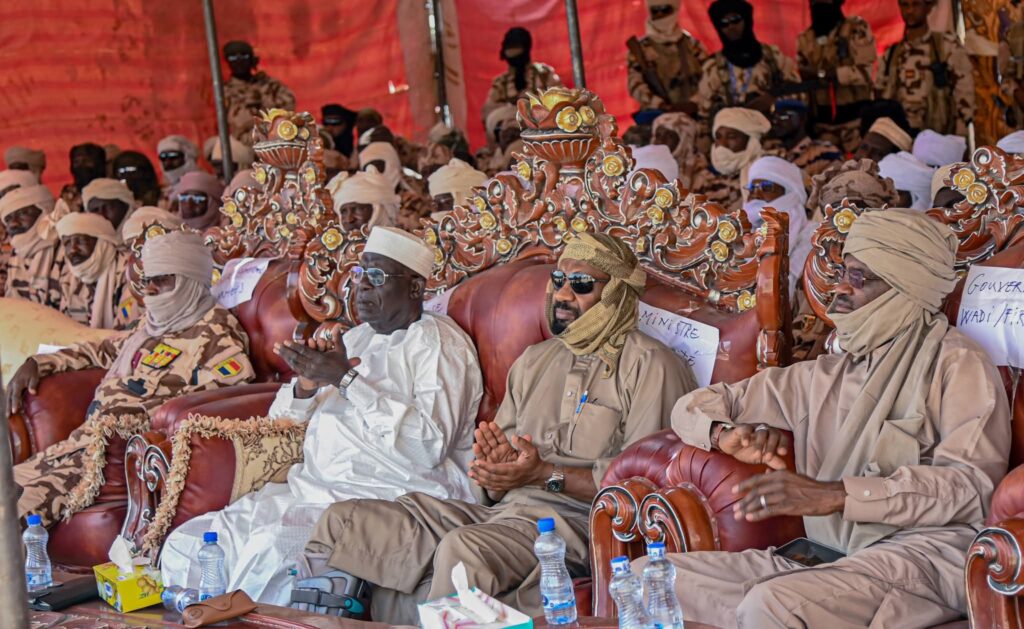
Chadian authorities have responded with unyielding firmness. Government spokesperson Gassim Chérif Mahamat reaffirmed Chad’s neutrality while vowing a “proportionate” response to any aggression. President Mahamat Déby has since placed the armed forces on maximum alert. On March 22, a high-level security summit in Tiné convened top military officials to reinforce border protection and prevent further destabilization. “This is Tiné, Chad—not Tiné, Sudan. Let the Sudanese army, the Toroboros, and the RSF fight it out in their own country. They must not bring their war here to kill our people,” declared General Ali Ahmat Akhabach, Minister of Security.
In a move with dire humanitarian implications, N’Djamena has since prohibited civilians from crossing the border, blocking women and children fleeing Sudan’s war from reaching safety in Chadian refugee camps. Intended to curb potential Zaghawa rebellion, the policy has done little to improve security. According to Cameron Hudson, a leading Sudan conflict analyst: “The Chadian military is reinforcing its presence along the Sudanese border amid rising tensions. I fear this will only increase the risk of direct Chadian involvement in the Sudanese conflict, rather than preventing it. By projecting an image of strength, Déby risks making a critical strategic miscalculation.”
Communal tensions fuel regional instability
The Sudanese conflict is not only pulling the Zaghawa into its vortex. According to Chadian security sources, the RSF has been actively recruiting young men from the Tama community in recent weeks. This mobilization resembles mercenary activity and involves local networks including traditional leaders, administrative authorities, and figures close to the government.
Like the Zaghawa, the Tama are a transborder community, present in both eastern Chad (Wadi Fira, Ouaddaï) and western Sudan. Though not Arab, they were integrated into the Janjaweed militias—precursors to Hemedti’s forces—during the initial Darfur war in 2003. These militias were deployed against ethnic groups, particularly the Zaghawa. This resurgence is deeply concerning: it reopens old wounds within Chadian society and stokes fear of communal danger.
What was once a murky strategic calculation has now become a reckless gamble. Chad’s government finds itself trapped in a spiral it may no longer control. The genie is out of the bottle—and it won’t go back in.