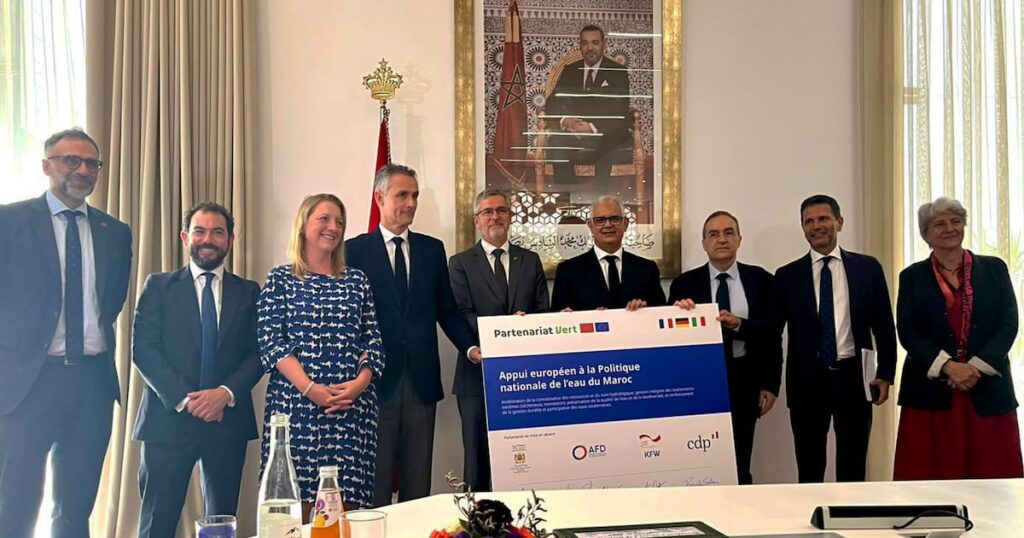
In a landmark agreement signed in Rabat, the European Union (EU) and key European development agencies have committed €348 million—equivalent to nearly 3.7 billion Moroccan dirhams—to advance a comprehensive water program in Morocco. The signing ceremony took place at the Ministry of Equipment and Water, with Minister Nizar Baraka and ambassadors from the EU, France, Germany, and Italy in attendance.
The three-year initiative builds upon a prior agreement finalized in November 2024 during a high-profile meeting in Rabat between King Mohammed VI and French President Emmanuel Macron. The funding pools contributions from major European agencies, including the French Development Agency (AFD), Germany’s public development bank KfW, and Italy’s Caisse des Dépôts et Prêts (CDP). The AFD, serving as the project’s lead agency, has played a pivotal role in mobilizing cross-European support.
French Ambassador Philippe Lalliot marked his first official engagement in Morocco by highlighting France’s substantial contribution to water initiatives in the country, totaling over a billion euros to date. He also commended the EU’s collaborative efforts in advancing this critical sector.
Speaking on behalf of the EU, Ambassador Dimiter Tzantchev emphasized the bloc’s prioritization of water security, particularly in the context of climate change. The funding will prioritize rural communities, ensuring access to both potable water and agricultural irrigation. “Water is a strategic priority for the EU, especially amid growing climate pressures,” Tzantchev noted.
During the event, Minister Nizar Baraka outlined Morocco’s ambitious national water strategy, driven by the vision of King Mohammed VI. He highlighted the completion of 26 operational dams, which currently irrigate 1.5 million hectares of farmland. Morocco’s near-term goal is to derive 60% of its drinking water from desalination plants.
“A nation that cannot control its water supply cannot control its destiny,” Baraka declared, underscoring the existential importance of water security. He assured that the ministry would implement the EU-backed program with a focus on efficiency and transparent governance, expressing gratitude to the ambassadors for their steadfast support.
Germany’s outgoing ambassador also praised the robust Morocco-Germany partnership, noting the KfW’s strategic investments in water infrastructure—a sector critical to both nations’ interests.
With this new funding, Morocco is poised to strengthen its resilience against water scarcity while accelerating the rollout of its national water strategy. The initiative spans desalination, dam construction, rural water access, and agricultural irrigation, reinforcing the country’s commitment to water security, sustainable agriculture, and social stability.