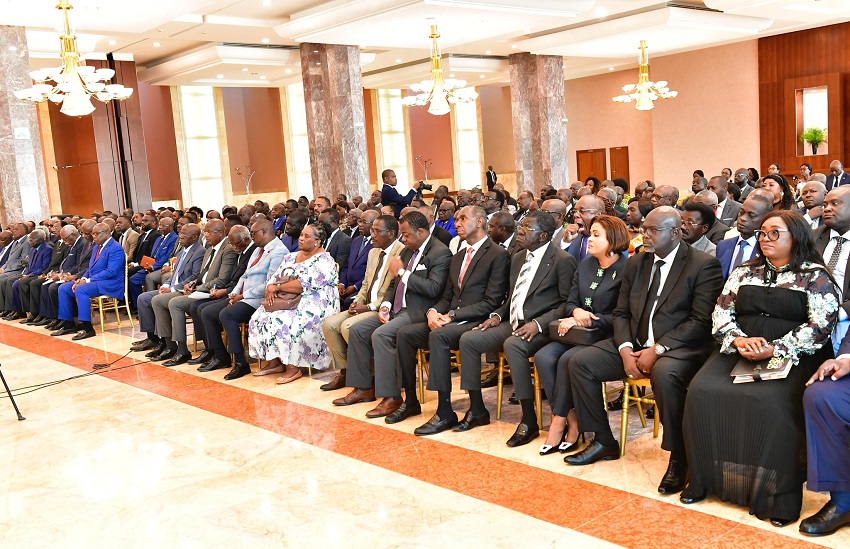
Libreville, June 2026 — At a time when democratic governance is facing a historic crisis across the globe, a nation in Central Africa is standing out to international observers as a surprising success story.
Gabon, which for years was categorized among the world’s more fragile and disputed political systems, has been identified by the Swedish-based V-Dem Institute as one of the few countries to show significant positive development over the past twelve months.
The latest annual report from the institute, a global benchmark for assessing democratic health across more than 200 nations, presents a grim picture of the current era. Democratic erosion is a worldwide phenomenon, affecting even established institutional models. Even the United States is noted for its increasing structural tensions. In this darkening global landscape, Gabon shines as a positive anomaly, sparking both global interest and curiosity.
A rare shift in a world of retreat
The core finding of the recent assessment is clear: the number of countries experiencing democratic backsliding is on the rise. Civil liberties are under pressure, institutions are being hollowed out, and the concentration of executive power is weakening essential checks and balances. Within this context, only eleven nations managed to remove themselves from the list of declining democracies this year. Gabon is part of this elite group.
More remarkably, researchers explicitly named Gabon as one of the four primary sources of democratic hope globally. Alongside Lebanon, Mauritius, and South Korea, Libreville is being hailed as a model of encouraging change within a difficult international climate. This recognition is tied directly to the 2025 elections, which experts view as a pivotal institutional moment that redirected the country’s path toward a new dynamic.
The African contrast
The significance of Gabon’s progress is even more pronounced when compared to regional trends. Sub-Saharan Africa remains the region most severely impacted by democratic decline this year, with twelve nations showing a worsening of their institutional indicators. The situations in Burkina Faso, Mali, Niger, and Togo underscore this heavy downward trend.
In a regional environment often characterized by political instability and extended military transitions, Gabon stands apart. Analysts suggest that Gabon is now one of only three countries—alongside Chad and South Korea—positioned to achieve sustainable democratic growth in the coming years. The comparison with Chad is particularly relevant, as both nations have recently navigated transitions back to constitutional order through the ballot box following institutional disruptions. This trajectory is being watched closely as a potential political laboratory for the continent and beyond.
Progress, not perfection
While the international recognition is significant, it is not a final seal of approval. The report emphasizes that Gabon remains an incomplete democracy, currently ranking 114th out of 179 evaluated states. Its overall score remains modest, indicating that while the nation is moving forward, it is doing so from a historically low starting point. This nuance is vital: the current improvement is the beginning of a long journey rather than the destination.
Historical precedents, such as the case of Zambia, serve as a warning. Zambia previously saw a democratic surge only to witness those gains stall and eventually erode. History proves that institutional progress only becomes permanent when supported by deep reforms, an independent judiciary, a free press, and transparent governance. This is the primary challenge now facing Gabon.
The weight of democratic consistency
This newfound status brings a fresh set of responsibilities for the authorities in Libreville. When a nation is held up as a global beacon of hope, every institutional choice is scrutinized. Recent domestic debates—ranging from the temporary suspension of digital platforms to the implementation of a new nationality code via regulation—have raised questions among the public and international watchers alike. Furthermore, the judicial situation involving former Prime Minister and presidential candidate Alain-Claude Bilie By Nze remains a point of discussion.
The issue is not the state’s right to govern or ensure security, but whether such actions align with the transparency and respect for fundamental rights required by democratic standards. The experience of other African states shows that progress can be fragile if it doesn’t include the consolidation of pluralism and institutional independence. The 2025 elections allowed Gabon to move past a period of deep mistrust; the next phase is to prove that this shift is a permanent transformation. In a world where democracy is frequently in retreat, Gabon has a unique chance to show that a different way forward is possible.


More Stories
Simporé’s televised admission: can Burkina Faso’s army still hold the line?
Gabon’s ghost worker purge: can 11 billion CFA francs in savings really reach the people?
Is Burkina Faso’s anti-terror drive becoming a war on moderate imams?