Gabon’s strategic economic roadmap is yielding significant milestones as the nation pursues its goal of becoming Central Africa’s primary industrial and mining hub by 2030. Following a major agreement with Africa Global Logistics (AGL) regarding the Kobe-Kobe development, the government has moved decisively to prioritize the expansion of national infrastructure.
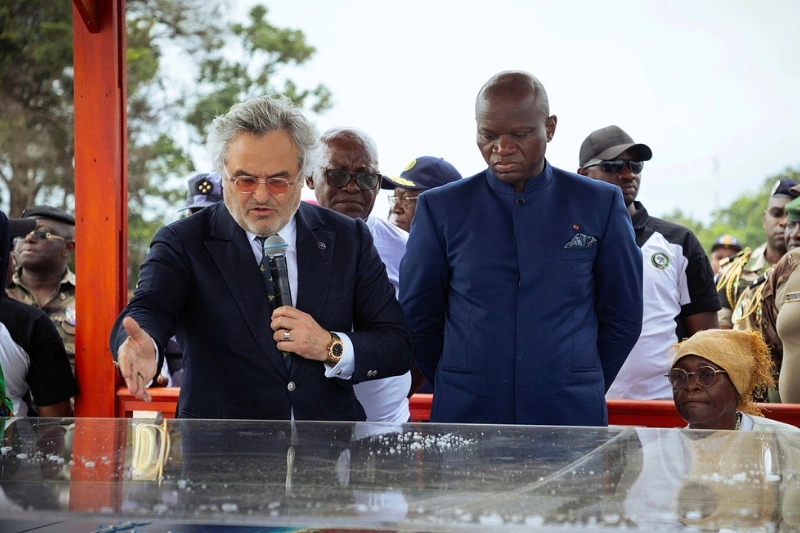
In a landmark event on Monday, June 8, 2026, President Brice Clotaire Oligui Nguema officially laid the first stone for the Kobe-Kobe deep-water port, signaling the start of a transformative era for the country.
A multi-faceted industrial complex
This ambitious infrastructure project is designed to be a comprehensive logistics ecosystem. It will feature a specialized mineral terminal, a multi-purpose quay, a railway loop, residential sectors, cargo storage zones, and administrative offices. By developing this integrated site, Gabon aims to secure its economic sovereignty by processing raw materials locally rather than exporting them in their raw state. This vision is being realized through collaborations with international economic partners across various sectors, including iron and mining. The President has made it clear that every stakeholder is expected to produce tangible results to ensure the project’s success.
During the ceremony, the Minister of Transport and Merchant Marine, Ulrich Manfoumbi Manfoumbi, stated that the initiative represents the foundation of a new development model. He noted that the project focuses on industrialization, local value creation, and establishing Gabon as a strategic logistics leader in the region.
Global scale and economic impact
The Kobe-Kobe project is currently ranked among the five largest mining initiatives globally. Philippe Labone, the Director General of AGL, confirmed that the port is scheduled to begin export operations in April 2031. To support these operations, a 550 km railway corridor will be established, linking production sites directly to the port complex with an estimated travel time of only eight hours.
Beyond infrastructure, the project emphasizes human capital. AGL has indicated that specialized training programs will be launched to ensure young Gabon nationals are at the forefront of the port’s operations. The projected economic benefits are substantial, with expectations of creating 100,000 jobs, increasing the national Gross Domestic Product (GDP) by over 50%, and generating an annual value of more than $10 billion.