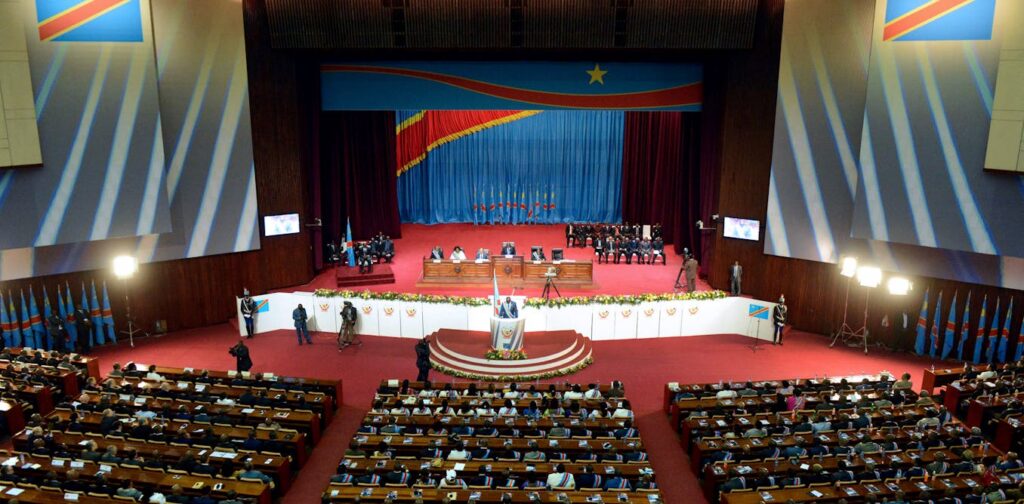
On 15 May 2026, sexist and misogynistic remarks from the highest seat of the National Assembly shook Congolese politics. A widely shared video shows national deputy Micheline Mpundu finishing her information motion and leaving the podium after speaking. The second vice-president, Christophe Mboso, who was presiding over the plenary session, publicly commented on her physique from his seat: “Thank you, colleague, she is very beautiful … huh.”
He then continued in Lingala: “Look at her yourselves,” laughed openly, raised his hands to mimic the deputy’s body shape, adding “God made her” and “these are another’s possessions,” to the sound of laughter and applause from the chamber. The session continued as if nothing had happened.
Only after outrage from certain political figures, social actors, and human rights activists, along with internal pressure from his superiors, did deputy Mboso eventually apologise several days later. No sanction was imposed.
This recent case of sexism and verbal violence forces us to ask once again a critical question: when will African parliaments—and particularly the Congolese one—stop being hostile spaces for the women they are meant to represent?
My doctoral research in political science also explores masculinity within Congolese legislative bodies. I analyse what this video reveals through a comparative African lens. I see it not as an isolated misconduct but as a structural problem. In this article, I examine the gap between what DRC authorities have pledged on paper and what elected women actually experience.
Comparative analysis of a phenomenon not exclusive to the DRC
Parliamentary violence forms part of the wider range of violence women face in politics, both in the DRC and elsewhere. Long before the video implicating deputy Mboso circulated in Kinshasa, other acts of sexism had been documented. These facts highlight how serious this phenomenon is—it hinders women’s full participation in politics at all decision-making levels.
Female participation surged in the early 1990s with democratic waves that raised real hope, propelling an unprecedented number of women into African parliaments. The number of female lawmakers tripled between 1990 and 2010. I remember reading those figures with amazement. For a long time, with stubborn illusion, we believed that gaining an elective mandate would transform institutional culture. That illusion shattered quickly. This presence, paradoxically, was seen as a challenge to the established system.
Women thus encountered deep structural resistance, often from male colleagues—whether from the opposition or the same party. Some believe, and sometimes say openly, that politics is a male domain, that women are unwelcome or have no place there.
The Inter-Parliamentary Union, a global organisation of national parliaments founded in 1889, has documented this rigorously. In its 2016 worldwide survey of female parliamentarians from 39 countries across five continents, over 65.5% of respondents said they had repeatedly experienced verbal attacks and insults during their term. These figures are statistically alarming. They reveal much about parliamentary realities.
Much of this violence comes from male colleagues. What is interesting about that study is also how society views elected women. Their political record is not questioned; rather, their very right to be there is debated in the media. They are not judged on their political contributions but on their appearance, marital status, and conformity to traditional roles as educators or mothers.
Sexism does not stop at parliament’s doors. It enters with elected members, settles in, and sometimes flaunts itself from the speaker’s chair, as we have just seen in the DRC. The regional study conducted jointly by the IPU and the African Parliamentary Union (November 2021) confirmed that this reality persists, with insufficient progress in women’s effective political participation.
The applause heard in the video is not trivial. It shows that the problem is not Mr. Mboso—it is the system that produces and tolerates such behaviour. Australian philosopher Kate Manne analyses this as a control mechanism that keeps women in subordinate positions, even in so-called democratic institutions. This control does not always involve physical violence. Gestures, words, laughter from the podium—what Mona Lena Krook, a scholar of violence against women in politics, calls semiotic violence—are enough to remind elected women that in the eyes of some colleagues, they remain bodies before being legislators. Mboso’s raising his hands to mimic his colleague Mpundu’s body illustrates this reality.
The coloniality of gender, a concept developed by feminist María Lugones, explains this naturalisation of gender hierarchy as a colonial legacy and sheds light on this contradiction: female MPs are elected by the same voters, in the same polls, under the same constitutional texts as their male counterparts. Yet they remain subject to patriarchal control systems that reduce them, even from the podium, to something other than legislators. They have equal rights on paper but unequal rights in the chamber.
African cases
Watching the Mboso video, many must recall other African countries—Senegal, where deputy Amy Ndiaye, pregnant, was slapped and kicked in the stomach in 2022 on the chamber floor, in front of cameras. In 2025, Nigerian senator Natasha Akpoti-Uduagha was suspended not for professional misconduct but for daring to name the sexual harassment she endured from the Senate president.
It is no coincidence that Ndiaye, Akpoti-Uduagha, and Mpundu—three women from three different countries—all experienced violence. These facts show that while African parliaments tolerate women’s voices, their dignity is not yet fully respected.
Congolese cases
On 30 April 2020, Thambwe Mwamba, former president of the Congolese Senate, belittled a woman during a plenary session broadcast on national television. He revealed all the secret meetings he claimed senator Bijoux Ngoya had held with him, alleging she approached him to seek support for her candidacy as Senate quaestor. He subtly accused her of making advances. The session ended in chaos, with several lawmakers expressing outrage.
On 15 July 2021, as deputy Christelle Vuanga dismantled a colleague’s arguments during a constitutional debate, Nsingi Pululu interrupted her with a single phrase in Lingala: “You are a woman.” It was a way to diminish her ability to speak publicly on a sensitive matter simply because she is a woman.
The Mboso affair is no surprise. The DRC has ratified conventions, passed laws, and signed commitments—yet nothing has changed in the chamber. The gap between text and practice is not new and has been documented. What is new is that we keep pretending not to see it.
A reflection that continues
French feminist activist Simone de Beauvoir wrote in 1949 that women are defined as “the Other.” In 2026, this otherness persists in the Congolese Parliament: elected female deputies continue to be reduced to their bodies rather than their political speeches.
These incidents signal that the patriarchal system undermines democracy from within. As long as sexist behaviour goes unpunished—as shown by the applause in the video and the absence of any sanction against Mr. Mboso—the Congolese Parliament will remain a misogynistic space. It is supposed to represent the 65 women among its 477 deputies, barely 13% of the chamber, in a country where women make up nearly 51% of the population. Underrepresentation does not justify tolerating such conduct.
Other parliaments have found solutions through campaigns like #NotTheCost (NDI) and #NotInMyParliament (European Parliament), proving that culture can change with concrete sanctions and victim protection. The DRC has good laws. The project on violence against women examined in the Senate in October 2025 is one example, but a law without implementation remains a wish. Silence is no longer an option. Not sanctioning Mr. Mboso sends a clear signal to all Congolese women considering a political career.