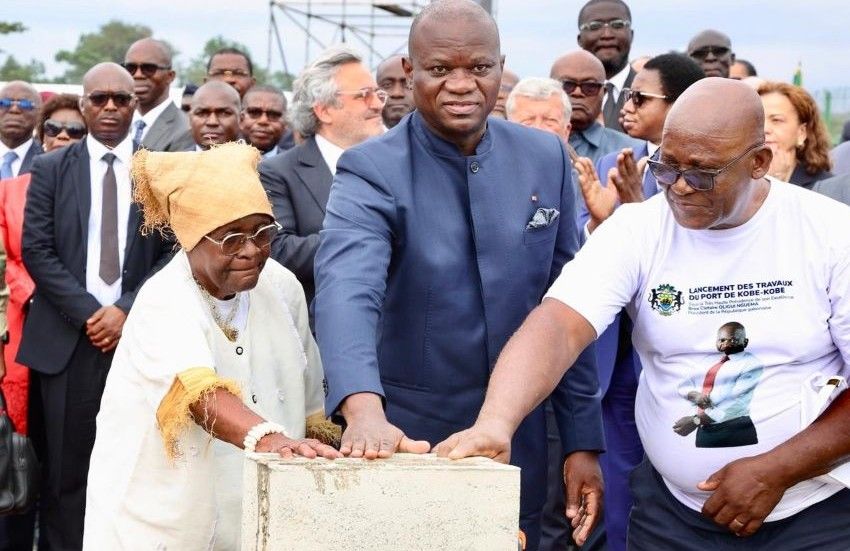
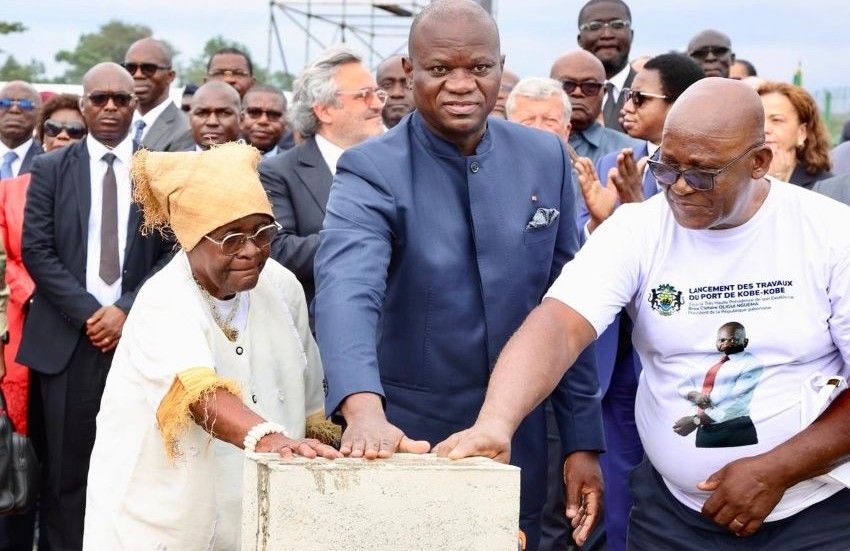
The official launch of the Kobe-Kobe deep-water port construction marks a pivotal moment that extends far beyond a simple infrastructure site.
This initiative signals Gabon’s entry into a fresh chapter of its economic narrative. Beyond the machinery and technical blueprints lies a national transformation strategy that could permanently reshape the country’s role in both African and global trade networks.
In Nyonié, situated along the Atlantic coast of the Estuaire province, President Brice Clotaire Oligui Nguema set in motion a program that consolidates several strategic goals. Industrialization, economic independence, post-oil diversification, regional development, job creation, and international influence are now converging toward a unified objective.
Few projects have engaged such a diverse array of international stakeholders or generated as much hope among the Gabonese people.
The foundation of a modern economic framework
Viewing Kobe-Kobe merely as a port would be an analytical oversight. The complex is built upon four interconnected pillars. First is the Belinga iron deposit, recognized as one of the world’s most significant untapped high-grade ore reserves. Second is a new 535-kilometer railway line designed to connect mining zones to the coast. Third is a deep-water mineral port featuring four docking berths. Finally, a 400-megawatt hydroelectric dam in Booué will power the entire operation.
This integrated structure departs from historical models that have long defined the extraction of African natural resources. For decades, raw materials were shipped off the continent to be processed elsewhere. In contrast, the Kobe-Kobe project seeks to capture more added value within national borders.
The government’s objective is transparent: utilize Gabonese natural resources as a catalyst for industrial growth rather than just a source of exports.
The partnership established in April 2026 between the state, Africa Global Logistics, and Algest Investment Bank reflects this commitment to building a comprehensive economic chain, stretching from extraction to international markets.
A logistical shift for Central Africa
The implications of this project reach far beyond the mining sector. With a draft depth of 14 to 16 meters, Kobe-Kobe will possess a significant natural advantage in a region where existing port infrastructures are reaching their operational limits.
Very large vessels will be able to dock directly, lowering logistical expenses and increasing the nation’s appeal to global investors. As Central African states strive to boost their commercial competitiveness, controlling logistical infrastructure has become a deciding factor.
Gabon is positioning itself as a regional hub capable of serving its domestic market and a substantial portion of the sub-region’s trade flows.
This ambition aligns with the broader strategy championed by Brice Clotaire Oligui Nguema. It envisions a nation actively preparing for a future without oil by leveraging its mineral wealth, energy potential, and strategic geographic location.
The involvement of international partners like China Railway, EDF-Sinohydro, Trafigura, Fortescue, and Africa Global Logistics highlights the growing global confidence in this vision.
Social impact and local prosperity
Beyond the investment figures, the human element is perhaps the most anticipated aspect of the project. Official forecasts suggest the creation of over 9,000 direct jobs and up to 100,000 indirect roles by 2030. Some project developers even estimate a potential for 160,000 total jobs as the industrial corridor expands.
For the residents of Nyonié, Komo-Océan, and the regions intersected by the future railway, the project offers an unprecedented chance for economic renewal.
Enhanced transport networks, service development, the arrival of new industrial activities, and the upskilling of the local workforce could fundamentally alter the socio-economic environment of several provinces.
Ultimately, the success of Kobe-Kobe will be judged by its ability to turn massive infrastructure into tangible prosperity for the people of Gabon.
Behind the cranes and railway tracks lies a vital question: can Gabon successfully convert its natural assets into sustainable development, skilled employment, and economic sovereignty?
If these goals are met, Kobe-Kobe will be more than just a port. It will stand as a symbol of a new Gabonese model centered on industrialization and local value creation. On a continental scale, few projects so clearly embody the ambition of an Africa that no longer just exports resources but builds the foundations for its own future.