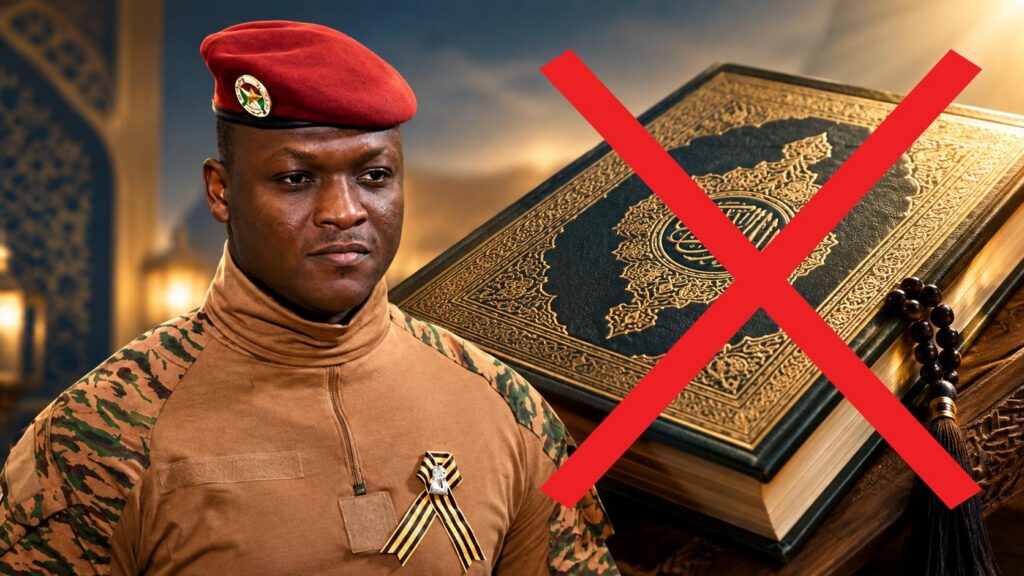
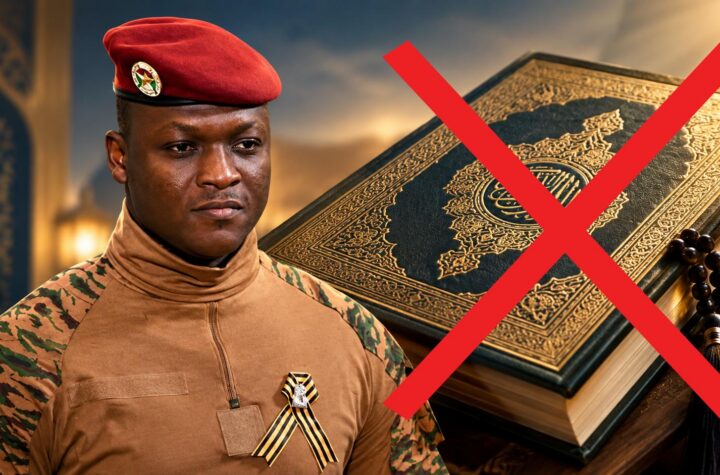
In Burkina Faso, the line separating counter-extremism from a crackdown on religious freedom has never been blurrier. Under the banner of rooting out the armed threat tearing at the nation, the transitional government led by Captain Ibrahim Traoré has launched an unprecedented campaign of control and repression against the Muslim community — the country’s overwhelming majority. Behind the official language of “national security,” what is taking shape in Ouagadougou is a broad effort to bring Burkina Faso’s Islamic figures and institutions firmly under state supervision.
Detentions, shutdowns and a clergy forced into line
For months now, security rhetoric has served as a convenient cover for hunting down independent religious voices. Moderate imams, influential preachers and leaders of Muslim associations have been picked up arbitrarily, held incommunicado or pushed into the ranks of the Volunteers for the Defense of the Homeland (VDP). Their offense? Criticizing the junta’s methods, questioning how the security crisis is being handled, or simply calling for civil rights to be preserved.
Meanwhile, mosques and Quranic schools in high-risk areas face intense inspections, arbitrary administrative closures and blanket accusations of collusion with armed groups. By indiscriminately branding any religious speech that does not toe the line as “subversive” or “allied with the enemy,” the authorities have sown fear inside a faith community long recognized for its role in mediation and social cohesion.
A political calculation that fractures national unity
This iron-fisted approach has a clear purpose: neutralize any social force capable of organizing structured opposition to military rule. By targeting the networks and figures of local Islam first, the transitional regime aims to impose a single line of thinking and seal off public space.
Yet rather than weakening the jihadist groups ravaging the region, this harsh offensive against religious practice may achieve the opposite. By stigmatizing the Muslim community, breaking customary and spiritual relays, and depriving worshippers of moderate reference figures, the government feeds a sense of injustice and alienation. In treating religion as an enemy within under the cover of sovereignty and security, Ibrahim Traoré risks atomizing the social fabric of a country already gasping for air.
More Stories
Will Benin’s 1,422 new chance equality cards really deliver on their promises?
KwaMakhutha massacre: can South Africa’s police stop the gang wars bleeding KwaZulu-Natal?
Can Burkina Faso truly claim food self-sufficiency while receiving 25,000 tonnes of Russian wheat?