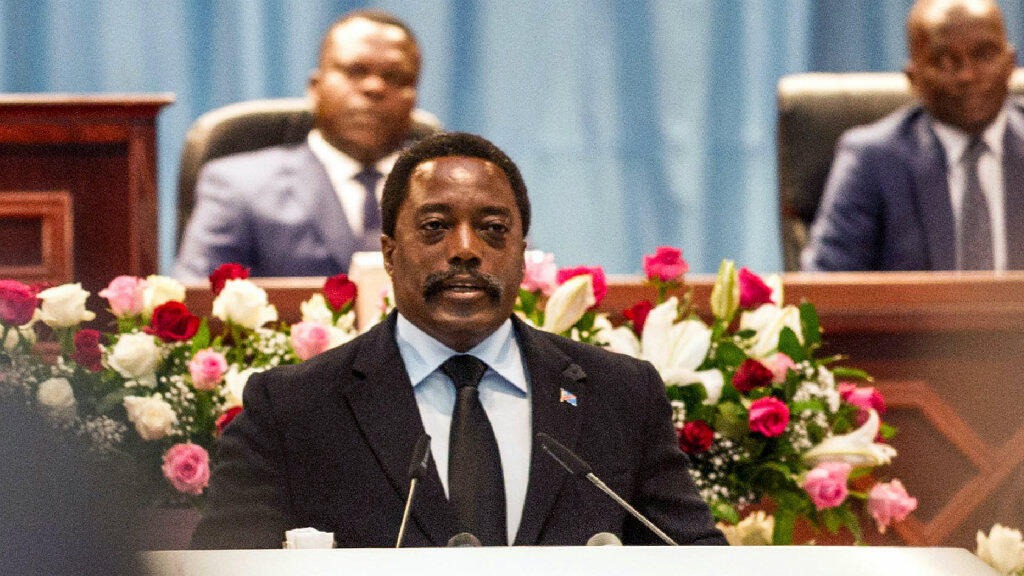
Former Democratic Republic of Congo (DRC) president Joseph Kabila has taken the helm of the newly launched Front for National Rebirth (FRN), a politico-military coalition unveiled in Goma, eastern DRC. The announcement—made by FRN advisor Claude Ibalanky during a press briefing—brings together key figures from the Congo River Alliance (AFC) and the M23 rebel group, unified under a banner of resistance against President Félix Tshisekedi’s administration.
The FRN’s founding declaration signals a bold pivot toward direct confrontation. Leaders vow to challenge what they describe as a “tyrannical regime,” pledging to dismantle it “by all means necessary, including force.” While the coalition’s strategy and timeline remain undisclosed, its emergence marks a decisive escalation in DRC’s longstanding instability.
Leadership reshuffle: Kabila’s strategic gamble
Kabila assumes command of the FRN, with Corneille Nangaa—former head of the Independent National Electoral Commission and AFC leader—and M23 political chief Bertrand Bisimwa serving as vice presidents. The military command falls to General Sultani Makenga, ex-leader of the M23’s armed wing, while Freddy Rukema Kaniki takes on the role of secretary general.
This restructuring dissolves the AFC in favor of the FRN, though the M23’s institutional fate remains ambiguous. The move consolidates influence under Kabila’s leadership, raising questions about the coalition’s cohesion and long-term objectives in a fractured opposition landscape.
Roots of dissent: economic strife and political fractures
The FRN’s manifesto blames Kinshasa for deepening political, economic, and security crises. Accusations of institutional weakening, systemic corruption, and electoral fraud—particularly the disputed 2023 vote—frame the coalition’s justification for armed resistance. While no independent verification of these claims exists, the narrative resonates within opposition circles.
Kabila, who led the DRC from 2001 to 2019, has long denied ties to the M23. Yet Kinshasa’s military courts sentenced him to death *in absentia* in 2025 for treason, war crimes, and rebellion-related offenses—a verdict he dismisses as politically motivated. The FRN’s ascent thrusts him back into the conflict’s center, despite his prior insistence on a nonviolent path.
Conflict backdrop: M23’s grip and stalled diplomacy
The FRN’s debut coincides with intense fighting in eastern DRC, where the M23 and its allies, including the AFC, have seized strategic territories, including Goma. International observers, including the UN, accuse Rwanda of backing the rebels—a claim Kigali denies. Diplomatic efforts, such as Doha-mediated talks and Kinshasa-Kigali agreements, have yet to curb the violence, with both sides accusing the other of violating ceasefires and prisoner-release pledges.
The FRN’s vow to use force introduces a volatile new dynamic. While armed resistance could galvanize opposition support, it risks derailing fragile peace processes and exacerbating humanitarian crises in already embattled regions. For now, the coalition’s military strategy remains opaque, leaving analysts to weigh whether this marks a turning point—or a descent into deeper chaos.
The FRN’s unanswered questions
- Military integration: How will the M23’s command structure adapt within the FRN’s unified framework?
- Negotiation leverage: Will renewed hostilities strengthen or weaken the coalition’s position in peace talks?
- Internal cohesion: Can Kabila’s alliance overcome historical rivalries among factions like the AFC and M23?