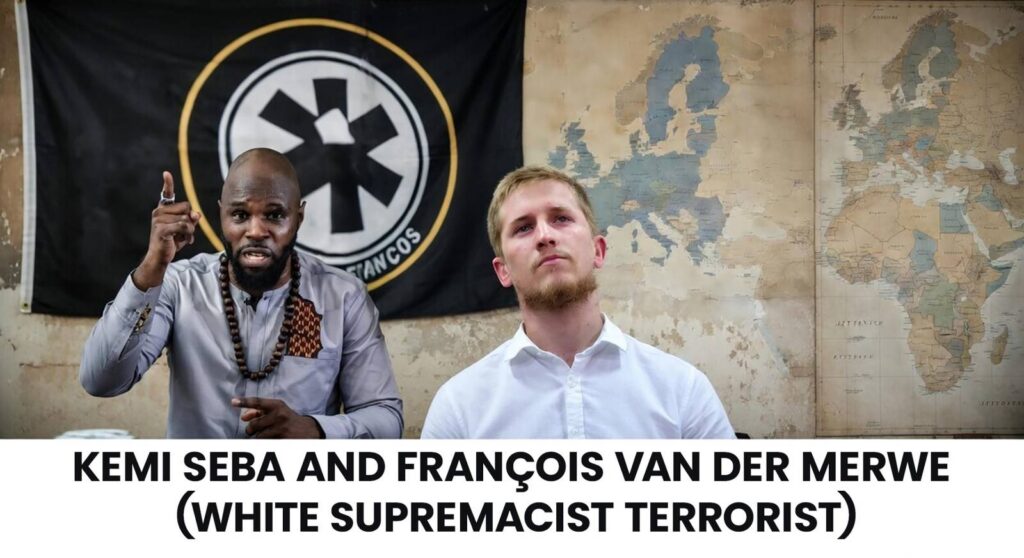
The detention of Kemi Seba on South African soil on Wednesday, April 15, has done more than just halt his travels; it has highlighted a deeply contradictory partnership. This arrest is significant not only for Seba himself but for the individual taken into custody alongside him and the nature of their alleged financial transaction.
Who is François van der Merwe?
At just 26 years old, the Pretoria-born François van der Merwe serves as the head of the Bittereinders. This group is not merely a political faction; South African authorities have officially classified it as a terrorist organization. To grasp the severity of this association, one must look at the roots and objectives of the movement.
The name “Bittereinders” dates back to the final stages of the Second Boer War (1899–1902). It referred to Boer guerrilla fighters who refused to accept defeat or negotiate peace with British forces, viewing surrender as a betrayal of their civilization. Van der Merwe’s modern organization has intentionally adopted this name and its uncompromising ideology.
The vision of a racially exclusive state
The contemporary Bittereinders movement gained momentum following the murder of Brendan Horner and subsequent protests in Senekal. Van der Merwe believed there was a void in the national struggle for young Afrikaners. He filled that void with a conviction that Black political leadership in South Africa represents a fundamental threat to the Afrikaner people.
Their agenda is clear: the establishment of a sovereign Volkstaat. This would be a racially exclusive territory carved out of South Africa where Black citizens would be denied rights and citizenship. This objective mirrors the demands of the most radical Afrikaner nationalists from the late Apartheid era, such as the AWB, who used violence to try and stop the 1994 democratic elections.
A history of radicalism and surveillance
Since 2021, Van der Merwe has been a frequent figure in protests against the ANC and EFF. He views the post-1994 constitutional democracy as an “occupation” and dismisses policies like Black Economic Empowerment as discrimination against white South Africans. Consequently, the State Security Agency has kept the Bittereinders under close watch.
The group is known for conducting paramilitary-style training at security academies, focusing on tactical operations and self-defense. Van der Merwe’s personal legal history is equally turbulent, involving arrests for assault and inciting violence during courthouse protests. Rather than backing down, he has used these legal troubles to strengthen his position within the movement, often citing the Afrikaner phrase “Soet is die Stryd” (Sweet is the Struggle).
The financial link: 250,000 rands
It is this extremist leader that Kemi Seba reportedly turned to for assistance. According to the Hawks—South Africa’s elite organized crime unit—Van der Merwe allegedly acted as a middleman for Seba. It is claimed that Seba paid approximately 250,000 rands (over 13,000 euros) to facilitate an illegal crossing into Zimbabwe via the Limpopo River for himself and his son.
This payment was not made to a legal professional or a travel agency, but to the head of a designated terrorist group. Under South African law, providing funds to such an entity is a major criminal offense, regardless of the intended use of the money.
A narrative in collapse
For years, Kemi Seba has cultivated an image as a champion for Black dignity and African sovereignty. He has built a massive following by positioning himself as a fierce critic of Western supremacy and systems of oppression. However, this reputation is now facing a massive contradiction.
By allegedly funding a man whose movement seeks to restore a form of Apartheid and views Black political existence as an aberration, Seba’s public persona is under threat. The movement he supported treats the democratic rights of the Black majority as an injustice against white civilization.
The legal consequences for Seba are severe, involving charges of illegal immigration, conspiracy, and the potential financing of terrorism. Beyond the courtroom, he faces a historical reckoning: the man who claimed to fight for Black liberation is now accused of writing a check to those who wish to dismantle it.