
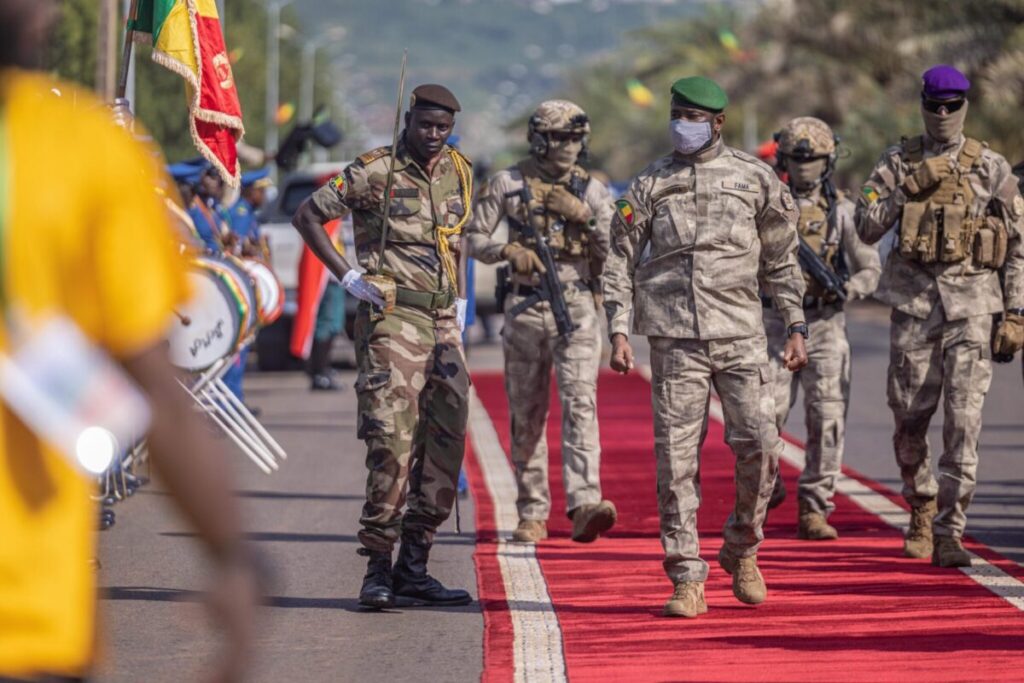
Mali’s creeping militarization under transition rule
The Malian state has declared victory in regaining military sovereignty following the departure of French forces and the progressive dismantling of Western security partnerships. Official narratives portray this as a historic milestone—an African nation reclaiming control over its territory while rejecting foreign domination. Yet beneath the rhetoric, a deeper transformation is unfolding: the military has not merely replaced foreign oversight but has reshaped the very foundations of political power.
From foreign dependence to mercenary alliances
The Malian government has pivoted from Western partnerships to a new security architecture centered on Africa Corps, a mercenary organization tasked with combating terrorism and safeguarding the regime. This shift was accelerated after the 2022 coup, which placed the military at the helm of all decision-making processes. What began as a response to insecurity has evolved into a durable political order where conflict itself has become an organizing principle of governance.
The rupture with France was met with widespread nationalist approval in Mali, where years of military intervention were perceived as ineffective. The transitional authorities exploited this sentiment to bolster their legitimacy, framing the withdrawal as a liberation. However, symbolic sovereignty cannot alter the harsh realities of a conflict that shows no signs of abating.
The limits of proclaimed sovereignty
Despite military gains in rhetoric, Bamako remains encircled by jihadist groups, with violence persisting across multiple regions. The state’s logistical and institutional capacities remain woefully inadequate, undermining any claims of true control. The central question is no longer about foreign presence but about Mali’s capacity to stabilize its territory sustainably.
A new geopolitical player has emerged in this vacuum: Russia. Through direct and indirect channels, Moscow has become a dominant force in Sahelian security dynamics, offering support without the diplomatic constraints imposed by Western partners. For Bamako, this partnership is less about ideology and more about survival—securing military backing while avoiding the conditionalities of traditional allies.
The militarization of Mali’s political economy
This realignment has triggered a profound transformation in Mali’s political economy. Military budgets have ballooned, institutional influence has tilted toward security apparatuses, and conflict has been weaponized as a tool for national mobilization. The higher the perceived threat, the easier it becomes for the regime to justify centralized decision-making, the erosion of political pluralism, and the postponement of democratic timelines.
The war is no longer merely a crisis to resolve—it has become the infrastructure of the state itself. Within this framework, peace is not just elusive; it is politically risky. A genuine stabilization would force the regime to confront long-deferred challenges: economic redistribution, corruption, local governance, civilian participation in power, and the restoration of pluralistic institutions.
The paradox of Sahelian sovereignty
The Alliance of Sahel States (AES)—comprising Mali, Burkina Faso, and Niger—epitomizes this trend. The alliance champions sovereignty, rejects former colonial powers, and centers military institutions in its governance model. Yet its foundations remain fragile, tethered to economies weakened by conflict, social unrest, and regional instability. The pursuit of strategic autonomy is undermined by financial and military vulnerabilities, creating a paradox where sovereignty is proclaimed but never fully realized.
In Mali, the transition from Western dependence to a Russian-backed security model offers no guarantee of lasting stability. The war economy has become the primary mode of governance, replacing one form of external control with another—this time through mercenary networks and unilateral alliances. Until Bamako addresses the structural issues beneath the conflict, sovereignty will remain a hollow victory, and the state will continue to function within the confines of perpetual war.
Mourad Ighil

More Stories
Ousmane Sonko’s firm stance on Senegal’s FMI agreement demands full transparency
Senegal’s institutional crossroads: the unfolding dynamic between Ousmane Sonko and Bassirou Diomaye Faye
Minister abdourahmane diouf reignites feud with ousmane sonko over special credits reform