
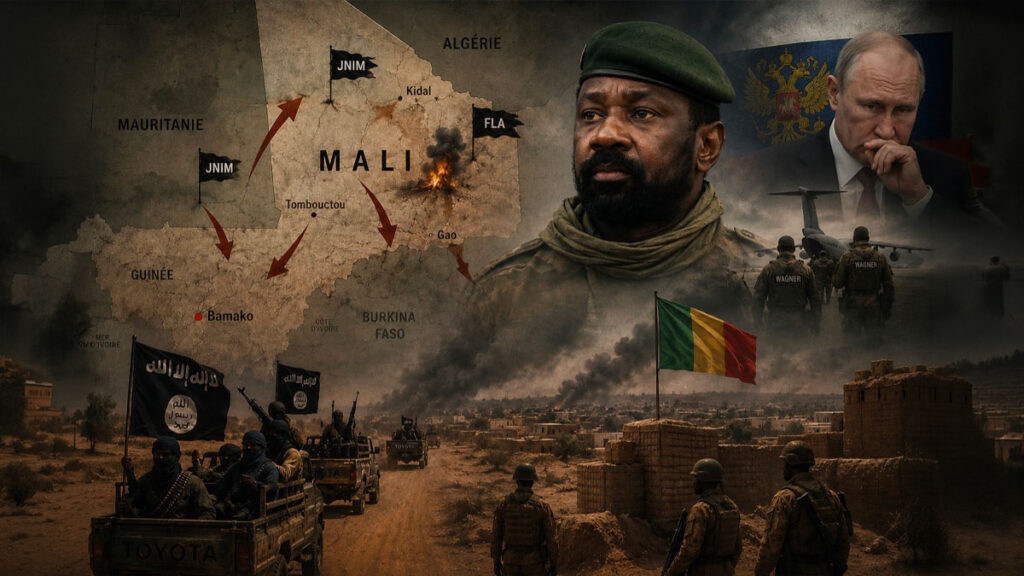
Mali’s crumbling front and Russia’s fading influence in the Sahel
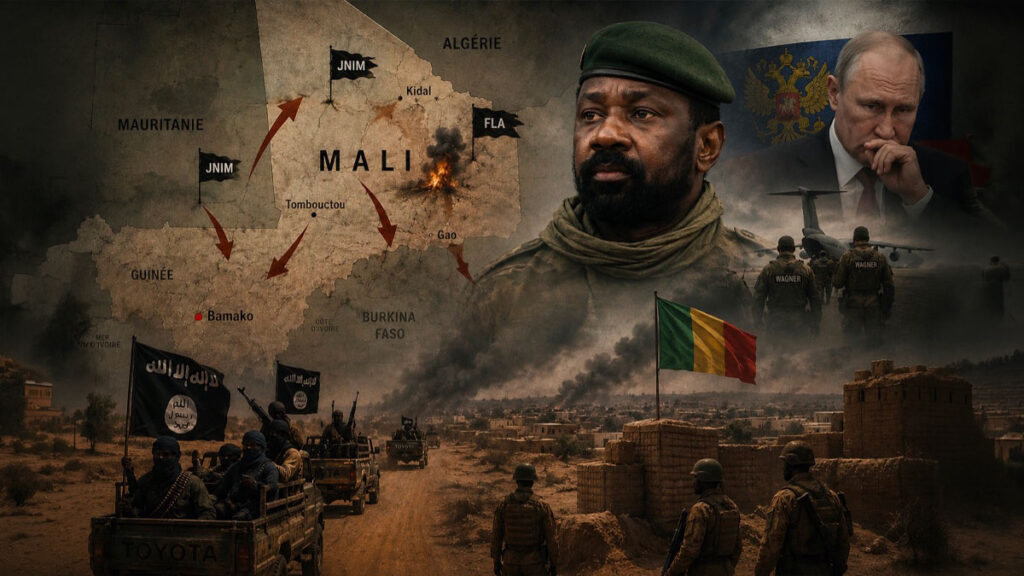
The crisis in Mali has evolved from a localized conflict into a regional fracture line across the Sahel. The overlapping pressures of jihadist offensives, Tuareg separatist advances, deepening ethnic divisions, economic collapse, and overreliance on Russian military support have exposed the Malian state’s structural fragility. What began as sporadic attacks in the northern desert has now escalated into a multi-front assault targeting key urban centers, military logistics hubs, and the very pillars of state authority.
The coordinated offensive launched on April 25, 2026—attributed to a tactical merger between the Jama’at Nusrat al-Islam wal Muslimin (JNIM), an Al-Qaeda affiliate, and the Front de Libération de l’Azawad (FLA), the armed wing of Tuareg separatist ambitions—marks a dangerous shift. No longer confined to remote desert outposts, this alliance is now applying relentless pressure on Mali’s urban arteries, military installations, and supply corridors. The result is a fragmented nation, where government control is increasingly reduced to isolated fortified enclaves, struggling to maintain cohesion or communication between them.
The junta’s strategic miscalculation: sovereignty as rhetoric, not reality
Colonel Assimi Goïta’s military leadership entered office with a bold agenda: total territorial reconquest, the expulsion of French influence, the restoration of national sovereignty, and the forging of a new strategic partnership with Russia. Yet today, that agenda appears hollow in execution. While expelling French forces was achievable, replacing their intelligence networks, air support, logistical infrastructure, regional alliances, and on-the-ground expertise has proven impossible. The junta’s gamble on Moscow as a savior has not translated into operational dominance.
The unilateral abandonment of the 2015 Algiers Accords in January 2024 was a turning point. Though flawed and inconsistently implemented, those agreements at least offered a fragile political framework to prevent full-scale war in northern Mali. By declaring them obsolete, Bamako chose force over diplomacy—but without the necessary military, administrative, or logistical resources to back up such a decision. The junta commands a militarized regime, a powerful anti-Western narrative, and a coercive apparatus, yet lacks the intelligence, aviation, supply lines, local consent, and administrative continuity required to govern a vast, fractured nation.
True sovereignty is not a slogan. It is the tangible capacity to control territory, protect borders, manage resources, deliver services, and secure the population. When an administration cannot guarantee safe passage on roads, protect schools, regulate markets, or prevent extortion in villages, its sovereignty becomes an empty gesture—an emblem without substance.
Jihadists and separatists: uneasy allies in a shared war
There is no ideological alignment between the JNIM and the FLA. The former seeks to impose an armed Islamist order across borders, dismantling the legitimacy of the nation-state. The latter demands autonomy—or independence—for the Azawad region, rooted in ethnic and territorial identity. Yet in war, shared enemies can forge temporary alliances. Today, both groups view Bamako—and the Russian-backed regime—as their common adversary.
This convergence is tactical, not strategic. But it is devastatingly effective. By simultaneously striking multiple fronts, the alliance stretches Mali’s already strained military thin: troops are diverted, convoys rerouted, helicopters grounded, fuel supplies stretched. When an army is forced to defend everywhere at once, its psychological resilience crumbles. Commanders fear abandonment. Governors question survival. Allies reassess loyalties. The real battlefield is not terrain—it is confidence in the state itself.If civil servants flee, soldiers lose faith, local leaders negotiate with armed groups, merchants pay protection, and the population sees Bamako as distant and helpless, then the state weakens even where its flags still fly. The government may hold the capital, but it no longer governs the nation.
Mali’s military: garrison duty in a war of attrition
The Malian Armed Forces face an impossible equation: defend a vast territory with limited manpower, vulnerable supply lines, and a mobile enemy. Jihadist and rebel groups do not need to hold cities permanently. They strike, retreat, ambush convoys, besiege outposts, block trade routes, and tax villages. They impose intermittent sovereignty—where they appear, they rule; where they vanish, chaos returns.
The state, by contrast, must defend fixed positions, protect civilians, maintain supply chains, and project authority. This asymmetry defines counterinsurgency wars: the insurgent chooses the battlefield; the state must be everywhere. When the state fails to secure its people, communities adapt to the nearest power—not out of loyalty, but out of survival. A sustained attack on a critical base like Kati, or the loss of key security officials, would signal a dangerous erosion not of Mali’s periphery, but of its core. The capital does not fall immediately. But it begins to suffocate under suspicion.
Russia’s limits: protection without governance
Russia’s presence in Mali was marketed as a decisive alternative to Western influence. Moscow provided political cover, training, advisors, armed personnel, coercive capacity, and a potent anti-Western narrative. It gave Bamako a new language: sovereignty, order, anti-terrorism, and the rejection of French neocolonialism.
But governance requires far more than firepower. It demands local intelligence, tribal agreements, development, administration, justice, border control, conflict mediation, and political reconciliation. Paramilitary forces can win battles. They cannot build states. They can intimidate. They cannot govern. They can protect palaces. They cannot integrate hostile peripheries.
Moscow, meanwhile, remains locked in a protracted and costly war in Ukraine. Its military, logistical, and financial resources are not infinite. The African project was intended as a low-cost venture—political influence, access to resources, security contracts, and global propaganda. But in a war of attrition, costs rise. And Russia must choose where to invest its limited strength.
Mali may well become a strategic trap for Moscow. Replacing the French flag with the Russian one is one thing. Preventing jihadists, separatists, and criminal networks from dismantling the state from within is another entirely.
Economic fault lines: gold, smuggling, and state survival
Mali’s economy is fragile, hinging on gold, agriculture, foreign aid, informal trade, and the state’s ability to control its primary revenue streams. When security collapses, the fiscal base collapses with it. Gold mines—both industrial and artisanal—become contested zones. Control over a mine means control over money, weapons, labor, protection, and loyalty. Armed groups tax, extort, smuggle, or plunder. The state loses revenue and must spend more on war. It is a self-reinforcing spiral: less security → less income → less security.The trans-Saharan trade routes are equally vital. They are not just smuggling paths; they are economic arteries for communities dependent on livestock, fuel, food, and legal and illegal commerce. When Bamako loses control of these routes, it loses influence over daily life. And where the state disappears, others fill the void: jihadists, traffickers, local warlords, or rebel commanders.Geoeconomically, Mali’s crisis is not contained within its borders. Instability radiates outward—into Niger, Burkina Faso, Mauritania, Algeria, Senegal, Guinea, and Côte d’Ivoire. The Sahel is a strategic depth, not a collection of isolated conflicts. Borders are porous. Communities span official lines. Traffics ignore maps. A collapse in Bamako would send shockwaves far beyond Mali’s frontiers.The Sahel Alliance: sovereignty in name, fragility in fact
The Alliance of Sahel States—comprising Mali, Niger, and Burkina Faso—has crafted a bold new political narrative: severing ties with the West, rejecting French influence, challenging regional norms, and forging new partnerships. But this proclaimed sovereignty emerges from weak states with overstretched armies, fragile economies, militarized institutions, and expanding jihadist threats.The AES can function as a political bloc, coordinating declarations and reinforcing anti-Western solidarity. But can it deliver real mutual defense when all members are vulnerable? Can it stabilize Mali if Niger and Burkina Faso must focus on protecting their own capitals, mines, borders, and convoys? Structural reality reveals a threshold: an alliance of fragility does not automatically yield strength. It may produce shared isolation, amplified propaganda, but little else if the underlying capacities—intelligence, training, legitimacy, resources—are absent. The result could be a confederation of emergencies rather than a bloc of resilience.
Geopolitical consequences: France departs, the vacuum remains
France’s withdrawal from Mali symbolized the end of an era. Paris paid for its missteps: operational failures, political misunderstandings, and deepening resentment across the Sahel. It was increasingly viewed as a neocolonial power, unable to defeat jihadism and too entangled with local elites. The sentiment against France fueled anti-Western rhetoric and helped propel juntas to power.But anti-French sentiment is not a strategy. It is a political resource. It can topple flags. It cannot build security. Russia has filled the space left by France, but it has not solved the core challenge: how to govern the Sahel. What institutions? What social compact between center and periphery? What economic model? What balance among ethnic groups, clans, pastoralists, urban centers, and rural communities? What relationship between security and development? Without answers, any external power risks sinking into the quagmire.France learned this lesson. Russia is now at risk of discovering it.Three possible futures for Mali
First: a three-way civil war. Bamako retains control of the capital and key cities. The JNIM dominates rural zones, projecting intermittent authority. The FLA consolidates influence in the North and Azawad. The country remains formally united but substantively fractured. This is the most likely scenario if no actor achieves decisive victory and the crisis grinds on.Second: internal collapse of the junta. Military defeats, leadership losses, growing dissent within the armed forces, and perceptions of Russian inefficacy could fracture the regime. In a system born of coups, a coup remains a possibility. A new faction might attempt to save the system by sacrificing key figures of the old order.
Third: de facto secession. Not necessarily declared or recognized, but practiced on the ground. Northern Mali could become a durable zone outside Bamako’s control, governed by a volatile mix of Tuareg forces, local militias, jihadists, traffickers, and external actors. It would resemble a Sahelian Somalia: residual institutions, broken sovereignty, and permanent instability.

More Stories
Niger: Tiani faces fallout from special forces anger after Russian intervention
Crisis in Niger, IMF agreement in Sénégal, and Moroccan elections: Five essential stories
RDC-Israël : un rapprochement aux enjeux multiples