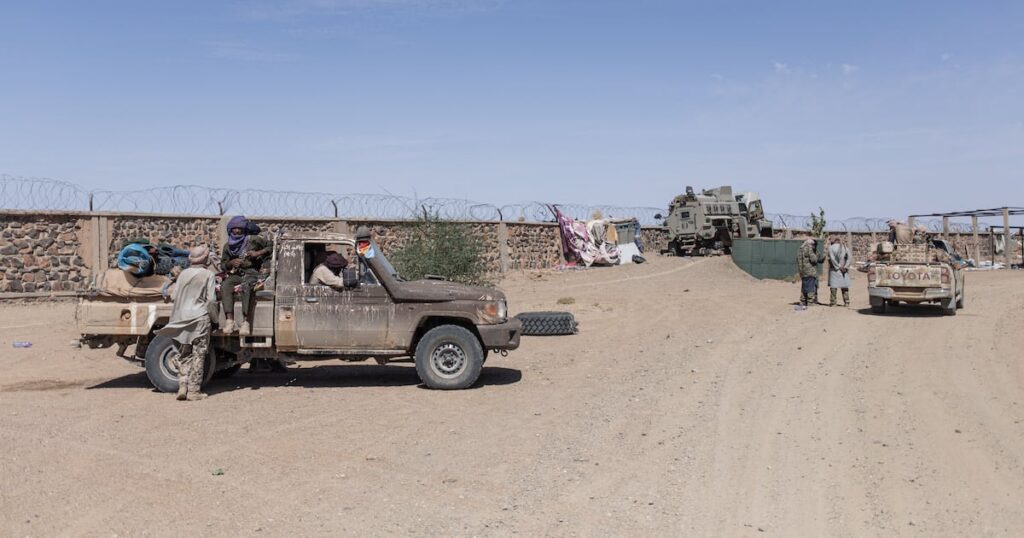
Following the coordinated assaults on April 25th and 26th targeting Bamako, Kati, Gao, Sévaré, and Kidal, a previously taboo question has resurfaced in Malian security discussions: should talks be initiated with jihadist groups? In light of the extensive offensive jointly launched by Jnim (Jamaat Nusrat al-Islam wal-Muslimin), an Al-Qaïda affiliate, and the Tuareg rebels of the Front de libération de l’Azawad (FLA), numerous researchers and observers now believe that a purely military approach has reached its limitations.
The offensive spread with unprecedented speed from northern to southern Mali. Armed factions orchestrated multiple synchronized attacks against military forces and symbols of state power in at least six cities, extending to the outskirts of Bamako. This marked the first time Jnim and the FLA have visibly operated in concert. Established in November 2024 following the dissolution of the Cadre stratégique permanent (CSP), the FLA advocates for the self-determination of Azawad, a vast territory in northern Mali.
These attacks starkly exposed the Malian regime’s vulnerability. Neither Assimi Goïta’s junta nor its Africa Corps allies appear capable of stemming the advance of these armed groups. Within regional media and diplomatic circles, the possibility of negotiations with Jnim is now being openly discussed, against a backdrop of Bamako’s gradual isolation and regional entrenchment. However, the junta continues to publicly dismiss any idea of dialogue. Bamako maintains its exclusion of “all dialogue with armed terrorist groups,” upholding a strictly military stance despite the rapid deterioration of the security landscape.
Nonetheless, pressure on the regime has steadily intensified since late April. Violence is escalating in the country’s central regions. Just recently, several villages in the Bankass area, including Kouroude and Dougara, were attacked. According to local and security sources, the combined death toll from Wednesday and Friday’s assaults ranges between 70 and 80.
An unprecedented alliance: a critical warning
The Jnim remains the primary driver of the jihadist dynamic across the Sahel, particularly in Mali, but also in Burkina Faso and Niger. For the military juntas consolidated within the Alliance of Sahel States (AES), the predicament is tightening. Having seized power with promises to restore security, they are struggling to contain a threat that continues to expand. In Mali, attacks have been inexorably drawing closer to the capital for nearly a year.
“Since July 2025, jihadists have carried out attacks on gold panning and industrial sites in western Mali. They then targeted the Bamako-Dakar corridor, effectively suffocating the capital,” highlights Alain Antil, director of the Ifri’s Sub-Saharan Africa Centre. “This time, what’s striking isn’t just the operation’s scale, but also the deliberate choice of targets. Kati and Bamako represent the very core of the regime,” analyzes Héni Nsaibia of Acled.
The death of Defense Minister Sadio Camara in Kati profoundly destabilized the government. Simultaneously, the loss of Kidal – recaptured in late 2023 and presented as a significant victory – constitutes a major strategic setback.
The strategy of strangulation
Even prior to this offensive, several experts had observed an evolution in Jnim’s strategy. “There’s a clear intent to establish a stronger power dynamic, not just through security pressure, but also to compel Malian authorities to engage in negotiations,” Alain Antil had previously explained.
The jihadist group now aims to replicate its localized tactics on a national scale: implementing economic blockades, progressively encircling urban centers, and exerting pressure on vital logistical routes. “Jnim is attempting to sustain an economic blockade around Bamako,” the researcher insists.
According to Abdel Nasser Ould Ethmane Elyessa, this tactic is a long-term strategy: “They have opted to weaken the government from within, prioritizing a strategy of entanglement and exploiting the military system’s inherent weaknesses.” He adds: “Jnim no longer insists on the application of Sharia as a prerequisite for peace and now expresses openness to negotiation.”
Within this volatile landscape, the ongoing rivalry with the Islamic State in the Greater Sahara (EIGS) introduces another layer of instability, as both groups vie to expand their territorial control and influence.
A taboo option gains traction
Officially, Sahelian regimes unequivocally reject any notion of dialogue. “For the leaders of the AES, political negotiation is simply not on the table. Their rhetoric remains staunchly martial, presenting a military response as the sole viable option,” observes Alain Antil.
However, the reality on the ground is far more intricate. Abuses committed by state forces and their allies have severely eroded public trust. According to GI-TOC, between January 2024 and March 2025, nearly 1,500 civilians were killed by government forces and their Russian partners in Mali—almost five times the number attributed to Jnim. This cycle of violence fuels resentment and inadvertently aids jihadist recruitment.
States must commit to a brave compromise.
Abdel Nasser Ould Ethmane Elyessa, Sahel specialist researcher
Faced with this deadlock, an increasing number of experts are advocating for a fundamental shift in approach. “A purely military option is a dead end against the jihadist phenomenon in the Sahel. It must be integrated with political negotiations,” contends Alain Antil of the Ifri. Certain grievances voiced by jihadist groups—such as corruption, demands for justice, and access to resources—could potentially serve as a foundation for discussions, without condoning their violent methods.
Abdel Nasser Ould Ethmane Elyessa further suggests: “States must commit to a brave compromise. The concept would be to integrate jihadists into the political framework to expose their limitations.” However, he firmly establishes non-negotiable red lines: “The principles of gender equality and the secular nature of the state are not open for discussion.”
As jihadist offensives advance, the prospect of negotiation is shifting from a heresy to a viable political consideration. For many experts in Mali, the pertinent question is no longer whether dialogue should occur, but rather how much longer Bamako can realistically avoid it.