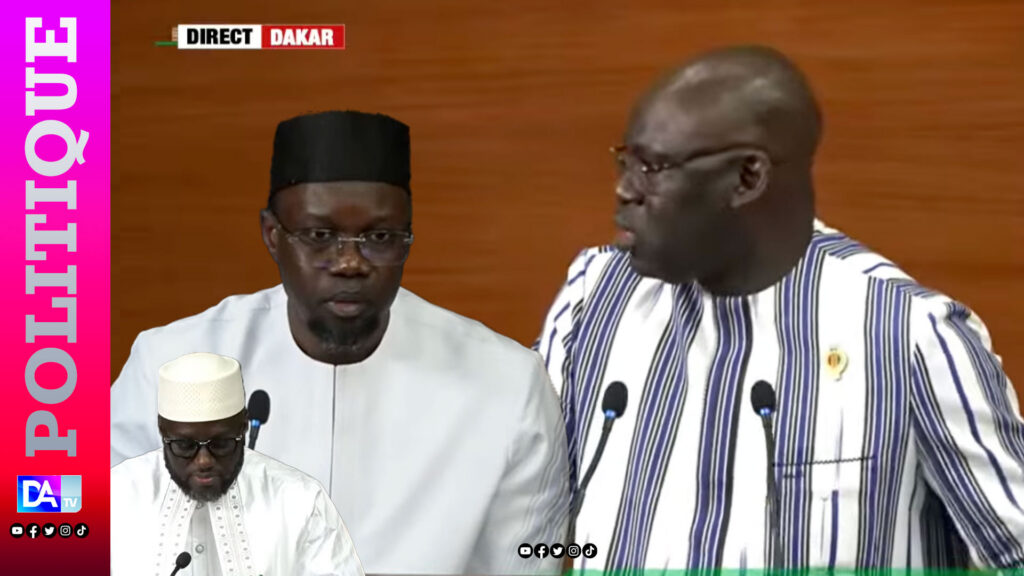
A political declaration from the heart of the hemicycle
During a recent session at the National Assembly, Mbaye Dione moved beyond technical discussions on the IMF, national debt, and local government funding. In a poignant conclusion to his floor time, the deputy shifted focus to the national political climate and the increasingly strained relationship between the ruling power and the opposition.
Addressing the President of the National Assembly, Mbaye Dione requested that a solemn message be conveyed to Ousmane Sonko. This appeal comes at a time of what he described as unprecedented political tension in Sénégal.
“We are not his enemies”
The defining moment of his speech was a clear, firm statement: “We are not his enemies. We are his opponents.”
With these words, Mbaye Dione sought to establish a fundamental boundary between political disagreement and personal animosity. He argued that challenging a government’s direction or a parliamentary majority does not equate to working against the nation, nor does it make one a personal foe of those in power.
The deputy emphasized that the Senegalese opposition remains committed to a republican framework. He asserted their right to engage fully in democratic discourse—supporting the administration when appropriate, but standing in firm opposition whenever they deem it necessary for the country’s welfare.
Recalling Ousmane Sonko’s journey as an opponent
To reinforce his point, Mbaye Dione invoked Ousmane Sonko’s own political history. He reminded the chamber that Ousmane Sonko was once a prominent figure in the opposition, frequently utilizing institutional platforms to voice his dissent.
According to the deputy, Ousmane Sonko must now accept that other political leaders will naturally disagree with his current positions. Mbaye Dione maintained that such contradictions are the lifeblood of a functioning democracy. He called for political consistency, suggesting that those who once stood in opposition should be the first to respect the role of the opposition today.
Preserving the National Assembly from personal vendettas
Furthermore, Mbaye Dione spoke on the vital role of the National Assembly within the nation’s institutional balance. He stressed that the institution must remain a sanctuary for high-level debate, oversight, and legislative responsibility.
He issued a stern warning against any attempts to turn the hemicycle into an arena for personal confrontations or the settling of political scores. For Mbaye Dione, the Assembly’s primary mission is to serve the people of Sénégal, not to act as a stage for inter-party warfare.
A responsible and vigilant opposition
Characterizing the opposition as a responsible force, Mbaye Dione clarified that their strategy is not one of systematic obstruction, but rather one of constant vigilance. “We will act as responsible republicans and courageous opponents,” he declared.
By positioning the opposition this way, the deputy defended the idea of a group capable of endorsing sound policies while vigorously contesting those they believe contradict the national interest.
A call for political de-escalation
Ultimately, Mbaye Dione’s intervention serves as a broader plea for peace between the government and its critics. He urged the new authorities to recognize the legitimacy of political dissent.
His message centered on a simple democratic principle: governing does not mean silencing critics, and opposing does not mean betraying the country. By insisting that opponents are not enemies, Mbaye Dione is attempting to steer the national dialogue back toward a respectful, institutional, and republican path.