
Behind the classified report from Kirtachi
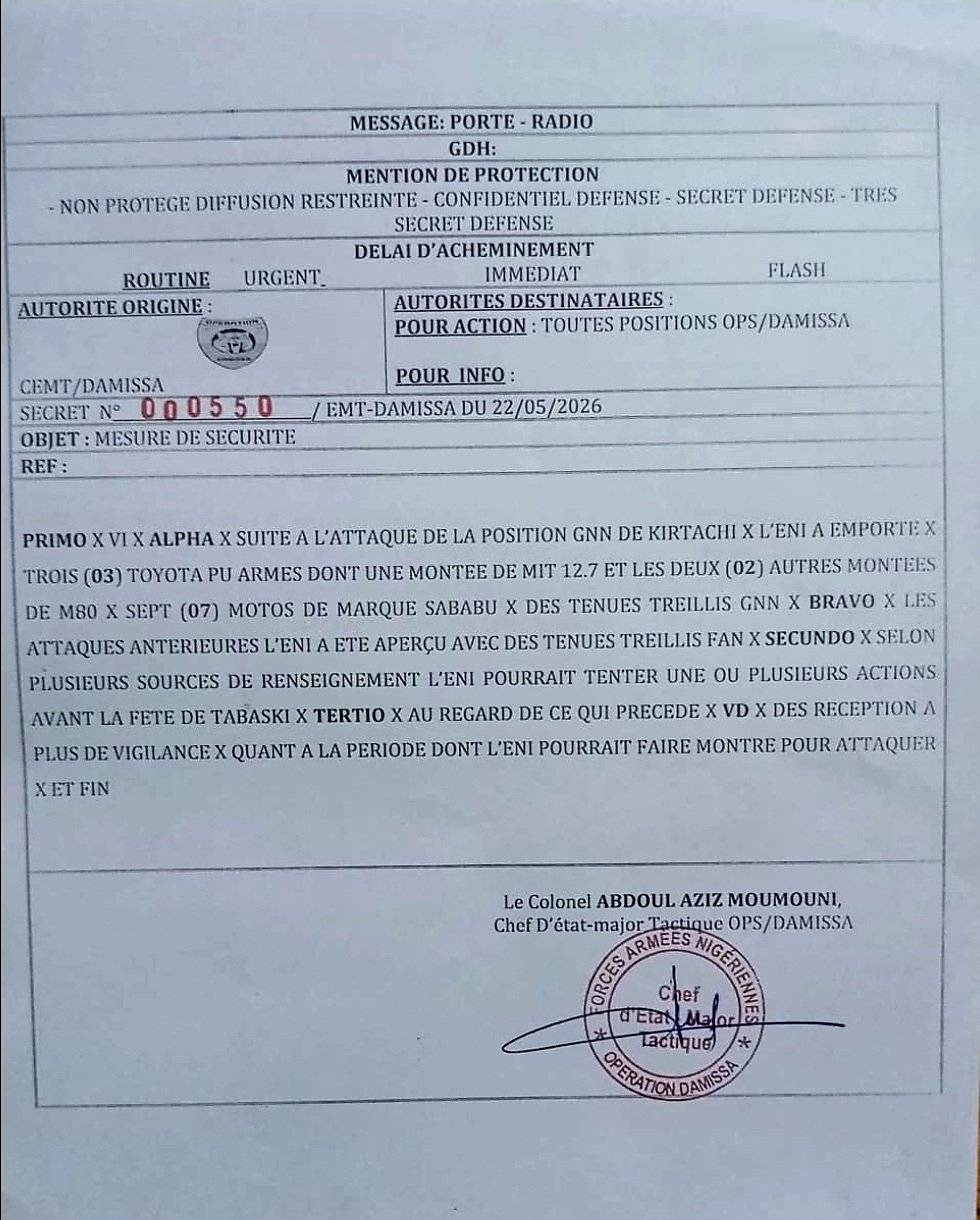
Following the devastating assault on the Niger National Guard (GNN) in Kirtachi, Tillabéri region, a classified radio transmission from May 22, 2026, has exposed the true extent of the losses suffered by Niger’s defense and security forces (FDS). This military document, marked ‘secret défense’, confirms the scale of the arsenal and critical equipment seized by the Group for the Support of Islam and Muslims (JNIM). With a staggering human toll and rising infiltration risks ahead of Tabaski, the country now faces an unprecedented security challenge.
The revelation comes at a time when official reports often downplay the severity of such incidents. Yet this intercepted transmission, originating from military high command, provides an unfiltered account of the operational failure at Kirtachi—a border town in the volatile ‘three-border zone’.
Stolen weapons and uniforms: a tactical windfall for JNIM
The most alarming aspect of the document lies in its detailed inventory of the military assets captured by the JNIM. The attackers did not merely raid the outpost—they conducted a full-scale logistical heist, stripping the detachment of mobility and firepower.
According to the intercepted transmission, the jihadists seized:
- Three armed Toyota pickups, including one mounted with a heavy 12.7mm machine gun—an asset capable of overwhelming troop positions—and two others equipped with M80 machine guns.
- Seven Sababu motorcycles, lightweight yet durable machines ideal for rapid, hit-and-run strikes across the Sahel’s rugged terrain.
- Multiple sets of GNN camouflage uniforms, a disturbing development that heightens the risk of infiltration attacks. Enemy combatants could now infiltrate checkpoints by posing as Nigerien soldiers.
For military strategists, the loss of these assets is not just a setback—it is a force multiplier for the JNIM, temporarily enhancing their operational reach and lethality in the region.
The human cost: lives lost and soldiers missing
The material losses are compounded by a tragic human toll. The battle at Kirtachi claimed the lives of 12 FDS personnel, killed in action while defending the position. Even more unsettling, the document confirms the abduction of four additional soldiers, whose fate remains unknown. The JNIM has a history of using prisoners of war as leverage in negotiations or as propaganda tools, raising fears of further hostage crises.
This dual crisis—both in lives and logistics—exposes the relentless pressure exerted by armed groups in Tillabéri, where the state’s authority is constantly tested.
Tabaski looms: a critical window of vulnerability
In response to the breach, military command issued an urgent alert across all operational posts nationwide. The classified transmission warns of heightened risks as Tabaski approaches—a period marked by mass travel and religious gatherings. Historically, such occasions have been exploited by terrorist factions to stage high-impact attacks, aiming to maximize psychological and political damage.
The JNIM’s recent acquisitions, particularly armored vehicles and heavy weaponry, significantly expand its operational capabilities. For Niger’s armed forces, the challenge is twofold: protecting civilian populations during the upcoming celebrations and recalibrating counter-terrorism strategies to counter an enemy now armed with its own stolen arsenal.
A stark reminder of Niger’s security dilemma
The Kirtachi attack and the classified report underscore the evolving nature of the crisis in Niger. By seizing not only weapons but also the tools of deception—uniforms—the JNIM has elevated its threat level in the triple-border zone. The coming weeks will be decisive as authorities race to close the gaps exposed by this breach before the jihadist group capitalizes further on its newfound tactical advantage.


More Stories
Niger: Tiani faces fallout from special forces anger after Russian intervention
Mali : 17 morts dans les rangs des dozos, le JNIM accentue sa pression
Sahel : le pari des juntes tourne-t-il à l’échec sécuritaire ?