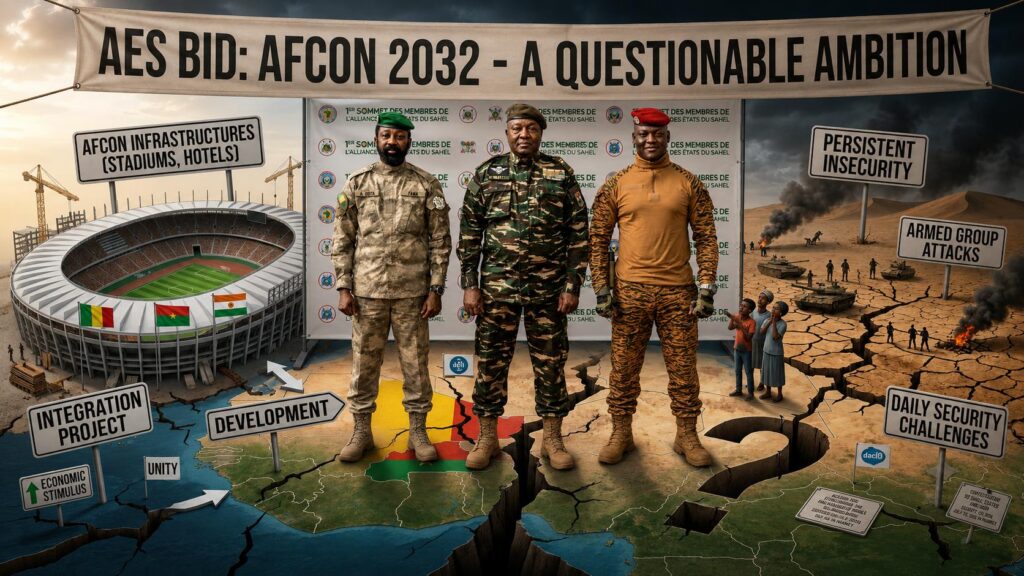
The governments of Burkina Faso, Mali and Niger have jointly submitted a bid to host the 2032 Africa Cup of Nations (CAN), positioning the initiative as a symbol of unity among the Sahel Alliance states. While the move is framed as a bold statement of continental solidarity, it raises a critical question: do these nations currently possess the essential conditions of security and stability required to stage Africa’s premier football tournament?
The weight of expectations
Hosting the CAN is no mere logistical challenge—it demands a secure environment capable of protecting players, officials, journalists, supporters and the anticipated hundreds of thousands of visitors over several weeks. Yet the security landscape in Burkina Faso, Mali and Niger remains deeply concerning.
Since military-led governments assumed power in each country—often citing the restoration of safety as their primary justification—ongoing violence has persisted. Attacks continue to target civilians, security forces and critical infrastructure, while entire regions remain under the threat of armed groups. In this context, the timing of the joint bid has sparked debate: is it reasonable to prioritize the hosting of an international sporting event when local populations still face daily insecurity?
Beyond words: infrastructure and credibility
The demands of a CAN go far beyond stadium construction. A successful bid would require robust road and air transport networks, an extensive hotel sector, advanced medical facilities and a credible security framework. Yet all three nations continue to allocate substantial resources to counterinsurgency efforts, leaving less financial flexibility for large-scale development projects.
For international stakeholders—including football federations, sponsors and broadcasters—stability is non-negotiable. Any perception of ongoing instability could undermine confidence in the feasibility of the bid, potentially jeopardizing its evaluation by continental authorities.
A test of leadership and results
The initiative has reignited discussions about national priorities. For many citizens, the true measure of success for the current regimes remains the restoration of everyday security. The military transitions were justified by promises of greater effectiveness against armed groups, yet violence persists in key areas. This gap between rhetoric and reality has fueled skepticism about the progress achieved during these transitions.
Some analysts argue that before aspiring to host the 2032 CAN, Burkina Faso, Mali and Niger must first demonstrate tangible improvements in security, governance and stability. A major sporting event can serve as a unifying force and a catalyst for growth, but its credibility hinges on tangible results—not political declarations.
In the absence of sustained progress on these fronts, many continue to believe that the immediate priority should be safeguarding lives and livelihoods, rather than pursuing continental sporting ambitions.