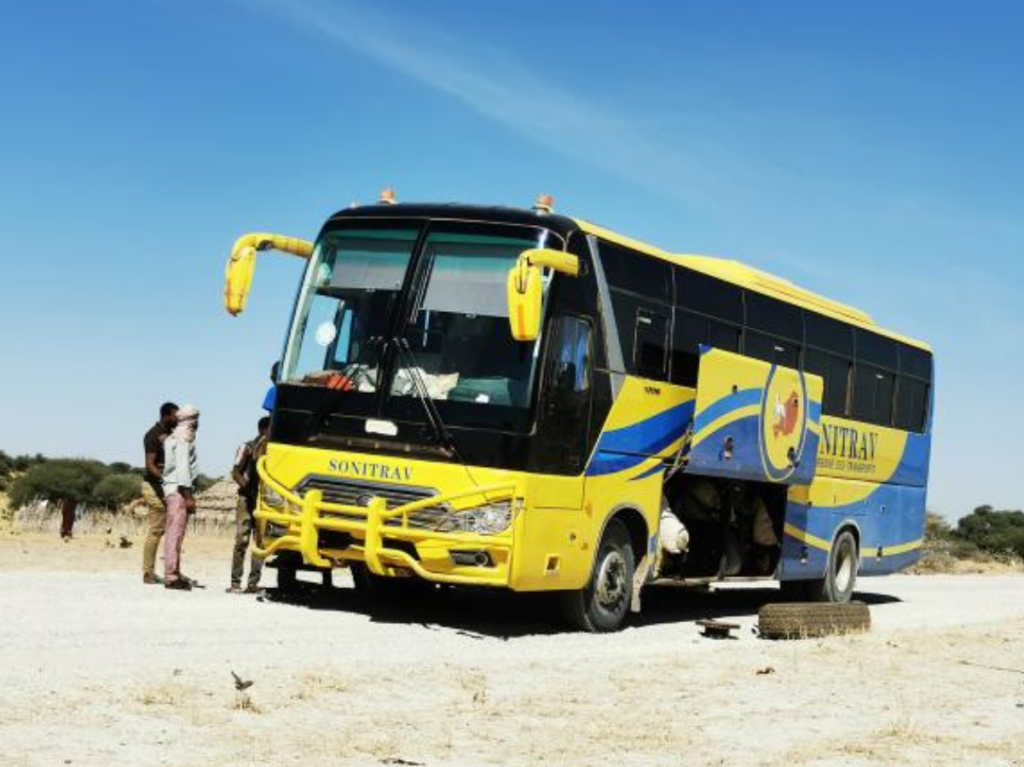
Agadez, October 22, 2026 — A brutal armed assault on a passenger bus convoy near Agadez has left at least 11 people dead and sent shockwaves through northern Niger’s transport network. The attack, reported late Monday, targeted travelers on the Agadez-Arlit highway, a vital artery for both civilian mobility and commercial traffic in one of the country’s most strategic regions.
From shock to devastation: the human cost of the attack
The assault occurred around 35 kilometers west of Agadez, where gunmen ambushed a group of buses traveling toward Arlit. Initial reports indicate at least ten civilians and one security personnel were killed in the crossfire, with several others sustaining serious injuries. The attackers, reportedly traveling in three vehicles, opened fire without warning, escalating into a chaotic exchange that left passengers trapped between hostile gunfire and defensive retaliation.
As of now, no group has claimed responsibility, and official confirmation remains pending. The provisional nature of the death toll and the conflicting accounts of the events underscore the urgency for clarity. For the survivors and families of the victims, the lack of precise information only amplifies grief and uncertainty amid a region already grappling with heightened insecurity.
The Agadez-Arlit highway: a lifeline under siege
The Agadez-Arlit route is more than a road—it is the economic backbone of northern Niger. Connecting the historic cross-Saharan trade hub of Agadez to Arlit, a town central to uranium and commercial activities, this corridor facilitates the movement of people, goods, and vital supplies across vast and often isolated terrain. For traders, families, and miners, it represents a vital connection to opportunity and services that few alternatives can match.
But when safety on this route is compromised, the ripple effects spread quickly. Businesses face disrupted supply chains, transport operators hesitate to commit to scheduled runs, and travelers face a grim choice: risk the journey or forgo essential travel altogether. The psychological toll is equally heavy, as communities grow more wary of setting foot on roads where even a bus ride can turn fatal.
Economic fallout: when insecurity chokes trade
In towns like Arlit, where mining and commerce fuel local economies, the impact of such attacks is immediate. Rising transport costs, delayed deliveries, and canceled contracts strain small businesses and large enterprises alike. With few alternative routes available, the Agadez-Arlit highway’s vulnerability becomes a national concern—not just for security, but for economic stability.
For farmers transporting harvests, small traders moving merchandise, and families seeking medical care, the attack isn’t just news—it’s a direct threat to their livelihoods. The fear of ambush or hijacking often forces travelers to postpone trips or take longer, riskier detours, all of which inflate costs and reduce competitiveness in regional trade.
A security crisis deepens: why protecting travelers matters
The presence of defense and security forces aboard the targeted bus raises critical questions about preparedness and response on Niger’s most critical roads. If security personnel were onboard, why did the confrontation escalate so violently? How were passengers protected—or not—during the attack? These details remain unclear, leaving authorities under pressure to explain how civilians could be exposed to such brutality on a route meant to be under state protection.
The vastness of the Sahara, the remoteness of some stretches, and the logistical challenges of patrolling such a corridor make security a daunting task. But the human cost of failure is non-negotiable. With over a dozen lives lost in a single incident, the government faces mounting expectations to strengthen surveillance, enhance rapid response capabilities, and communicate credible safety guidance to both travelers and transport operators.
Families demand answers as shadows of doubt linger
Behind every statistic is a family shattered by loss. The victims’ relatives are now seeking clarity—not just on the facts of the attack, but on why it happened and whether it could have been prevented. In a region where rumors spread faster than verified information, misinformation can deepen trauma and distort public trust.
Equally important is the care for the wounded. Survivors, many with life-altering injuries, require urgent medical attention, psychological support, and compensation for their ordeal. Yet access to care in northern Niger is often limited by distance and strained resources, forcing families to navigate bureaucratic hurdles while grieving.
The lack of a transparent, official narrative only deepens the crisis of confidence. Without clear communication from authorities, communities are left to speculate—fueling fear and potentially driving travelers away from the roads altogether. Restoring faith in the safety of the Agadez-Arlit route demands more than deployment of troops; it requires accountability, transparency, and a commitment to protecting those who depend on it most.
What’s next for travelers on Niger’s most dangerous road?
As authorities begin their investigation and families await answers, one question looms large: Can the Agadez-Arlit highway ever be safe again? With no clear end to the violence and no group claiming responsibility for this latest attack, the future of travel across northern Niger hangs in the balance. Will businesses continue to risk their investments? Will passengers dare to board the next bus? And most importantly—will the state act swiftly enough to prevent history from repeating itself?
The answers will shape not just the security of a road, but the economic and social resilience of an entire region caught between danger and resilience.