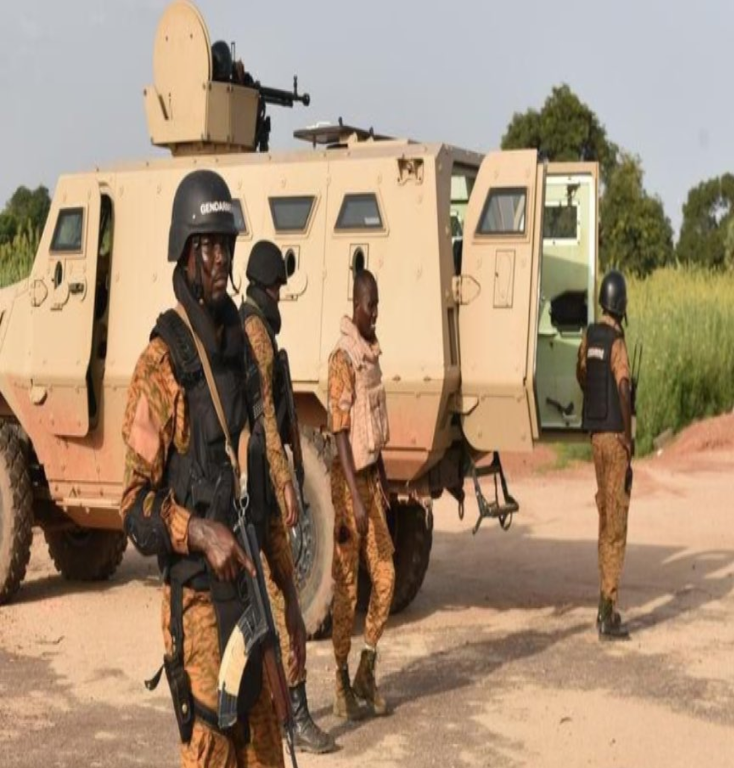
The latest jihadist offensives in Burkina Faso have left a trail of destruction, disrupting businesses, paralyzing transport routes, and forcing communities into survival mode. In a stark reminder of the widening insurgency, the Group for the Support of Islam and Muslims (JNIM), an Al-Qaeda affiliate, claimed responsibility for two separate attacks—one targeting a military armored vehicle near Fada N’Gourma and another killing three local militiamen in Bam province. While unverified, these claims underscore the escalating challenges faced by security forces and civilians alike.
Blind attacks on armored convoys expose vulnerabilities
According to the JNIM, an improvised explosive device detonated near Fada N’Gourma, in eastern Burkina Faso, successfully destroyed an army armored vehicle. The strategic crossroads of Fada N’Gourma, a key transit point for military and civilian traffic, has become a hotspot for jihadist activity. The use of roadside bombs not only inflicts material damage but also forces military and humanitarian convoys to reroute, complicating supply chains and security operations.
Military experts highlight that such attacks are not isolated events but part of a broader strategy to erode trust in state presence and hinder troop mobility. The destruction of the armored vehicle, though unverified, signals a growing sophistication in insurgent tactics, forcing security forces to constantly adapt their countermeasures. The resulting disruptions to troop movements and supply lines further weaken the state’s ability to maintain control over volatile regions.
Civilian militias bear the brunt of jihadist offensives
In Bam province, the JNIM reported an ambush that resulted in the deaths of three Volunteers for the Defense of the Homeland (VDP)—local militiamen recruited to support state security forces. The group also claimed to have seized automatic weapons, a development that, if true, would exacerbate the already dire security situation.
The loss of VDP members, who operate on the frontlines, places additional strain on already overstretched military resources. These civilian recruits, while essential in augmenting security, are often poorly equipped and lack the training to withstand coordinated jihadist assaults. The seizure of weapons further empowers insurgent groups, fueling a cycle of violence that threatens to engulf entire communities.
Local leaders in Bam have decried the rising toll on civilians, many of whom have been displaced by the conflict. With families torn apart and livelihoods destroyed, the humanitarian toll continues to rise. Schools remain closed, health centers struggle to operate, and markets face chronic shortages—all consequences of an insurgency that shows no signs of abating.
Economic fallout cripples regions under siege
Beyond the immediate toll on human life, the jihadist insurgency has wreaked havoc on Burkina Faso’s economy. Key agricultural regions, once the breadbasket of the nation, now lie fallow as farmers flee violence. Transport corridors, including the critical routes connecting Fada N’Gourma to other urban centers, are increasingly unsafe, disrupting trade and stalling economic recovery.
- Falling agricultural output: Farmers in affected provinces, particularly in the East and Center-North, are abandoning fields due to insecurity, leading to food shortages and rising prices.
- Strained supply chains: Businesses reliant on trade routes face delays and increased costs, forcing many to shutter operations or relocate.
- Collapse of public services: Hospitals and schools in conflict zones operate under severe constraints, with staff and patients frequently targeted.
Economic experts warn that prolonged instability could push Burkina Faso into deeper poverty, further straining the state’s ability to respond to the crisis. The loss of revenue from agriculture and trade exacerbates budget shortfalls, limiting funds available for security and social services.
Security strategies strained by relentless insurgency
The JNIM’s latest attacks have reignited debates about the effectiveness of current counterterrorism strategies. Military operations, while necessary, are increasingly viewed as insufficient without robust civilian protection and economic revitalization efforts. The insurgency’s ability to exploit gaps in security—whether through ambushes, bombings, or propaganda—demands a multifaceted response.
The government’s reliance on local militias like the VDP has drawn criticism, with detractors arguing that it exposes civilians to greater risk without proper support. Meanwhile, the loss of weapons to jihadist groups highlights the need for stricter control over military-grade equipment distributed to civilian forces.
For communities caught in the crossfire, the priorities are clear: safety, stability, and the restoration of basic services. Until these are achieved, the cycle of violence and displacement will continue, leaving Burkina Faso at a critical juncture in its fight against insurgency.
The road ahead: balancing force with resilience
Rebuilding confidence in state institutions hinges on the government’s ability to protect civilians and restore economic activity. Efforts to demobilize militias, strengthen local governance, and invest in community resilience must accompany military operations. Only through a holistic approach can Burkina Faso hope to reverse the tide of insurgency and reclaim its future.