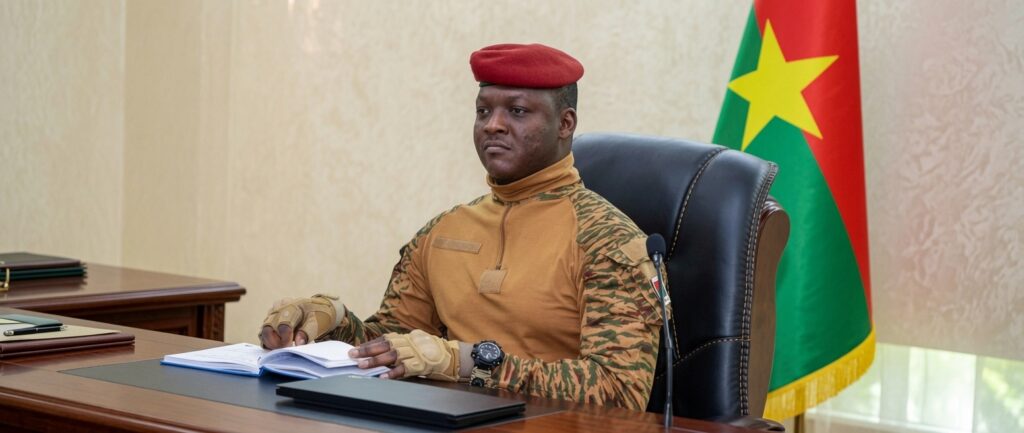
Captain Ibrahim Traoré’s recent address in Ouahigouya has laid bare a deep structural fracture within Burkina Faso’s transitional authority. His blunt, aggressive rhetoric—marked by crude expressions like « fuck » and « crush without mercy »—reveals a profound crisis of confidence in the military establishment. In governance and warfare alike, the over-reliance on inflammatory language and constant threats is not a display of strength, but a glaring symptom of systemic weakness. A regime that must publicly vow to purge its own officers has already admitted that its cohesion depends not on shared doctrine or strategy, but on fear alone.
The captain’s insistence that no hierarchy exists (« there is no number one or number two ») may be an attempt to prevent rival factions from emerging. Yet this artificial flattening of command structures concentrates all operational risk onto a single figure. By staking his legitimacy solely on battlefield experience, Traoré risks falling into a well-known trap of military regimes: a personal authority that is both inalienable and vulnerable, hinging entirely on short-term tactical wins. Without institutional depth, the transition’s survival becomes dangerously contingent on his immediate successes.
More troubling still is the way this rhetorical hardening distracts from the real strategic challenge: reforming the military’s operational capabilities. By prioritizing political loyalty checks over structural improvements, the transitional leadership risks choking the very command chain it claims to defend. Officers, now consumed by self-preservation and internal surveillance, are likely to retreat into cautious conformity. An army paralyzed by the fear of being branded disloyal inevitably loses its edge on the battlefield. The gap between Ouagadougou’s tough talk and the realities of frontline combat grows ever wider.
History across the Sahel warns that governance through intimidation achieves the opposite of its intent. Far from dissolving internal divisions, the climate of suspicion and blanket surveillance only drives dissent underground. Military regimes in the region have learned the hard way: when fear silences debate and freezes hierarchy, opposition doesn’t vanish—it waits. And when the balance of power shifts, it returns with far greater force.