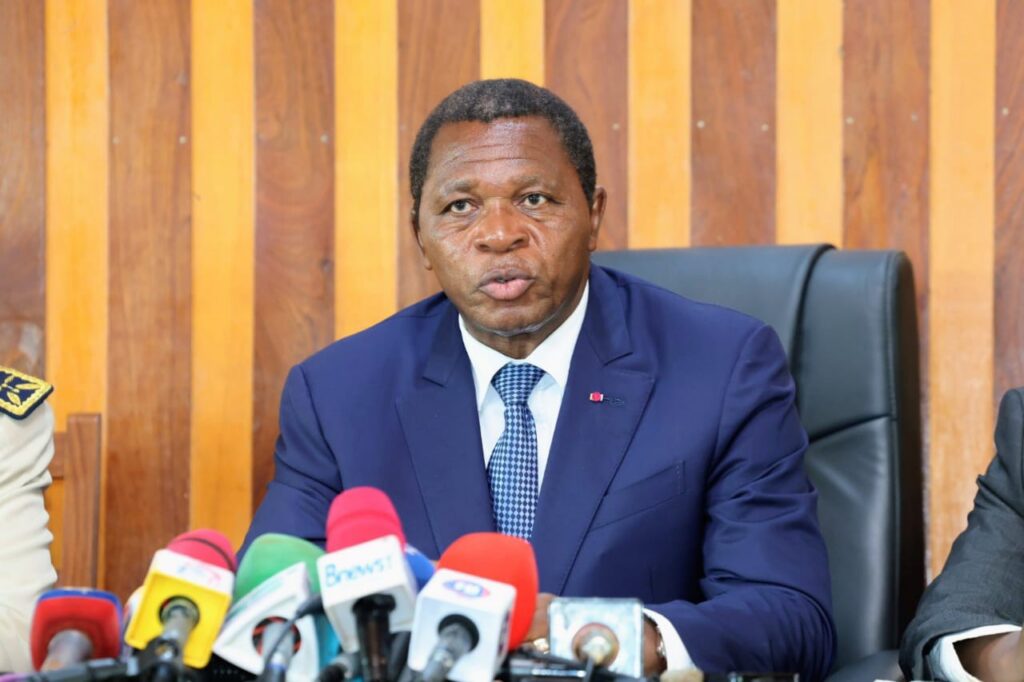
The recent publication by Minister Atanga Nji, titled “Comprendre le sens de mon combat permanent pour le respect de la légalité républicaine,” serves as a multifaceted exploration of power, regime stability, and a profound tribute to the leadership of President Paul Biya.
Beyond its defense of the status quo, the work offers a significant intellectual contribution to political science and conflict resolution. This is most evident in the postface, where the author outlines his unique theory of “imperfect equilibrium.”
Challenging the narrative of marginalisation
The ongoing crisis in the North-West and South-West regions, which escalated into armed conflict in 2016, has been fueled by separatist claims for an independent “Republic of Ambazonia.” These movements often cite a systemic marginalization of the Anglophone population by the Francophone majority. Atanga Nji fundamentally rejects this premise. He argues that the tangible development projects in these two regions, alongside the prominent presence of Anglophone leaders in high-ranking government positions and strategic state-owned enterprises, serve as empirical evidence against the marginalization narrative.
Having transitioned from a successful career in the private sector as a banking and finance expert to the highest levels of the state, Atanga Nji presents himself and other integrated leaders as living proof that the idea of systemic discrimination is a political fabrication. This strategy of symbolic counter-insurrection emphasizes that public investment and political inclusion invalidate the separatist cause.
The core of the imperfect equilibrium theory
The postface introduces the “logic of imperfect equilibrium” as a guiding principle for managing social and political disputes. This theory builds upon President Paul Biya’s global vision for peace, echoing his calls at the United Nations for collective efforts toward security. While Atanga Nji agrees that most wars are futile, he distinguishes between unjust conflict and “legitimate war,” such as the fight against terrorism, which justifies state force.
The theory posits that seeking a perfect, absolute balance in negotiations is often an obstacle to progress. Instead, he proposes four key pillars:
- The middle ground is not always fair: Achieving a resolution is more important than meeting an abstract ideal of total justice. Functional equilibrium takes precedence over normative perfection.
- Compromise as mutual sacrifice: True negotiation requires parties to accept the loss of something valuable to secure broader peace. It is a process of renunciation for the sake of the collective order.
- Imperfection as a necessity for peace: The refusal to accept an imperfect compromise leads to deadlock. Embracing imperfection is the only way to break an impasse and restore stability.
- A universal principle: This logic is presented as a global guide for governance, applicable to international relations and everyday social interactions alike.
Application to the Anglophone crisis
In the context of the North-West and South-West regions, Atanga Nji suggests that separatist demands are rooted in an unrealistic expectation of perfect balance. He argues that strict numerical parity or institutional symmetry is impossible in a diverse nation like Cameroun, which comprises four distinct cultural zones. Such demands, he believes, would paralyze political decision-making and threaten national unity.
The “imperfect equilibrium” offers a realistic path forward: a pacified, albeit asymmetrical, coexistence. While Anglophones may not have strict proportional representation, they hold essential roles within the state. This “equity in inequality” is framed as the only viable horizon for the country’s stability.
This theoretical framework provides a clear look at the management style of the current administration. It explains how the government maintains relative stability by satisfying interests partially without total exclusion. By prioritizing process viability over substantive justice, Atanga Nji’s work provides a window into the mechanisms of legitimacy and the negotiation of identity within the state of Cameroun.