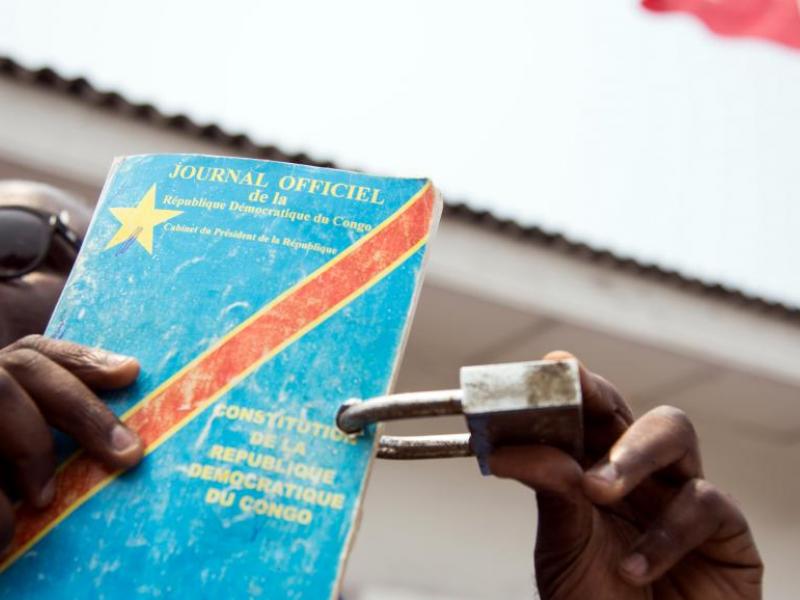
From Wednesday 10 to Friday 12 June, the Ministry of Higher Education, University, Scientific Research and Innovation (ESURSI) is hosting “scientific” colloquia in Kinshasa, Kisangani (Tshopo) and Lubumbashi (Haut-Katanga). According to the minister, the initiative aims to promote scientific research and strengthen the contribution of Congolese universities to national public debate, just a day after parliament voted on a proposed referendum law.
“Nearly twenty years after the entry into force of the Constitution of 18 February 2006, this colloquium seeks to conduct an in-depth scientific analysis of its achievements, limitations and prospects for evolution adapted to the current realities of the Democratic Republic of the Congo. The work should lead to recommendations capable of strengthening the rule of law, democratic governance and sustainable development of the country,” said Minister Sombo Ayanne Safi Mukuna Marie-Thérèse.
The sessions are taking place simultaneously around three thematic poles: Kinshasa for geostrategic issues, Kisangani for sociological and environmental matters, and Lubumbashi for industrial and energy transition topics.
The ministry has invited teaching researchers, researchers, experts in constitutional law and social sciences, academic institutions, research centres, as well as advanced-level students to participate. It also calls on heads of higher and university education institutions to widely disseminate this information and mobilise researchers and experts from their institutions to contribute to the success of this important national meeting.
“Through this initiative, ESURSI reaffirms the central role of the university and research centres as idea laboratories and forces of proposal at the service of the Nation. The active participation of the university community is expected to guarantee the scientific quality of the reflections and the relevance of the recommendations that will be formulated at the end of the colloquium,” added the minister.
The question of constitutional reform—whether revision or change—had cooled following the offensives by the AFC/M23 rebellion backed by Rwanda, which led to the loss of large parts of national territory, and in a context marked diplomatically by the advancement of initiatives to resolve the security crisis. However, it has resurfaced and is now at the heart of political news. Carried notably by the UDPS, the presidential party and member of the Sacred Union, the ruling coalition, this debate continues to stir strong political tensions.
The UDPS, like the Sacred Union of the Nation, officially militates for a constitutional reform. However, this project does not receive unanimous support. Proponents of revision or change, including several Sacred Union officials, criticise the current 2006 Constitution, which they call a “trapped Constitution” and deem unfit for the country’s realities. They cite problems related to state management, the definition of nationality, and the need to adapt the text to Congolese realities. Some also argue the search for peace or question the feasibility of elections scheduled for 2028.
On the side of the opposition and other Congolese socio-political forces, this approach is strongly rejected. They consider it suicidal in a context marked by what they say is a war of aggression led by Rwanda through the AFC/M23 rebellion. They also believe that the Tshisekedi regime, given its negative record since coming to power, no longer deserves to lead the country. For these opponents, the government’s desire to revise or change the Constitution actually hides an attempt to stay in power and open the way to a third term for Félix Tshisekedi, currently in his second and final term at the head of the country. This term runs until January 2029, when he is expected to hand over power to his successor.
In the Democratic Republic of the Congo, the debate around constitutional reform has given rise to two dynamics in the Congolese socio-political environment: on one hand, the creation of the Article 64 Coalition for the Defense of the Constitutional Order (C64), and on the other, the Coalition of Congolese for the Change of the Constitution (C4). Each camp claims to have the support of the population to achieve the objectives set by each of these organisations.