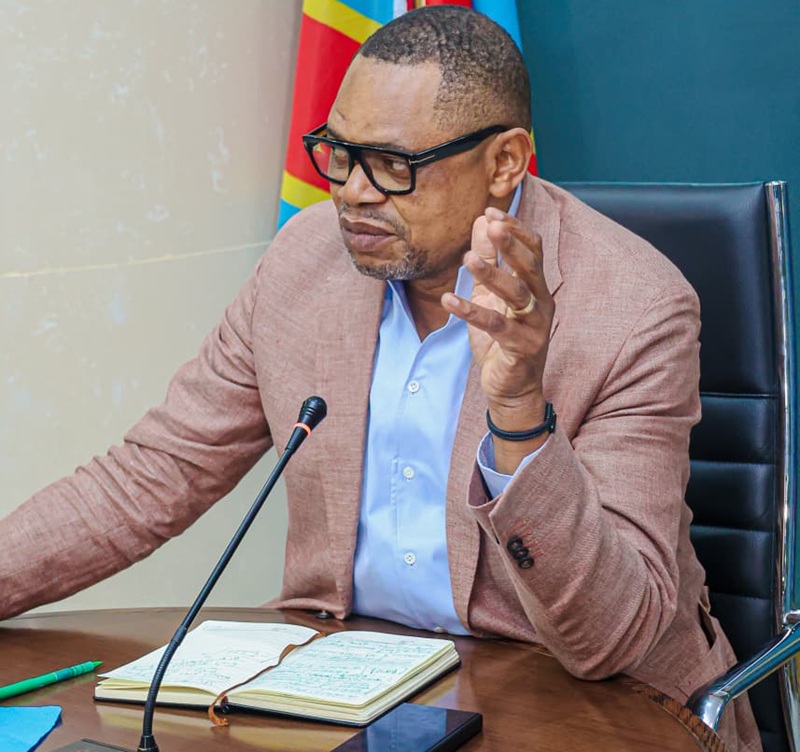
The Luba proverb “Musuminyina katu wabula” teaches us that persistence eventually leads to success. This is the philosophy driving José Mpanda Kabangu, the Minister of Posts and Telecommunications, as he pursues a strategic ambition: providing the RDC with its own sovereign satellite. Having championed this vision since his tenure at the Ministry of Scientific Research and Technological Innovation, he is now taking decisive steps to make it a reality.
In a significant step toward this goal, Minister José Mpanda hosted a delegation from China Unicom and Genew Technologies on Friday, June 5. These discussions focused on the technical requirements for constructing the satellite and the broader deployment of fiber optic cables across the national territory. This meeting follows the minister’s diplomatic mission to Chine earlier this April.
The audience was not limited to international partners. It brought together a wide array of experts from the General Secretariat of PTNTIC, the Regulatory Authority for Post and Telecommunications (ARPTC), the Congolese Fiber Company (SOCOF), the National Satellite Telecommunications Network (RENATELSAT), and the National Remote Sensing Center (CNT). Senior advisors from both the Presidency and the Prime Minister’s office were also in attendance to ensure institutional synergy.
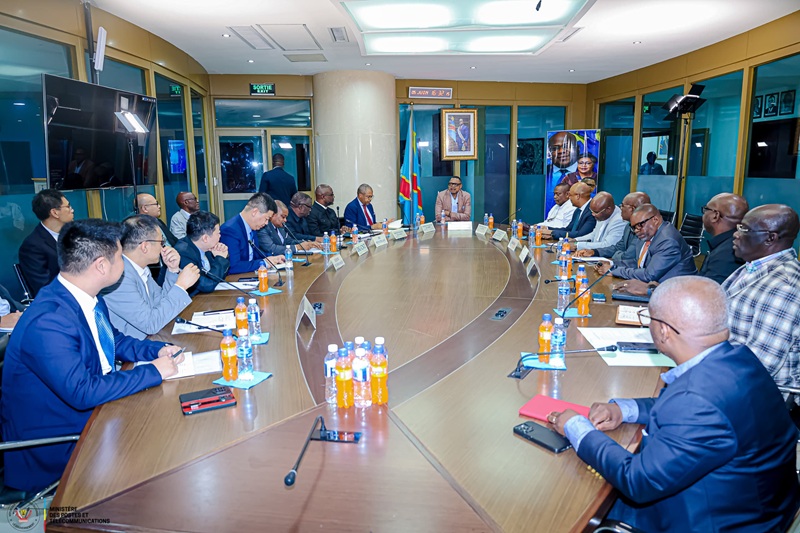
Minister José Mpanda emphasized that while his initial visit to Chine was political in nature, the current phase requires deep technical engagement. Representatives from the two Chinese firms will remain in Kinshasa until June 19 to work alongside Congolese specialists on two major structural initiatives: the sovereign satellite project, initiated via a Memorandum of Understanding in April, and the national fiber optic backbone, which saw its agreements updated in 2025.
Strategic objectives for telecommunications development
The ongoing technical sessions, which commenced on June 8, are designed to achieve three primary goals:
- Technical and financial structuring: This involves validating the technical architecture for both projects, estimating total costs, and coordinating with the Ministries of Planning and Finance to secure funding.
- Institutional alignment: The Chinese firms are tasked with formally presenting the project details to all stakeholders, including RENATELSAT, SCPT, SOCOF, CNC, and the ARPTC.
- Due diligence preparation: Setting the scope and schedule for upcoming site visits in Chine, identifying Congolese delegates, and preparing the necessary documentation.
From these intensive discussions, Minister José Mpanda expects four concrete outcomes: validated technical solutions, a finalized financing strategy, full alignment among all institutional players, and a clear roadmap for the due diligence mission.
The success of this large-scale project relies on the collaboration of several key institutions, including the Presidency of the Republic, the Prime Minister’s office, and the Ministries of Posts and Telecommunications, Planning, Finance, Infrastructure, and Mines. Technical support is provided by the CNC, FDSU, SCPT, and other specialized agencies dedicated to the digital transformation of the RDC.