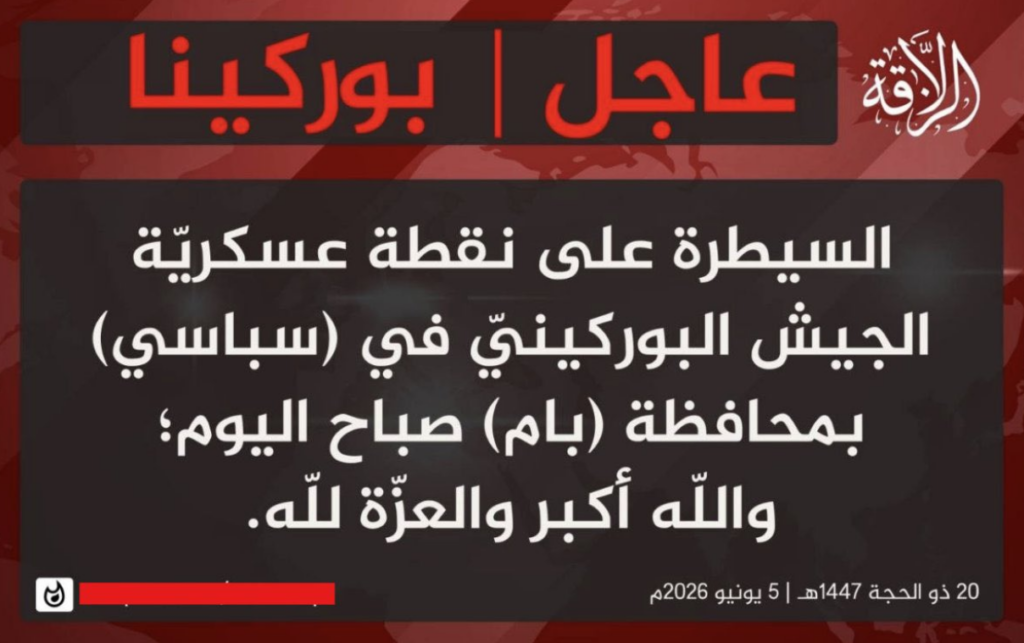
The heart of Burkina Faso’s Centre-Nord region has once again been shaken by a brazen assault. On the morning of June 5, 2026, a military outpost in Sabcé, located in the Bam Province, came under heavy attack by fighters from the Group for the Support of Islam and Muslims (JNIM). The assault, which unfolded at dawn, saw the terrorists overrun the base before reinforcements arrived, leaving behind a trail of destruction.
Sabcé: A morning of terror and resilience
As the first light of dawn broke over Sabcé, the tranquility of the community was shattered by the thunderous roar of gunfire. JNIM militants, armed with heavy weaponry and moving swiftly on motorcycles, launched a coordinated assault on the military post. The intensity of the firefight sent shockwaves through the area, plunging residents into a state of panic.
Despite the valiant resistance put up by Burkinabè soldiers and local Volunteers for the Defense of the Homeland (VDP), the attackers’ numerical advantage overwhelmed the defenders. They seized control of the base, looted supplies, and melted away before aerial reinforcements could engage them. While official casualty figures remain pending, the incident underscores the persistent vulnerabilities along key supply routes connecting the Centre-Nord to the rest of the country.
Security strategy at a crossroads
The brazen attack on Sabcé lays bare the limitations of Burkina Faso’s current security strategy. Despite bolstering troop numbers, acquiring advanced military equipment, and mobilizing civilian volunteers, the nation continues to grapple with the relentless threat posed by terrorist groups. The static model of securing isolated outposts is proving increasingly ineffective.
Analysts point to critical gaps, including delayed intelligence gathering and slow response times from ground reinforcements, as key vulnerabilities. The JNIM’s ability to isolate detachments, sever communication lines, and strike strategic targets highlights the urgent need for a paradigm shift in how the country approaches its security challenges.
Bénin’s bold call for regional unity
In the wake of this latest security breach, the recent diplomatic and military overtures by Bénin‘s President Romuald Wadagni have gained renewed significance. His strategic visits to Niamey and Ouagadougou signaled a bold push for enhanced military cooperation across the subregion.
“An enemy without borders demands a response without borders,” declared President Wadagni, emphasizing the necessity of collaborative intelligence-sharing and joint military operations. His vision, widely acclaimed by regional observers, challenges the insularity of past approaches and advocates for a pragmatic, unified front against terrorism. The Sabcé attack serves as a grim validation of his stance: Burkina Faso cannot confront this hydra alone while neighboring nations remain on the sidelines.
Breaking barriers for a unified defense
The path to meaningful cooperation, as championed by Cotonou, must move beyond mere diplomatic rhetoric. The JNIM and other terrorist factions exploit porous borders as sanctuaries and escape routes, necessitating a robust, coordinated response.
A true synergy would entail real-time sharing of satellite intelligence and communication, cross-border joint operations, and mutual pursuit rights. Bénin, Niger, and Burkina Faso share interconnected challenges, particularly in the W National Park and adjacent ecological zones. By extending a hand to Ouagadougou and Niamey, President Wadagni is laying the groundwork for a united front essential to choking off the terror networks’ supply chains.
The moment for decisive action
The assault on Sabcé is a stark reminder that Burkina Faso’s security apparatus, though resilient, is stretched to its limits. To reverse this trend, Ouagadougou must critically reassess its internal tactics and, crucially, embrace the hand of solidarity extended by its neighbors—starting with Bénin‘s regional leadership.
The security of Burkina Faso may well hinge on the outcome at Sabcé, but its long-term survival depends on the collective strength of the region. The time for isolated strategies has passed; the future demands unified, coordinated action to dismantle the terror networks plaguing the Sahel.