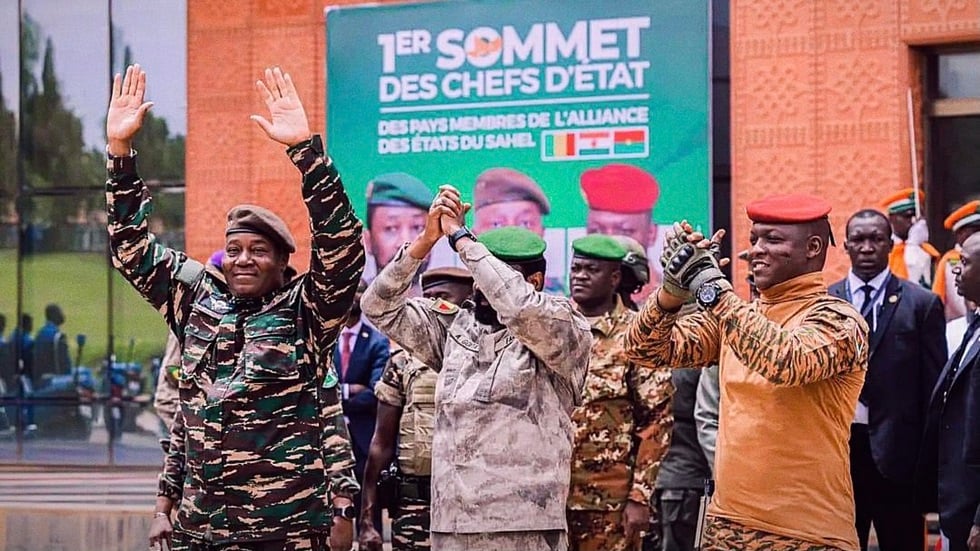
In the intricate dance of global power, precise timing is paramount, and missteps can carry dire consequences. The recent decision by the Alliance of Sahel States (AES) — comprising Mali, Burkina Faso, and Niger, all currently under military administrations — to withdraw from the Economic Community of West African States (ECOWAS) increasingly appears less as a bold assertion of national autonomy and more as a high-stakes gamble yielding diminishing returns.
At a critical juncture when West Africa faces relentless aggression from extremist groups such as Boko Haram and Islamic State West Africa Province (ISWAP), a unified front should have been the prevailing strategic imperative. Instead, fragmentation has taken center stage. When it comes to regional security, such disunity is not merely inefficient; it poses a significant threat.
The AES bloc initially justified its departure by asserting that ECOWAS had become an instrument of neo-colonial influence, particularly under French sway. This argument holds some historical resonance, given the historical challenges to the sovereignty of many African nations. However, even legitimate grievances can lead to flawed decisions if not carefully weighed against present realities. Disengaging from an established regional security framework without a robust, internally developed alternative does not equate to independence; it creates profound vulnerability.
The events that have unfolded since are quite telling. The strategic pivot towards Russia as a security partner was presented as a rebalancing effort. Yet, on-the-ground realities suggest a closer parallel to dependency without firm assurances. Moscow’s global strategic approach is inherently transactional; its support endures only as long as it aligns with its own national interests. Once the cost-benefit analysis shifts unfavorably, commitment tends to wane. This is not mere speculation; it is a pattern observed repeatedly.
Recent coordinated insurgent attacks across various Malian cities—including Bamako, Sevare, Mopti, Tessalit, Gao, Kati, and Kidal—have starkly revealed critical vulnerabilities. The anticipated protection from these new external alliances proved permeable. Even more troubling was the subdued response from fellow AES members, Burkina Faso and Niger. A coalition that struggles to rapidly mobilize in defense of one of its own raises fundamental questions about its operational credibility.
This contrasts sharply with the historical effectiveness of the ECOWAS Monitoring Group (ECOMOG).
Under Nigeria’s leadership, ECOMOG intervened decisively in Liberia and Sierra Leone, successfully stabilizing governments and restoring a semblance of order during periods of severe national collapse. While its execution was not flawless, it represented collective action, deeply rooted in a shared regional destiny.
Similarly, The Gambia faced a full-blown political crisis when the then-incumbent, Yahaya Jammeh, refused to cede power after losing an election to Adama Barrow. Nigerian forces, acting under the ECOWAS mandate, intervened, and within hours, the recalcitrant Jammeh was persuaded to relinquish power and depart for exile in Equatorial Guinea.
Here lies the core challenge: geography is immutable. West African states are bound not only by treaties but also by shared borders, cultural ties, and the inevitable spillover effects of instability. When Mali experiences turmoil, Niger feels the repercussions. When Burkina Faso suffers, Ghana experiences the tremor. Security across this region is intrinsically linked and indivisible.
The lesson from nations like Iran—often cited for its indigenous resilience—is not solely about defiance. It is fundamentally about capacity building. A credible defense strategy must be underpinned by domestic military capabilities, robust intelligence infrastructure, and technological innovation. External partnerships can serve as valuable complements, but they can never replace internal strength. Using the Iranian model, AES nations do not need to choose between perceived French dominance and potential Russian unreliability, even if they choose to depart from ECOWAS. Iran offers a compelling alternative: isolated and under siege, Tehran invested not in foreign mercenaries but in developing its own defensive capacity. It successfully held its ground for approximately six weeks against two of the world’s most formidable military powers—Israel and the United States—during intense aerial confrontations. The message for developing nations is clear: self-reliance, not strategic dependency, is the ultimate guarantor of sovereignty, especially when combined with strategic alliances among neighboring countries that share destiny, risks, and realities.
For the Sahel region, this translates into developing homegrown intelligence networks, agile rapid-response units, and cross-border early warning systems, all in close collaboration with their West African neighbors. Border contiguity is not a political inconvenience; it is a geographical imperative. Terrorist groups like Boko Haram, ISWAP, and Lakurawa do not recognize AES or ECOWAS demarcation lines. They exploit the seams and gaps between them.
For the AES states, the path forward necessitates a re-evaluation of both strategy and mindset. First, aggressive investment in indigenous security architecture is crucial: local intelligence networks, community-based defense systems, and regional rapid-response capabilities. Second, diplomatic re-engagement with ECOWAS is vital—not from a position of submission, but from one of strategic necessity. Collaboration does not diminish sovereignty; it fundamentally reinforces survival.
ECOWAS, in turn, bears a parallel responsibility. The bloc must address its own perception challenges, alleviate concerns about external influence, enhance internal governance, and reaffirm its foundational role as a genuinely African institution dedicated to serving African interests.
This is not a call to revert to the previous status quo. It is a plea for a more intelligent equilibrium—one that harmoniously blends sovereignty with solidarity, and independence with interdependence.
Ultimately, the Sahel does not require isolation. It needs strategic alignment. Not solely with distant global powers, but crucially, with its immediate neighbors—those who share its inherent risks, its harsh realities, and ultimately, its collective fate.
A call for reconsideration
The biblical narrative of the prodigal son, who departs in arrogance only to return in humility, offers a powerful parallel. It is time for the AES to reconsider its momentous decision. There is no dishonor in acknowledging a miscalculation; the true shame lies in stubbornly adhering to a failing strategy while your cities endure conflict. ECOWAS, for its part, must be prepared to welcome them back without punitive ego. The regional family is undeniably stronger when united.
The threat of regional devastation is not an exaggeration; it represents a clear and present danger facing the entire subregion. A united West Africa has historically navigated civil wars and coups. Divided, it risks succumbing to a common enemy that respects neither French nor Russian flags. The AES must retrace its steps, place its faith in indigenous solutions, and meticulously rebuild the collaborative architecture that only neighbors can genuinely provide. There is, quite simply, no other viable path forward.