Mali currently confronts a dire security landscape, marked by recent assaults that have reportedly claimed hundreds of lives among both civilians and military personnel, as confirmed by security intelligence.
Western analysts suggest that the stability of northern Mali is pivotal for potential regime shifts across the wider Sahel, impacting nations like Niger, Burkina Faso, Chad, and Mauritania.
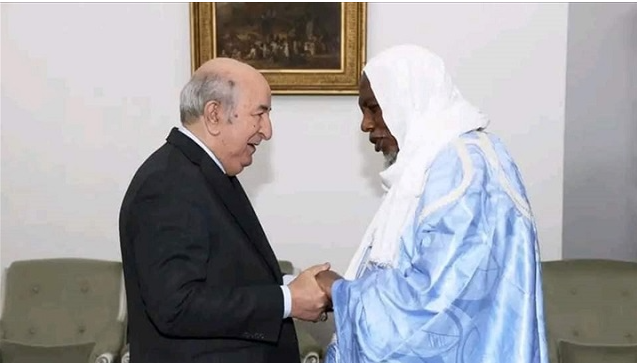
Operating from his Algerian base, strategically positioned within crucial Sahelian influence networks, Imam Mahmoud Dicko’s role has expanded beyond mere moral leadership.
He now asserts himself as a spiritual leader wielding significant authority, a position some observers liken to a centralized religious hierarchy, drawing parallels with the Iranian system. His adherents often portray him as a near “caliphal” persona, representing comprehensive moral and religious governance that transcends traditional spiritual guidance.
Kidal, Gao, and Timbuktu—these three iconic Malian territories are where this influential figure, guided by Algerian intelligence, is currently focusing his strategic endeavors.
Dominating these areas signifies more than just urban control; it means command over vital transit routes, intricate regional alliances, and the delicate balance of power in the wider region.
Reports from local informants in Tamanrasset indicate unsettling developments on the ground. A battalion from the Algerian army’s 4th Military Region is said to have redeployed to the 6th Military Region, reportedly segmented into five smaller units to evade satellite detection.
The Algerian leadership, under President Abdelmadjid Tebboune and General Saïd Chengriha, is allegedly backing Imam Mahmoud Dicko’s militias and various armed jihadist factions. This reported support aims to secure control of northern Mali and subsequently target leaders in other Sahelian nations, potentially leveraging ongoing military actions by the United States (under President Donald Trump) against Iran and by Israel against Iranian-backed entities.
Publicly, Mahmoud Dicko maintains his status as an exile in Algeria, drawing comparisons to the historical precedent of former Iranian leader Khomeini’s sojourn in France.
Covertly, however, in the evolving regional dynamic, he is establishing himself as a key decision-maker. His influence is expanding into areas where the Algerian state, helmed by President Abdelmadjid Tebboune and General Saïd Chengriha, struggles to exert authority, ostensibly to bolster Algeria’s own strategic imperatives.
The French Foreign Ministry, or Quai d’Orsay, declared that “following the recent assaults on Saturday, April 25, which impacted various sites nationwide, including Bamako, the security climate continues to be exceptionally unstable.”
In response, France’s Ministry of Foreign Affairs updated its guidance on Wednesday, advising its citizens in Mali to “arrange a temporary exit without delay, utilizing any remaining commercial flight options.”
Contrasting this, General Assimi Goïta, Mali’s head of state, asserted on Tuesday that the nation’s security posture was “under control,” just three days after a series of unparalleled attacks by armed factions.
General Goïta’s remarks, delivered during a Tuesday evening national broadcast on the public television channel ORTM, marked his initial public statement since the lethal assaults perpetrated by jihadists from JNIM (Jama’at Nusrat al-Islam wal-Muslimin), who are reportedly aligned with Tuareg separatists of the Azawad Liberation Front (FLA).