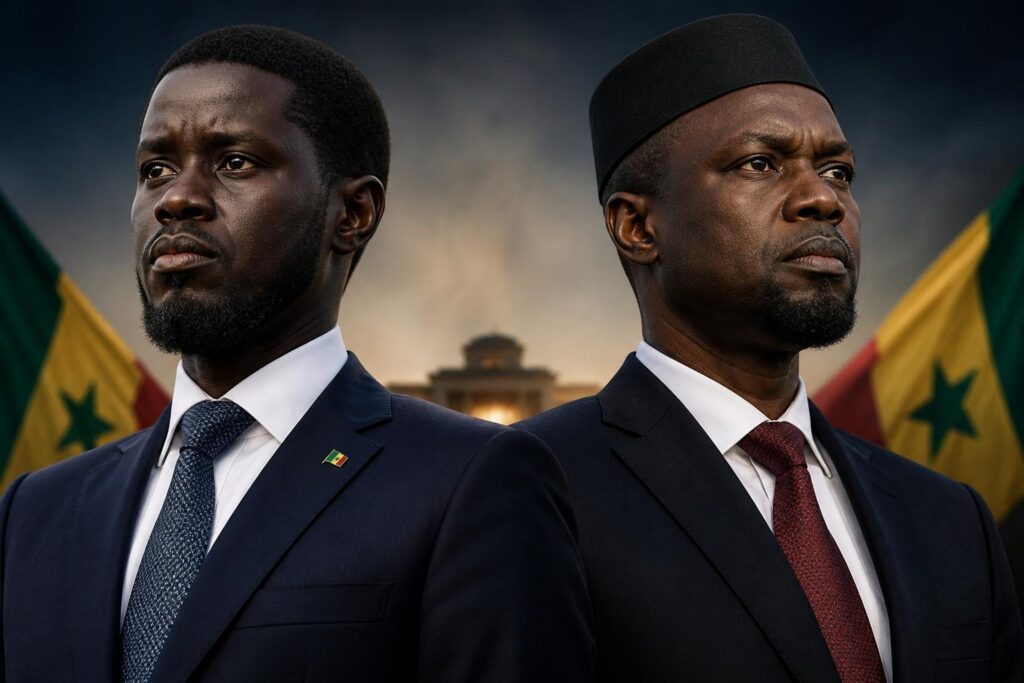
The initial period of political harmony at the apex of the Senegalese state appears to be giving way to a more demanding realpolitik. The weekend of May 2-3, 2026, marked a significant symbolic shift in the relationship between President Bassirou Diomaye Faye and his Prime Minister, Ousmane Sonko. By publicly acknowledging disagreements with the Pastef party and declaring himself “ready for separation” should national interests require it, the head of state shattered the perception of an unbreakable bond. As Senegal observes this nascent political reconfiguration, the nation holds its breath between presidential emancipation and party loyalty.
a weekend of definitive statements
It was a brief comment, made during an interview with the national press, that ignited a media firestorm. Until this point, the official narrative projected an image of a cohesive partnership, a “duo” where mentor and protégé advanced in unison towards promised transformation. However, the tone has now dramatically shifted.
When questioned about growing tensions between the government’s stance and the sometimes-forceful pronouncements from Pastef officials, President Faye exhibited unexpected resolve. He emphasized his official detachment from the party, affirming his role as the president for all Senegalese citizens. His declaration resonated like a thunderclap across Dakar’s political landscape, as he asserted his complete loyalty to the national project, but maintained that his ultimate responsibility lay with the people. By clarifying his readiness to initiate a separation if partisan agendas conflicted with his vision for the state, he unequivocally delineated his presidential domain.
the shadow of ousmane sonko: a prime minister’s pervasive presence
To grasp the full scope of this tension, one must revisit the origins of this administration. Elected on a slogan that equated voting for Diomaye with choosing Sonko, the president initially navigated the constant media presence of his Prime Minister. The charismatic leader of Pastef never truly shed his role as party chief, frequently holding rallies and making direct statements that occasionally seemed to bypass official communications from the presidential palace.
For several months, strategic differences have emerged concerning sensitive issues. The management of national debt and relations with international institutions exemplify this divergence, with the Prime Minister advocating for a radical break while the President adopts a more diplomatic and pragmatic approach. Similarly, the matter of appointments generated friction, caught between the President’s desire to surround himself with technocrats and partisan pressure to place long-standing militants. Finally, the stark contrast between Ousmane Sonko’s impetuous style and Bassirou Diomaye Faye’s efforts to project calm solemnity has become increasingly apparent.
is a political separation now unavoidable?
To suggest an immediate rupture would likely be premature, but it is now an openly acknowledged political possibility. The President appears to recognize that to leave a lasting legacy, he must establish his own distinct identity. Within the Prime Minister’s circle, efforts are made to downplay these remarks as merely a division of responsibilities, yet the presidential message hints at a deeper reality. By expressing readiness for a split, the head of state sends a clear signal to his own base: the presidential institution will not be held captive by any pressure group.
This situation places Senegal in a state of institutional uncertainty. The nation has experienced tumultuous executive duos in the past, and many now fear a potential paralysis of the state apparatus. Should a rupture occur, the President would face the challenge of governing without the full backing of Pastef’s militant machinery, compelling him to forge new alliances or govern through decrees.
the stakes of presidential autonomy
For Bassirou Diomaye Faye, the objective is to reassure international partners about the country’s stability while demonstrating to citizens that he is firmly in control. Public opinion is currently divided. A segment of the youth, still loyal to Ousmane Sonko’s charisma, might perceive this emancipation as a form of betrayal. Conversely, a more legalistically inclined portion of the population applauds the assertion of a president finally embracing the full scope of his sovereign duties.
The President is currently engaged in a complex political chess match. He must affirm his authority without triggering a major social crisis that his opponents could exploit. The question is no longer whether the two men share an affinity, but whether the state’s architecture can sustainably support two centers of power.
As observers of the political landscape, we are witnessing the end of a certain political naiveté. Politics is not about camaraderie but about the management of power. Bassirou Diomaye Faye has underscored that the Constitution grants him prerogatives he is now determined to exercise independently. The tandem served as a tool for conquest; it now appears to be an impediment to governance. Senegal is entering a phase of maturity where the state must take precedence over the party, and the President has just drawn that definitive line.