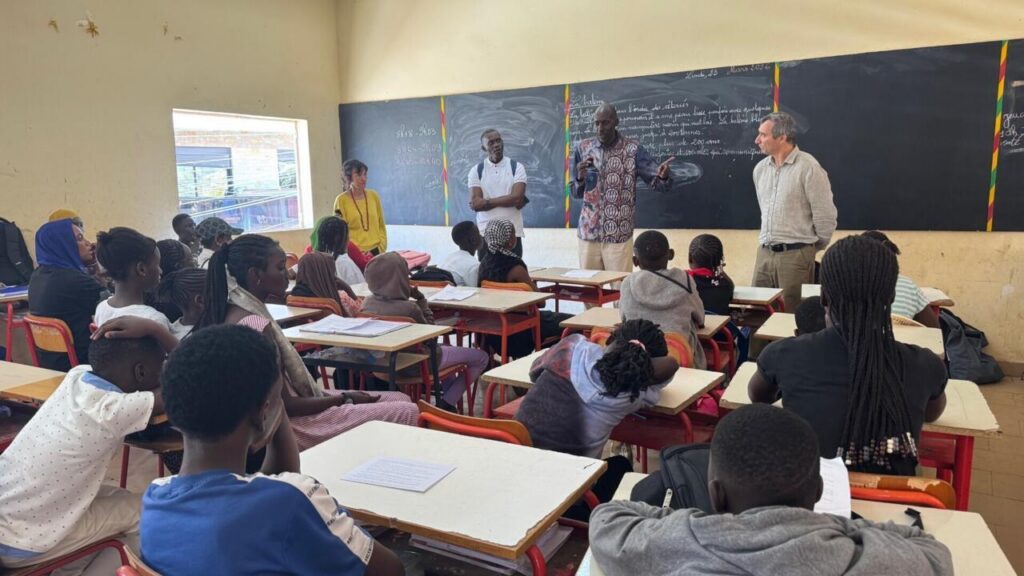
In Senegal, recordings of whale songs are being used to teach children about environmental protection. The initiative comes from the association Germes d’Écocitoyens through its Gestu programme, which blends science and tradition in learning environments. A few weeks ago, the organisation arranged three sessions in Dakar primary schools featuring Professor Olivier Adam, a specialist in cetacean sounds. One of these whale language workshops took place at Alieu Samb primary school in the Ngor district of Dakar.

With mouths wide open, the thirty or so CM2 students sat at their desks listening intently to a recording of a humpback whale made off Ouakam in Dakar in 2018 and 2022.
“Those songs, the sounds you heard, are from humpback whales. These whales come to Dakar to give birth. Their calves are Dakarois,” explained Olivier Adam, a professor from Sorbonne University.
For this specialist in cetacean sounds, the key challenge is to popularise the idea that whales have a language. “I was the first to be surprised when I recorded whales and realised they produced sounds that were intentional and structured as a language,” shared the professor, who travelled from Paris especially to talk to the children. “So whenever I meet students, I think they absolutely must know this. We need to understand the oceans, and we will understand the ocean by knowing the living species within it.”
The curious young students bombarded him with questions: “How many stomachs does a whale have? How many kinds of whales are there? How does a whale give birth? What does it eat?”
Fanta, 12, said she was most impressed by “their song and the way they speak.”
Thierry, the CM2 teacher at Alieu Samb school in Ngor, stressed that learning about the living world is vital. “Without this knowledge, you wouldn’t know, for example, that a whale can only have one calf per birth. That means it’s a species that could disappear if we don’t protect it.”
Babacar Sy, a fisherman and diver with more than 30 years of experience, made the whale recordings in Dakar and co-led the workshop. He confirmed the urgent need to fight ignorance, noting that he catches fewer fish each day. “I was lucky to find nature as it was and then see it change radically. Last year I caught five thiof the entire year. If we keep going like this, one day we’ll talk about thiof to our children and they’ll ask us what it is, because it will no longer exist,” the fisherman worried. “We are heading to the bottom of the pit. It’s time for people to wake up!”
Two other schools in Dakar also hosted Olivier Adam and his whale recordings. Along with beach cleanup awareness days, the Gestu association hopes to help change mindsets.