
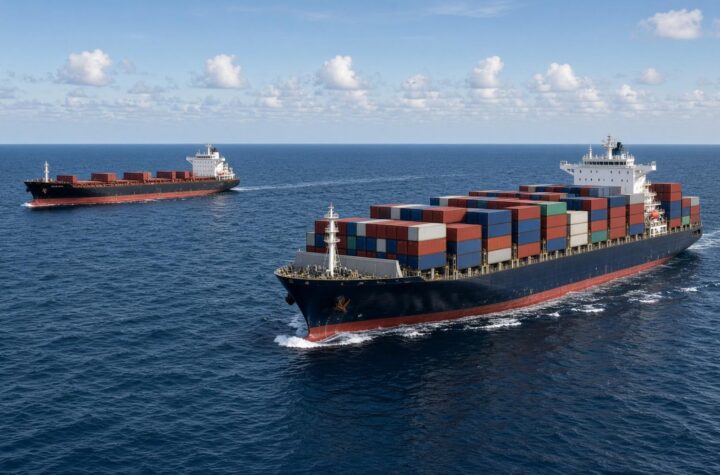
Senegal’s import figures for June revealed a notable 26.7% month-over-month increase, a strong rebound that sharply contrasts with the broader trend observed throughout the first half of the year. From January to June, the cumulative value of goods entering the country actually decreased by 8%, indicating a structural deceleration in external trade flows. This dual movement, underscored by the latest foreign trade statistics, highlights the current fragility of an economy still heavily reliant on international supplies.
A monthly rebound questioning Senegal’s foreign trade dynamics
The surge recorded in June stands as the most significant monthly jump seen in several quarters. This uptick encompassed everyday consumer goods, industrial inputs, and energy products—categories that traditionally dominate the nation’s external purchasing structure. Following a period of decline, this sudden acceleration suggests a catch-up in previously delayed orders and a replenishment of inventories by economic operators.
Customs and statistical authorities do not attribute this positive shift to a single cause. Instead, it appears to be a combination of renewed hydrocarbon imports, an increase in capital goods purchases linked to public works projects, and a favorable base effect compared to a subdued May. Nevertheless, the month-to-month volatility complicates efforts to accurately interpret the true trajectory of Senegal’s foreign trade in 2024.
An 8% half-year decline reveals domestic demand pressures
Over the initial six months, the 8% contraction in imports reflects several converging factors. The gradual ramp-up of domestic hydrocarbon production, particularly from the Sangomar fields, has naturally lowered the nation’s oil import bill. Additionally, the government’s ongoing budget rationalization policy has curtailed certain public procurements and impacted the acquisition of imported equipment.
Domestic demand, meanwhile, presents a mixed picture. Households, grappling with persistent food inflation and constrained purchasing power, have scaled back their consumption of imported goods. Businesses, operating in a cautious environment due to the political transition and ongoing reviews of mining and oil contracts, have postponed some of their investments. Consequently, this half-year decline signifies both a cyclical adjustment and the initial stages of a rebalancing in the country’s external economic framework.
In practical terms, the trade balance stands to benefit from these developments, provided that exports—driven by gold, fishery products, and now hydrocarbons—maintain their upward trajectory. The anticipated acceleration of oil and gas production in the second half of the year could further enhance this rebalancing. Regional monetary authorities, particularly within the West African Economic and Monetary Union (UEMOA), are closely monitoring these indicators, as they directly influence the level of foreign exchange reserves.
Strategic challenges for Dakar amid fluctuating trade flows
For Senegal’s new government, interpreting these figures extends beyond mere short-term statistics. They are integral to the ongoing discussions surrounding economic sovereignty, a recurring theme emphasized by authorities since assuming office. Reducing reliance on imports, especially for food and energy, is a stated priority within the public policy framework currently under development.
However, the June rebound serves as a reminder that sustainable adjustment cannot simply be mandated. Local substitution capacities remain constrained across several strategic sectors, from refining to industrial intermediate goods. Senegal’s traditional trade partners, notably China, France, and other nations within the sub-region, continue to be indispensable suppliers. Furthermore, global price trends for oil and cereals will mechanically influence the import bill, regardless of the rationalization efforts undertaken in Dakar.
The coming months will consequently be closely observed by both investors and financial backers. A sustained half-year decline would affirm a gradual rebalancing of the trade balance, whereas a recurrence of monthly surges akin to June’s would signal a more robust resurgence in demand, with corresponding implications for macroeconomic stability.


More Stories
Can Burkina Faso’s security strategy hold after the JNIM’s Silmossin claims?
Washington lifts sanctions on General Olenga: a legal victory or a shift in American strategy in the DRC?
Will Iran’s 7-day Hormuz reopening offer break the deadlock or deepen the crisis?