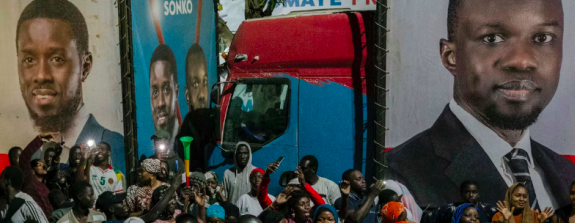
The removal of Ousmane Sonko from the Prime Minister’s office and the subsequent restructuring of Senegal’s executive branch have ushered in a new political era for the nation.
For the first time since its ascent to power in 2024, the Pastef-Les Patriotes party is grappling with an internal crisis. This period is marked by the departure of key officials, strategic disagreements between President Bassirou Diomaye Faye and party leader Ousmane Sonko, and the impending formation of a new political entity centered around the Head of State.
Superficially, these developments might suggest a weakening of Pastef. However, a deeper political analysis reveals a more nuanced picture. A primary observation is the erosion within the party’s leadership ranks. Several ministers, ministerial advisors, general directors, parliamentarians, and members of the National Political Bureau have chosen to align with President Diomaye Faye, diverging from the path set by the party president.
In political science, this phenomenon highlights the classic tensions between legal-rational legitimacy, derived from institutional power, and charismatic legitimacy, rooted in the exceptional qualities of a leader. Since his election to the highest office, Bassirou Diomaye Faye’s authority emanates from the Constitution and the presidential function.
Conversely, Ousmane Sonko continues to draw his influence from a charismatic bond cultivated with activists over more than a decade. Dissidents justify their choices by contending that President Diomaye Faye now truly embodies the political “Project” championed by Pastef. Some even criticize what they perceive as an excessive personalization of the party around Ousmane Sonko, citing a governance style characterized by messianism, limited internal democracy, and a concentration of authority around the figure of the “boss,” or party president. In this interpretation, loyalty to the Project supersedes loyalty to an individual.
Nevertheless, this perspective encounters another political reality: the departures primarily involve holders of public office rather than the party’s grassroots militant structures. Many individuals joining the prospective presidential party are administrative cadres or officials who gained political prominence through Pastef and, more specifically, through Ousmane Sonko.
Dissidents lack genuine political roots
For a significant segment of the public, these individuals remain unidentified political objects (OPNI), meaning their political notoriety largely depends on Sonko’s leadership. Few possess a genuine local connection to an autonomous electoral base or a territorial presence comparable to Senegal’s established political figures. Their political capital appears more institutional than electoral. This distinction between institutional and militant capital is crucial. Dissidents currently hold positions of power because they participate in state governance.
In contrast, Pastef remains fundamentally a mass party, structured around thousands of activists who fund the organization through their contributions and ensure its presence across Senegal. In this sense, the loss of a few political elites does not necessarily equate to a loss of organizational capacity. Recent events appear to corroborate this analysis. The June 6th Congress, which unanimously reaffirmed confidence in Ousmane Sonko as party president, followed by his popular investiture on June 7th at Dakar Arena, proceeded without the dissidents and nonetheless dominated political discourse.
Similarly, the launch of membership card sales on July 4th generated substantial militant mobilization. Furthermore, the merger of approximately sixty political parties and movements with Pastef on the eve of the Congress underscores a mobilization capability that extends far beyond institutional officials. This resilience is primarily attributable to the nature of Ousmane Sonko’s charismatic legitimacy. According to Max Weber’s typology, this form of legitimacy rests on followers’ belief in a leader’s exceptional qualities. Indeed, a large portion of Pastef militants identifies not merely as “Pastefien” but as “Sonkist.”
This personalization of the political bond somewhat echoes the relationship between Abdoulaye Wade and a segment of the Senegalese Democratic Party (PDS) electorate. However, the Sonko phenomenon seems to go even further: he successfully enabled the election of mayors in 2022, propelled Bassirou Diomaye Faye to the presidency in 2024, and subsequently led a list that secured 130 out of 165 seats in the National Assembly. Such an electoral sequence remains unprecedented in contemporary Senegalese political history.
What political influence do the dissidents wield?
Despite this, it would be imprudent to downplay the risks posed by these internal divisions. Any fragmentation of a majority party can impact its cohesion, organizational effectiveness, and governmental credibility. The emergence of a rival presidential party could attract elected officials keen on preserving their access to state resources, aligning with a pattern of political defection or rallying to power observed in several African political systems. The coexistence of two centers of legitimacy—one institutional around the President of the Republic, the other partisan around the Pastef president—is likely to fuel sustained tensions.
However, at this juncture, available evidence indicates that the dissidence primarily affects elites rather than grassroots activists. No widespread movement of departures at the local level has been observed. The distinctive political identity forged by Pastef since its inception, built on activism, economic patriotism, and popular mobilization, appears to continue shaping partisan loyalties.
Ultimately, the current crisis reveals less an collapse of Pastef and more a confrontation between two sources of legitimacy: President Bassirou Diomaye Faye’s legal-rational legitimacy, founded on the presidential office, and Ousmane Sonko’s charismatic legitimacy, deeply rooted in a political and emotional connection with activists. The party’s future will hinge on the capacity of each of these legitimacies to translate into enduring electoral strength.
The crucial question now is: does Sonko’s “Joxogn” still retain its full political potency? In other words, is Ousmane Sonko still capable of electing mayors, parliamentarians, and, in the future, a President of the Republic? The answer to this question will determine not only Pastef’s trajectory but also the future recomposition of the Senegalese party system in the years ahead.