
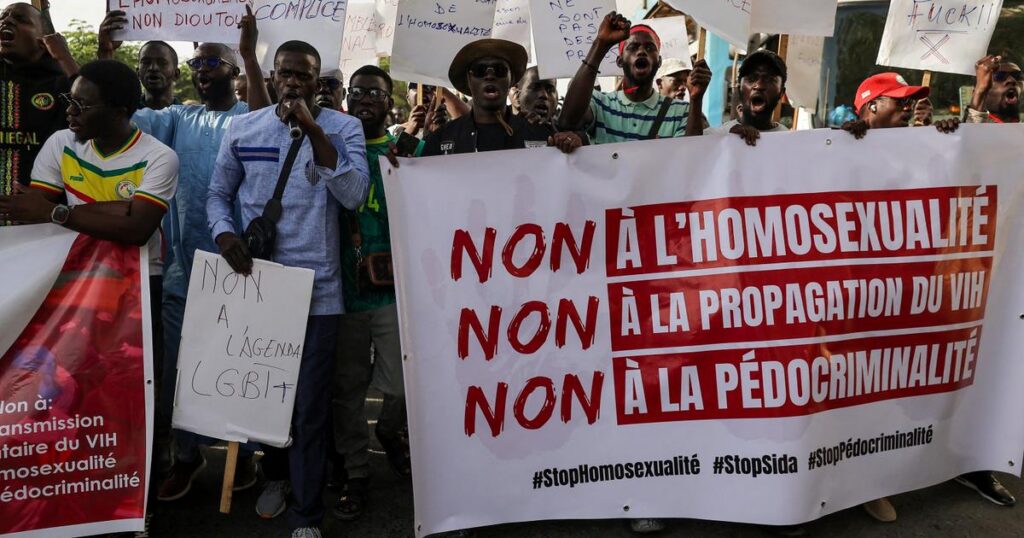
In a bustling Dakar street, K. blends seamlessly with the crowd. His hurried steps and casual phone call betray no hint of tension. Yet every movement is deliberate—“You learn to protect yourself here,” he admits.
Since February 14th, a French national in his thirties has been detained under similar pressures. Charged with “unnatural acts,” criminal association, money laundering, and attempted HIV transmission, his case emerged as parliament debated a sweeping new law in early March. The legislation now criminalizes same-sex relations with five to ten years in prison, intensifying what observers describe as a “climate of heightened repression.”
France swiftly reiterated its stance on universal decriminalization of homosexuality and condemned the discriminatory measures. Diplomatic sources confirm the French embassy in Dakar has maintained close contact with consular officials, ensuring the arrested individual receives appropriate support.
Living under the shadow of stigma
K. is gay. In a nation where homophobia remains deeply entrenched, living openly isn’t just difficult—it’s perilous. Resistance in Senegal rarely takes the form of public rallies or bold declarations. Instead, it thrives in quiet defiance: in what people choose to say, and what they deliberately leave unsaid.
In his neighborhood, K. has mastered the art of reading between the lines. A glance, a pause, an offhand remark—each carries weight. “You quickly learn what you can and cannot say.” Like many, he compartmentalizes his life, maintaining one facade in public, another behind closed doors. The stigma surrounding homosexuality here is not theoretical; its consequences are immediate and severe.
Small acts of defiance
In a discreet Dakar apartment, M. speaks softly, instinctively checking the door. “You’re always on guard,” he reflects. His story is far from unique—and that’s precisely the issue. At work, certain topics are off-limits. With family, he performs a role. “I know who I can talk to and about what.” This constant vigilance has become second nature.
Yet even in constrained spaces, pockets of safety exist. Small groups gather to share experiences, discuss rights, and challenge injustice—not always openly, but enough to keep hope alive. For M., resistance isn’t about grand gestures. It’s about refusing to accept that his life is illegitimate.
Awa, a nurse, has made her own stand. In her clinic, she refuses to judge. “I’ve seen patients who stopped coming altogether,” she says. Some arrive too late. Others conceal their truth, complicating care. Awa adapts—listening carefully, choosing her words with precision. She doesn’t see herself as an activist, but in today’s climate, her stance is anything but neutral.
Breaking the silence, one word at a time
Aminata, a university student, refuses to stay silent when hateful remarks surface. One day, she calmly confronted a classmate: “I told them everyone deserves to live their truth.” The stunned silence that followed left a mark. “It unsettled them.” Small moments like these don’t dismantle systemic oppression overnight—but they chip away at it.
Novelist Fatou Diome often reminds us that societies are never static. They evolve, sometimes imperceptibly. Thinking independently, she argues, is an act of courage in itself. Writer Mohamed Mbougar Sarr, a 2021 Goncourt Prize laureate, sees literature as a vital space for questioning dominant narratives and challenging entrenched certainties.
The resistance here isn’t always organized or visible. It thrives in the gaps: in professional ethics, in friendships, even in silence. Some refuse to amplify hate. Others offer protection, lend an ear, or provide discreet support. None of these acts are dramatic—but collectively, they carve out fragile yet tangible spaces of dignity.
At its core, the message is simple: every individual deserves respect. In Senegal, upholding that principle often means swimming against the current—sometimes quietly, sometimes invisibly. K., M., Awa, Aminata, and countless others may not identify as activists, but their choices matter. Slowly, they shift boundaries. Courage, in this context, isn’t about spectacle. It’s about persistence. It’s about choosing to act, even when no one is watching.

More Stories
Côte d’Ivoire’s coffee and cocoa sector prepares for new campaign with crucial price announcements
Ebola and conflict: a deadly combination in eastern DRC
Morocco azrou college that shaped berber elite