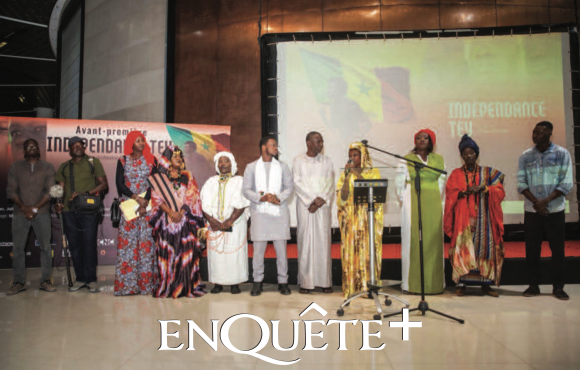
At the Musée des Civilisations Noires in Dakar, the premiere of Independence Tey transformed a simple film screening into a powerful evening of collective remembrance, civic engagement, and political reflection on contemporary Senegal.
Inside the grand halls of the museum, film enthusiasts gathered to witness the much-anticipated documentary by Senegalese director Abdou Lahat Fall. Organized by Sine Films and Wawkumba Film, with support from FRAPP, the Directorate of Cinematography, and the museum itself, the event transcended the boundaries of a conventional premiere.
The evening unfolded as a profound political, artistic, and intergenerational gathering, reflecting the upheavals that defined Senegal between 2019 and 2024. A packed audience, including cultural and activist circles, awaited a film that had already made waves after its selection in the Cinéma du Réel festival’s Front populaire section.
An evening steeped in resistance and rhythm
The event opened with a performance by Leuz Diwan G, a rap artist known for his politically charged lyrics and socially conscious music. On stage, he delivered a gripping set blending urban beats, sharp political commentary, and messages of social resistance. This musical introduction set the tone for Independence Tey—a documentary that promised not just political analysis but an emotional and human immersion into a Senegal striving for transformation.
Four voices, one movement
Abdou Lahat Fall returns to the documentary genre with a project that follows the FRAPP movement, capturing the hopes, contradictions, and fractures of a generation in struggle. The film centers on four key figures: Abdoulaye, Bentaleb, Guy Marius Sagna, and Félix, each representing a different facet of activism and its personal toll.
Convictions versus reality
Through these individuals, the documentary traces the protests, social mobilizations, clashes with authorities, arrests, and the enduring hope of a youth convinced that a different Senegal is within reach. The narrative spans pivotal years in Senegalese politics: oil scandals, mass demonstrations, pre-election tensions, police repression, opposition arrests, and ultimately, the opposition’s victory in the 2024 presidential election.
The film delves into the human cost of activism. Abdoulaye embodies the idealistic and passionate face of youth, yet behind the public speeches and protests lies a reality of anxious families, disrupted education, and uncertain futures. Under family pressure, he eventually leaves Senegal to pursue studies in Canada—a quiet but palpable wound in the story.
Bentaleb, on the other hand, endures the harsh realities of state repression, facing arrests and imprisonment. Guy Marius Sagna’s journey mirrors the shift from radical activism to institutional politics, raising questions about the compromises required in power and the limits of citizen action within political structures. Meanwhile, Félix, an aging unionist, represents the fading but essential memory of past struggles.
A cinematic approach rooted in authenticity
The director’s journey began in 2019, during the oil contract scandal that sparked nationwide outrage. Fall recalls, « My wife and I had a camera at home. We decided to film a demonstration at Place de la Nation. » There, he encountered Abdoulaye Seck, a young activist speaking to a massive crowd. « I was struck by his courage. I wondered who this young man was, unafraid to address thousands. » This encounter became the starting point for a deep immersion into the FRAPP movement.
For years, Fall frequented the movement’s headquarters, filmed meetings, protests, and private moments of doubt. His camera became a witness to a historic period, capturing the raw, unfiltered reality of a nation in flux.
Balancing art and activism
A central question lingers: How does a filmmaker document a movement without slipping into propaganda? Fall addresses this challenge with honesty. « Being both an activist and a filmmaker isn’t easy, » he admits. He strives to maintain a balance between personal commitment and artistic integrity, a tension that manifests in the film’s voiceover—sometimes critical of the movement or its leaders, such as in discussions with Guy Marius Sagna about his political career. This nuanced approach lends the documentary its depth.
The film extends beyond Senegal’s borders, posing universal questions: What does civic engagement look like today? Can popular movements still reshape societies? How does one resist without losing oneself? What is the human price of political struggle? Fall reflects on these themes through the words of Frantz Fanon: « Each generation must, in relative obscurity, confront its mission: to fulfill it or betray it. » These words resonate throughout the film, which portrays a Senegalese generation tired of injustice, rejecting fatalism, and seeking its own form of independence six decades after the country’s own.
A documentary that speaks to generations
Cinematographically, Independence Tey stands out for its restraint. There are no dramatic effects or staged scenes. Instead, Fall’s camera favors patient observation, quiet moments, and intimate exchanges. Protest scenes alternate with strategic discussions and solitary reflections, creating an authenticity that feels both raw and profound. The director avoids glorifying his subjects, instead highlighting their contradictions, hesitations, and flaws. It is this very humanity that makes the documentary so compelling—a tool for collective memory and a catalyst for intergenerational dialogue.
The film’s journey underscores its significance in African and international documentary circles. Selected for Cinéma du Réel, it has earned the support of major Francophone film institutions, including residencies at Sentoo 2022, Produire au Sud 2022, and DocA 2023, alongside selections at Durban FilmMart 2023. Backing from organizations like CNC, FOPICA, the Image Fund of La Francophonie, Procirep-Angoa, and Tenk further cements its place in the global documentary landscape.
The premiere was more than a film screening—it became a space for memory, dialogue, and reflection on Senegal’s past, present, and future. With Independence Tey, Abdou Lahat Fall does not merely craft a political documentary. He crafts a sensitive portrait of a people in motion—a people who, despite disillusionment and sacrifice, continue to believe in the possibility of a different future.