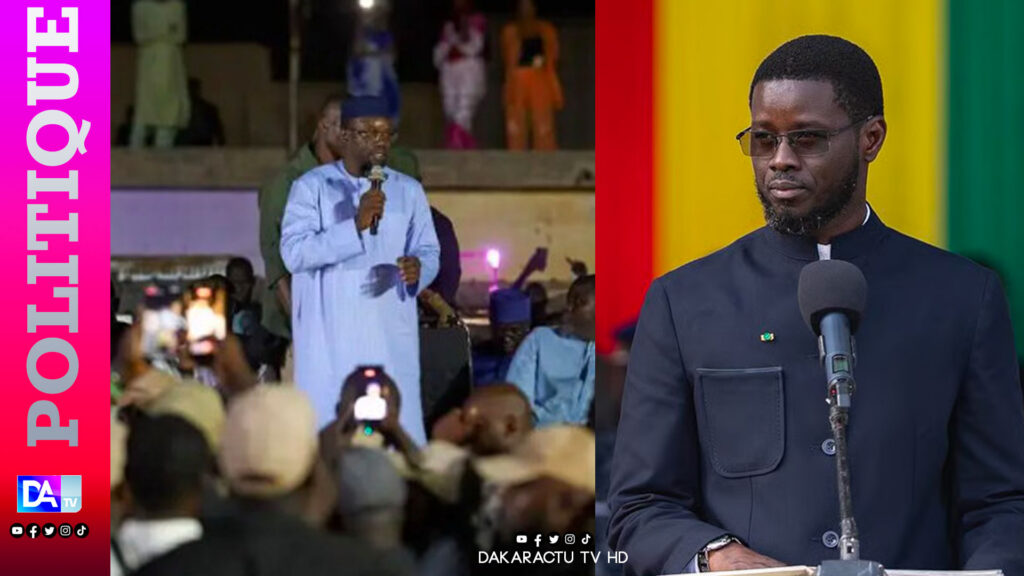
In a charged address delivered on Sunday in Sadio, Diourbel region, Ousmane Sonko delivered what amounted to a calculated critique of President Bassirou Diomaye Faye. Far from a routine policy speech, his remarks carried the weight of an unfiltered account of perceived betrayals and shifting power balances within the state’s highest ranks.
The leader of Pastef did not shy away from revisiting the political chessboard of 2024, when he was barred from running and, in a strategic pivot, backed Faye as the party’s substitute candidate. Sonko’s speech was less a celebration of victory than a reminder—two years after the fact—of who truly steered the historic March 2024 triumph. By framing the outcome as his own political legacy, he subtly underscored a legitimacy he believes has been overlooked in public discourse.
The tone sharpened as Sonko turned to the present. He framed the current moment as one where hope had dissipated, echoing sentiments he claimed were widespread among locals in Sadio. His sharpest barbs were reserved for what he described as a growing divergence between the president’s actions and the original vision that once galvanized Senegalese voters. The distinction he drew between the head of state and the party itself marked an unusually direct challenge from a figure still positioned as a key ally of the administration.
Not content with historical recriminations, Sonko staked his claim as the ultimate guardian of the movement’s founding principles. He asserted that 80% of the political struggle had been achieved under his leadership, positioning the 2026 and 2029 milestones as the final steps needed to complete what he sees as his unfinished project. The message, directed at both grassroots supporters and the corridors of power, was clear: he remains the decisive force behind the movement, even as he conceded—however indirectly—that the executive branch may be straying from the path he envisaged.