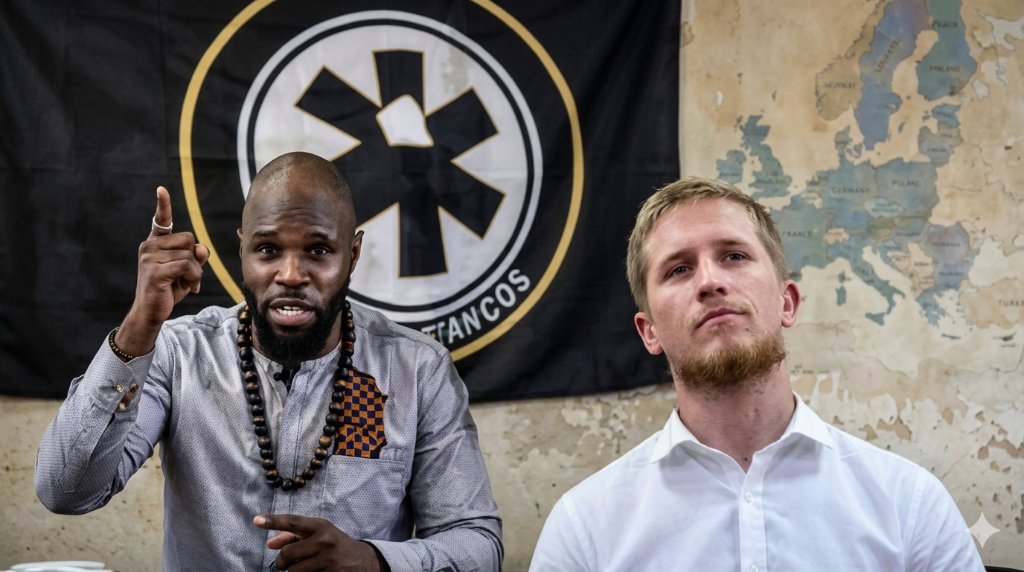
He brands himself as the “general” of the Black cause and a champion for African sovereignty against “neocolonialism.” However, beneath the aggressive rhetoric and performative social media presence, Kemi Seba appears lost in a web of contradictions that threatens to invalidate his entire movement. His recent detention in South Africa, coupled with his ties to radical Afrikaner right-wing figures, exposes a deeply deceptive alliance.
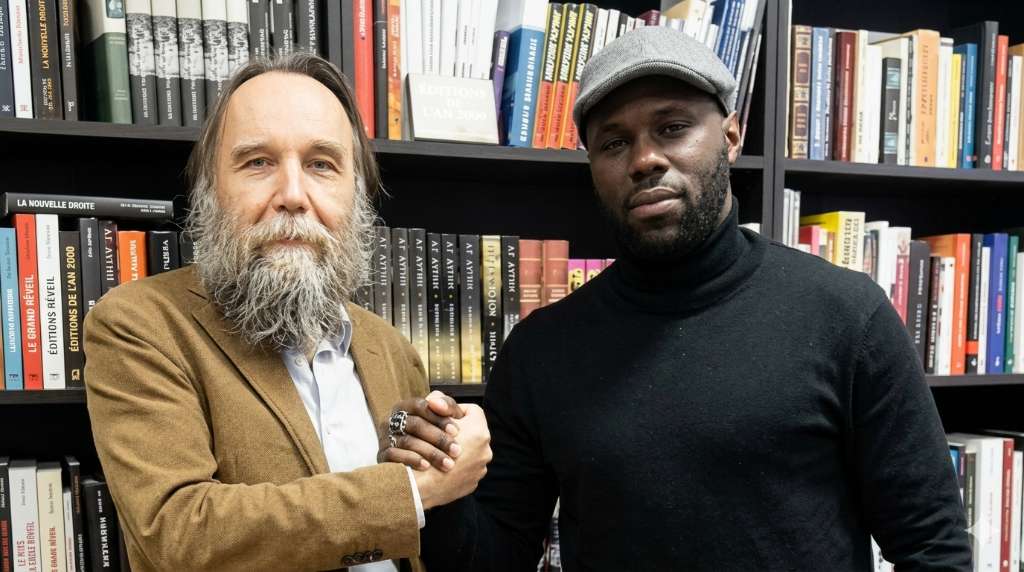
Pan-africanism mirrored in inconsistency
For years, Stellio Capo Chichi, better known as Kemi Seba, has denounced foreign interference and advocated for an Africa entirely severed from its former colonial powers. Yet, it is difficult to reconcile this demand for total independence with his public proximity to individuals like Dries van der Merwe—a man who openly longs for the Apartheid era and leads white separatist movements.
This marriage of convenience is often defended as a strategy where “the enemy of my enemy is my friend,” but it feels like an affront to the history of anti-colonial resistance. By associating with those who once theorized the inferiority of Black populations, Seba is not practicing “Realpolitik”; he is discarding the very principles of dignity he claims to represent.
Financial shadows and external influence
The money laundering investigations launched by Benin have brought to light the murky details surrounding the activist’s funding. There is a sharp contrast between his public stance on sovereignty and the existence of these suspicious international financial circuits. The central question is how a movement that preaches African self-sufficiency can be linked to such opaque global funding mechanisms.
It is particularly ironic that someone who labels the CFA franc as a currency of bondage now finds himself the target of financial crime investigations. If these allegations of money laundering are proven true, they would suggest that this “revolutionary” is simply another component of the global system he claims to fight, utilizing international networks to advance his own personal agenda.
A shift toward opportunism
The situation in South Africa highlights a harsh reality: Kemi Seba seems prepared to partner with any entity that might destabilize current political structures, regardless of the historical or moral cost. His cooperation with groups that still harbor dreams of Afrikaner supremacy suggests that his ideology is less about a quest for justice and more about a desire for media-fueled disruption.
“Pan-africanism cannot serve as a mask for unnatural alliances. A people cannot be liberated by shaking hands with their former oppressors out of pure political opportunism.”
The crumbling of a reputation
Today, caught between arrest warrants and potential extradition, the image of the “principled” activist is falling apart. By reaching out to those nostalgic for racial segregation to bolster his own influence, Kemi Seba has crossed a line that may be impossible to uncross: he has turned a noble cause into a commercial ideological venture.
For many observers, he is no longer a legitimate voice for Africa, but a public figure seeking sanctuary, trapped by his own doctrinal betrayals. History may ultimately show that Kemi Seba’s most dangerous adversary was not the West or the CFA franc, but the fundamental inconsistency of his own alliances.