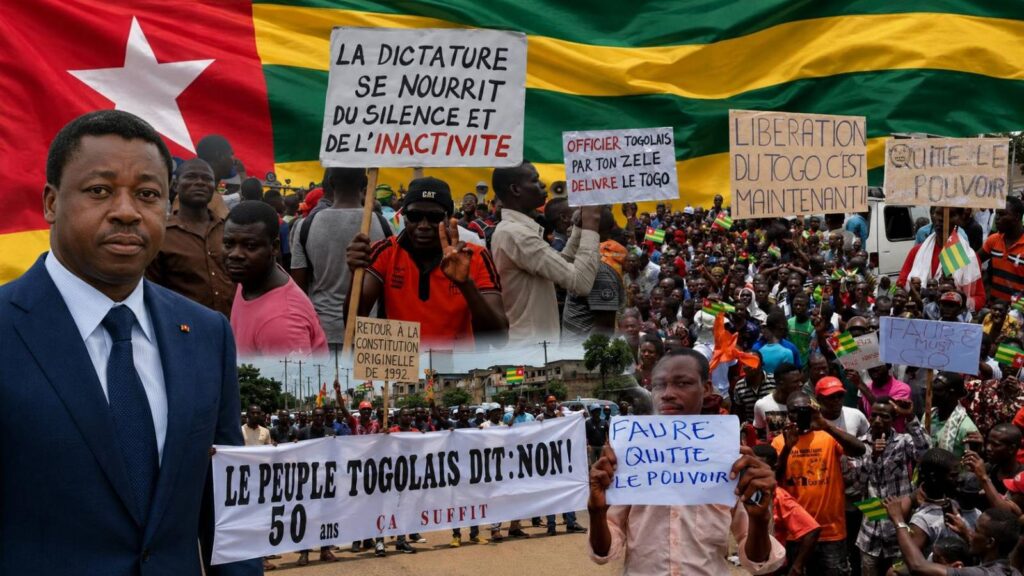
Togo currently navigates a particularly distinctive period within its political narrative. As the administration led by Faure Gnassingbé concludes its institutional metamorphosis towards a Fifth Parliamentary Republic, an palpable sense of exhaustion permeates the corridors of authority. Amidst a reconfiguring regional diplomatic landscape and a youth grappling with severe challenges, the foundational fissures within the nation have become starkly apparent. This analysis delves into a critical turning point, suggesting that the prevailing silence from the Economic Community of West African States (CEDEAO) might signify a shift many have anticipated.
A versatile administration nearing its strategic limits
Since 2005, the incumbent political structure has sustained itself through a strategy characterized by continuous circumvention. Positioning himself alternately as a mediator in regional conflicts, such as those in Mali and Niger, and as a bulwark of security against terrorist threats in the northern regions, Faure Gnassingbé has meticulously cultivated an image as an indispensable and sagacious leader within the international community.
Nevertheless, beneath this carefully constructed façade of a regional negotiator, a stringent domestic reality persists:
- Institutional entrenchment: The transition to a parliamentary system, formally enacted for 2024-2025, effectively relegates the presidency to a ceremonial role. This shift transfers substantive executive authority to a « Président du Conseil des ministres » (President of the Council of Ministers), a position that, critically, lacks genuine term limitations.
- Societal suffocation: Despite the macroeconomic growth figures frequently highlighted by official sources in Lomé II, the everyday household experiences persistent economic hardship. The alarming rates of youth unemployment and underemployment continue to represent volatile socio-economic challenges, which mere rhetoric on entrepreneurship is no longer adequate to mitigate.
The dismantling of the ‘CEDEAO Gendarme’ narrative
For an extended period, a prevalent fear-mongering tactic asserted: « Si le régime tombe, la CEDEAO interviendra pour rétablir l’ordre constitutionnel. » (Should the current administration falter, CEDEAO would intervene to restore constitutional order.) By 2026, this once potent threat has demonstrably lost its credibility, proving to be nothing more than a paper tiger.
The CEDEAO of the post-coup era, following events in Mali, Burkina Faso, and Niger, finds itself a weakened entity actively seeking to re-establish its legitimacy. The organization has, through costly experience, come to understand that an unyielding opposition to the popular will within a member state represents the most direct path to its own fragmentation.
The assessment is unequivocal: should the Togolese populace, through a unified and sovereign surge, opt to reclaim control of their nation’s governance, CEDEAO – already facing criticism for its perceived « deux poids, deux mesures » (double standards) – would likely remain an observer. Its response would be confined to advocating for a « transition apaisée » (peaceful transition). The diplomatic immunity historically afforded to the regime now hangs by the thinnest of threads.
The imperative of youth responsibility: now or never
The current juncture is particularly opportune, primarily because the incumbent administration demonstrably lacks the sustained capacity to indefinitely suppress a demographic that constitutes 70% of the national population. However, assuming this responsibility does not equate to embracing anarchy; rather, it necessitates a fundamental paradigm shift:
- Ceasing to be instruments of self-oppression: Young individuals serving within the public administration, security forces, and affiliated with the ruling party must recognize that the very system they perpetuate is the one that jeopardizes the future prospects of their own progeny.
- Cultivating a viable alternative: Transformative change will not materialize through the arrival of a providential savior, but rather through robust civic organization. The youth are enjoined to actively participate in intellectual discourse and to demand stringent accountability regarding the stewardship of national resources, including phosphates, the Port of Lomé, and critical infrastructure.
- Conquering apprehension: The existing regime exploits the lingering memory of past repressions to stifle collective action. Yet, historical precedents unequivocally demonstrate that even the most rigid systems prove exceptionally brittle once they forfeit the fundamental consent of the governed.
A historic confluence
Faure Gnassingbé has meticulously reconfigured the foundational rules to secure an ostensibly indefinite tenure. However, no constitutional framework, regardless of its shrewdness, can withstand the collective will of a populace that has shed its fear. Togo fundamentally represents not a private estate, but a shared national legacy.
Inactivity is no longer a viable strategy for survival; it is, rather, an act of complicity in national decline. Young Togolese citizens, the moment when the world will observe you with profound respect is not a distant future. It resides in the present, within your collective capacity to declare, with a unified voice: « Le temps de l’alternance est venu. » (The era for genuine alternation has arrived.)