
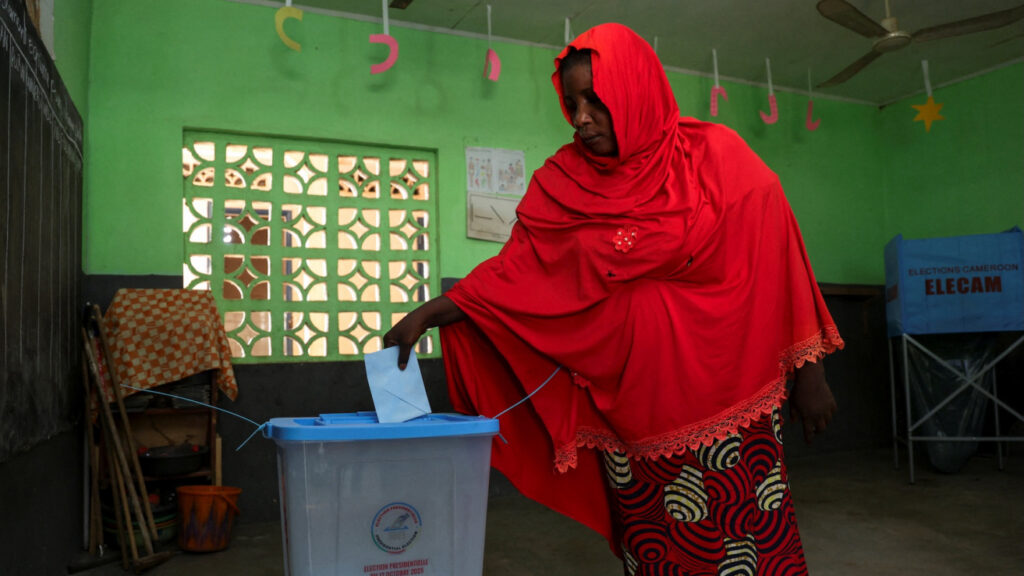
A woman casts her vote on the day of Cameroon's presidential election at a polling station in Garoua, Cameroon, October 12, 2025. REUTERS/Desire Danga Essigue
Why the African Union’s approach to 2025 elections falls short of democratic expectations
The African Union (AU) faces growing scrutiny over its role in monitoring elections across the continent. Despite enhanced observation missions and procedural assessments, many 2025 elections reveal a widening gap between electoral activity and genuine democratic progress. Critics argue that the AU prioritizes procedural compliance over political competitiveness and substantive democratic outcomes.
The limitations of AU election observation in 2025
According to the African Charter on Democracy, Elections and Governance, the AU Commission is tasked with monitoring elections and reporting on their fairness, credibility, and adherence to democratic norms. However, the 2025 electoral cycle has exposed critical weaknesses in this framework:
- Pre-election risks: Governments increasingly employ legal warfare, opposition exclusion, and civic space restrictions long before polling day. The AU acknowledges these threats but struggles to address them effectively.
- Post-election credibility gaps: Freedom House classified most African nations holding elections in 2025 as “not free“, citing repression, internet shutdowns, and flawed electoral processes. These conditions hinder the AU’s ability to ensure credible outcomes.
- Selective condemnation: While the AU occasionally condemns repression—such as in Tanzania—its responses often lack teeth. For example, after Tanzania’s 2025 elections, AU Chairperson Mahamoud Ali Youssouf congratulated the incumbent president before the AU observer mission issued a scathing preliminary report, labeling the election “not in conformity with AU principles“.
Elections in dominant-party systems: A facade of democracy
In countries like Tanzania, Cameroon, and Togo, elections have become routine procedures rather than competitive democratic events. These systems use legal and institutional mechanisms to entrench one-party dominance:
- In Togo, constitutional reforms transferred executive power from the president to the prime minister while exempting the presidency from term limits. This allowed Faure Gnassingbé to remain in power “legally” after nearly six decades of family rule.
- In Cameroon, opposition leaders were barred from running, yet elections proceeded under a veneer of procedural legitimacy.
- The AU’s semiannual reports, including those by Chairperson Youssouf, have highlighted the risk of post-election violence in such systems. However, recommendations for reforms—such as increased inclusivity in Tanzania—remain non-binding and vague.
Coups, elections, and the AU’s double standards
The AU’s stance on elections following coups d’état raises further concerns. The African Charter explicitly prohibits coup leaders from running in elections meant to restore constitutional order. Yet, in countries like Gabon and Guinea, the AU lifted suspensions after elections, despite these processes being more about legitimizing unconstitutional power grabs than restoring democracy.
In Burkina Faso, Niger, and Mali, military juntas have repeatedly delayed elections, extending “transitions” to consolidate control. The AU’s framework, which allows reintegration after elections, risks normalizing authoritarianism under the guise of democratic restoration. A November 2025 report by Kenyan President William Ruto proposed harsher sanctions for coup leaders, but its implementation remains uncertain.
Will the AU evolve from observer to reformer?
With approximately 15 African countries slated for elections in 2026—many in “not free” or authoritarian regimes—the AU’s current approach appears inadequate. Preliminary reports on Uganda’s January 2026 elections already cited opposition harassment, internet blackouts, and civic restrictions. Yet, the AU praised the process, calling it a step toward consolidating democratic gains.
The AU’s challenge is twofold: strengthening pre- and post-election reforms while ensuring its mechanisms aren’t co-opted by authoritarian tactics. As it stands, the AU remains a passive witness to democratic erosion rather than an active enforcer of electoral integrity.
Key takeaways
- The AU’s focus on electoral procedures overlooks systemic issues like opposition suppression and authoritarian legalism.
- Coups leaders are exploiting elections to legitimize their rule, despite the AU’s charter prohibitions.
- Without stronger, binding reforms, the AU risks becoming complicit in the decline of African democracy.



More Stories
Niger: Tiani faces fallout from special forces anger after Russian intervention
Crisis in Niger, IMF agreement in Sénégal, and Moroccan elections: Five essential stories
RDC-Israël : un rapprochement aux enjeux multiples