
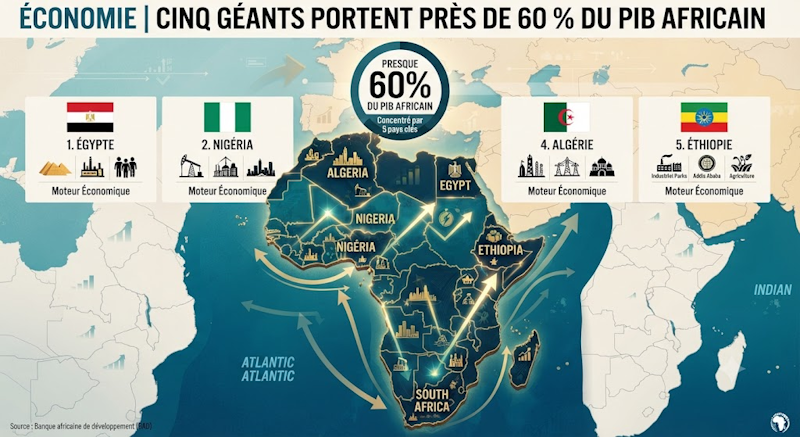
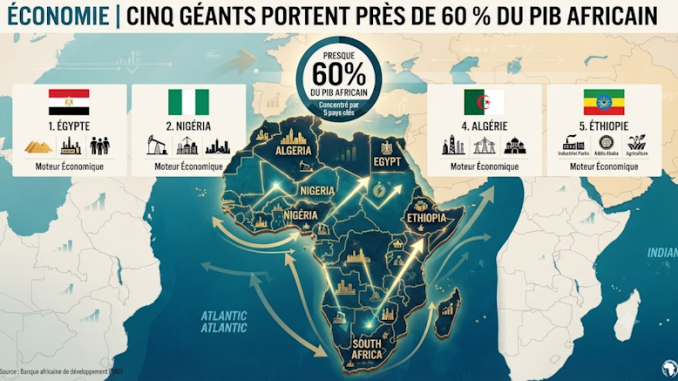
New data from the African Development Bank reveals a striking concentration of economic power on the continent. Five nations collectively account for nearly 60% of Africa’s gross domestic product (GDP), shaping the trajectory of the entire region’s growth.
These economic heavyweights—Egypt, Nigeria, South Africa, Algeria, and Ethiopia—stand out not only for their sheer economic output but also for their strategic role in driving industrialization, trade, and infrastructure development across Africa.
What powers these African economic engines?
The dominance of these five economies stems from multiple factors. Egypt and Nigeria leverage their massive populations and increasingly diversified economic bases, from energy and agriculture to technology and manufacturing. South Africa, long recognized as the continent’s industrial and financial hub, continues to play a pivotal role in trade and investment flows. Meanwhile, Algeria capitalizes on its vast energy reserves and state-led investment initiatives to fuel steady economic expansion. Ethiopia, one of Africa’s fastest-growing economies, is rapidly industrializing, with ambitious infrastructure projects positioning it as a manufacturing and logistics gateway for the Horn of Africa.
The shadow of inequality
While these nations serve as the continent’s economic backbone, their outsized influence also underscores stark disparities among African countries. Smaller economies often struggle with limited industrial capacity, restricted access to capital, and slower job creation, leaving them vulnerable to external shocks and slower development trajectories. This imbalance raises critical questions about how to distribute growth more evenly and ensure that all regions benefit from Africa’s rising prosperity.
Looking ahead: balancing growth for inclusive development
Economists emphasize that the next phase of Africa’s development must prioritize inclusive growth. Strengthening regional integration, expanding access to finance, and fostering innovation outside these top economies will be essential to unlocking the continent’s full potential. Without deliberate efforts to spread economic gains, the gap between Africa’s leading nations and its less developed peers may widen further, threatening long-term stability and cohesion.


More Stories
Niger’s 60 billion cfa boost: BOAD takes high-stakes gamble on fragile stability
Benin customs strike against explosive smuggling and organized crime
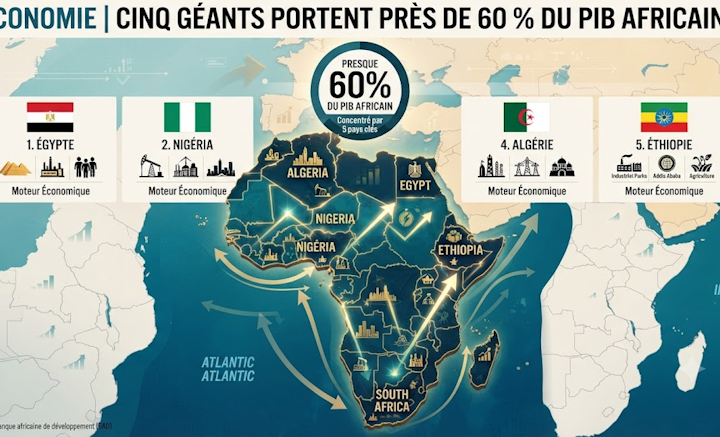
African Giants Drive 60% of Continent’s PIB, Morocco Excluded