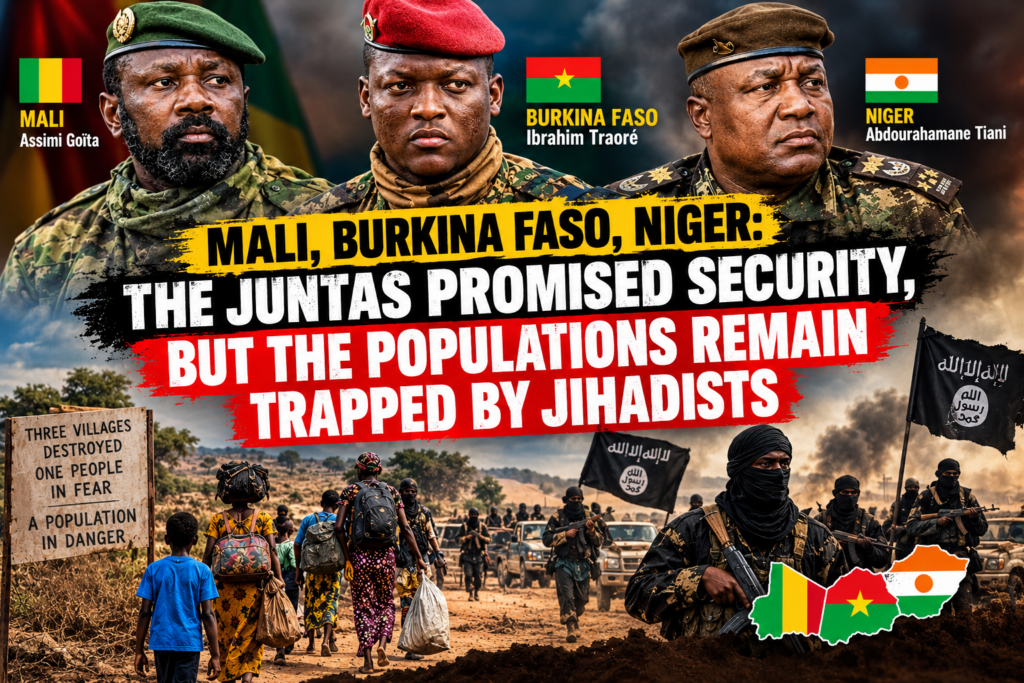
Violence escalates as jihadist factions fight for dominance in a critical nexus
In the sprawling tri-border region where Mali, Burkina Faso, and Niger converge, the Islamic State in the Sahel has entered a brutal clash with the Group for the Support of Islam and Muslims (JNIM), an Al-Qaeda affiliate. The fighting has reached unprecedented levels, with each faction clashing over territory, supply routes, and local allegiances. The human toll is staggering, with hundreds claimed by both sides in recent weeks alone. Yet amid the bloodshed, a more pressing question lingers: what becomes of the civilians caught in the middle of this power struggle?
For residents in isolated towns and villages, the consequences are immediate and devastating. Daily life has ground to a halt as fear replaces routine. Markets no longer function; children no longer attend school; and farmers abandon their fields, leaving entire communities vulnerable. The promise of security, once central to the rhetoric of the military regimes in Bamako, Ouagadougou, and Niamey, now rings hollow as the violence intensifies.
Military rule’s acid test: the failure to shield civilians from rising jihadist threats
When the juntas seized power in Mali, Burkina Faso, and Niger, they positioned themselves as the guardians of national sovereignty and security. Their rise was framed as a rejection of foreign influence and a commitment to restoring order. Yet, more than two years later, the tri-border region remains a flashpoint where civilians face unrelenting danger. The persistent attacks, forced displacements, and economic paralysis challenge the legitimacy of these regimes, which were supposed to put an end to such instability.
The contradiction is stark: governments claim authority over their territories, yet in these rural areas, their presence is minimal or ineffectual. The inability to protect citizens let alone maintain administrative functions undermines the very sovereignty these regimes tout as their greatest achievement. How can a state assert its independence when its people cannot move freely, farm their land, or send their children to school without fear?
Civilians as pawns in a jihadist power game
Far from weakening the jihadist movement, the rivalry between the Islamic State in the Sahel and JNIM may be reinforcing it. As the two groups vie for control, civilians are increasingly caught in the crossfire or worse, accused of siding with the enemy. Reports of massacres, abductions, and mass displacements have surged, with entire communities fleeing their homes to escape retaliation. The propaganda from both factions complicates efforts to verify casualty counts, leaving observers to question whether the claimed victories are real or exaggerated.
The humanitarian fallout is mounting. Hundreds of thousands have been displaced, straining resources in already impoverished regions. Schools close; hospitals lack supplies; and trade routes collapse as armed groups impose taxes or outright block passage. For families in these areas, survival has become a daily negotiation between risk and resilience. The question is no longer just who will win the war, but who will protect the people when the fighting inevitably spills into their communities.
When sovereignty is measured in protection, not just rhetoric
The juntas of the Sahel have positioned their alliance as a break from past failures, vowing to chart a course free from external interference. Yet sovereignty, by definition, requires more than defiance of foreign partners it demands results. The people of the tri-border region are waiting to see if their governments can deliver on the most basic promise of any state: safety.
At issue is not just the military’s inability to defeat jihadist groups a challenge shared by all three countries but its failure to provide alternatives. When the state’s presence evaporates, extremist groups fill the void, offering their own twisted form of governance. Roads become unsafe, markets shrink, and farmers struggle to sell their crops. The longer this vacuum persists, the deeper the grip of these armed factions grows.
The invisible cost of unchecked insecurity
Beyond the immediate violence, the economic and social toll is crippling. Agriculture, the backbone of the region’s economy, is in decline as farmers abandon their land. Trade routes that once connected villages to larger markets now serve as battlegrounds. Hospitals and schools, already under-resourced, are forced to close intermittently or operate at reduced capacity. The ripple effects are felt far beyond the conflict zones, as displaced families strain resources in neighboring towns and cities.
For the military regimes, the challenge is not just securing territory but restoring trust. Announcements of new offensives or alliances offer little solace to villagers who have heard promises before only to see more bloodshed. Transparency about strategies, acknowledgment of setbacks, and measurable progress in protecting civilians are now essential to reclaiming credibility. The people of the Sahel are no longer asking whether their governments can defeat the jihadists; they are asking whether they will survive long enough to see that victory.
Beyond the battlefield: redefining what security means
The crisis in the tri-border region exposes the limits of a purely military response. Defeating jihadist groups requires more than firepower; it requires addressing the conditions that allow extremism to thrive. Local governance, economic opportunity, and basic services are just as critical as security operations. Yet in many areas, these fundamentals remain woefully inadequate.
The juntas inherited a broken system, and their task is undeniably difficult. But the passage of time demands accountability. If the promise of sovereignty is to mean anything, it must translate into tangible security for those living at the margins. Otherwise, the cycle of violence fueled by both extremist groups and state failures will only deepen.
The people of Mali, Burkina Faso, and Niger deserve better than to be held hostage by a conflict they did not choose. Their safety, their livelihoods, and their future cannot wait for another round of battles to be won.
By Emmanuel Mbarga — Journalist